
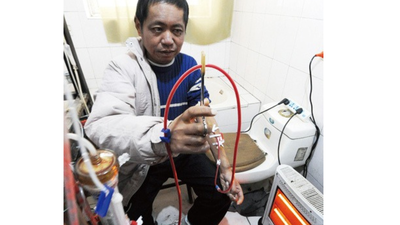
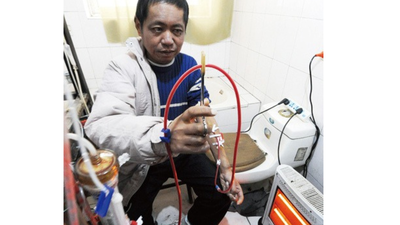
In 2013, Chinese man Hu Songwen attracted international attention after reports revealed that he had been using a homemade haemodialysis machine for about 13 years after the cost of hospital treatment exhausted his family’s savings. Hu was diagnosed with uraemia in 1993 while studying at the Nanjing Institute of Meteorology, after doctors found that both his kidneys had failed. His family struggled to pay for regular dialysis, with treatment costs eventually becoming unaffordable. Hu then studied the principles of haemodialysis and assembled a makeshift system using medical equipment and household items. By 2013, he was reportedly performing dialysis at home three times a week. Doctors warned that his method carried serious infection and other risks and should not be copied.
Hu was diagnosed with kidney failure as a university student
Hu was 21 and studying at the Nanjing Institute of Meteorology when he became seriously ill in 1993. His face became swollen, he had difficulty urinating and eventually struggled to stand. Doctors diagnosed him with uraemia, a condition associated with advanced kidney failure. He began receiving regular haemodialysis, but the treatment quickly placed a huge financial burden on his family. Contemporary reports said a dialysis session cost about 400 yuan, while his parents earned less than 1,500 yuan a month. His family sold valuables and borrowed money from relatives to continue paying for treatment. After around six years, they could no longer sustain the expense, leaving Hu searching for another way to receive the treatment he needed to survive.
He built a homemade dialysis machine from medical and household parts
Hu began studying the principles behind haemodialysis and experimenting with equipment during the 1990s. Reports said he had a strong background in chemistry and physics and taught himself how the blood-filtering process worked. He obtained components including a second-hand blood pump and dialysis tubing and combined them with household equipment. China Daily reported that his homemade system began operating on 31 March 1999 in a bathroom of less than five square metres. He prepared dialysis fluid using purified water and chemicals including potassium chloride, sodium chloride and sodium hydrogen carbonate. His setup also involved items such as a steel pot, ceramic bowls, a microwave and an old wooden scale. His mother helped him measure the dialysis fluid and operate the system.
He used the machine three times a week for about 13 years
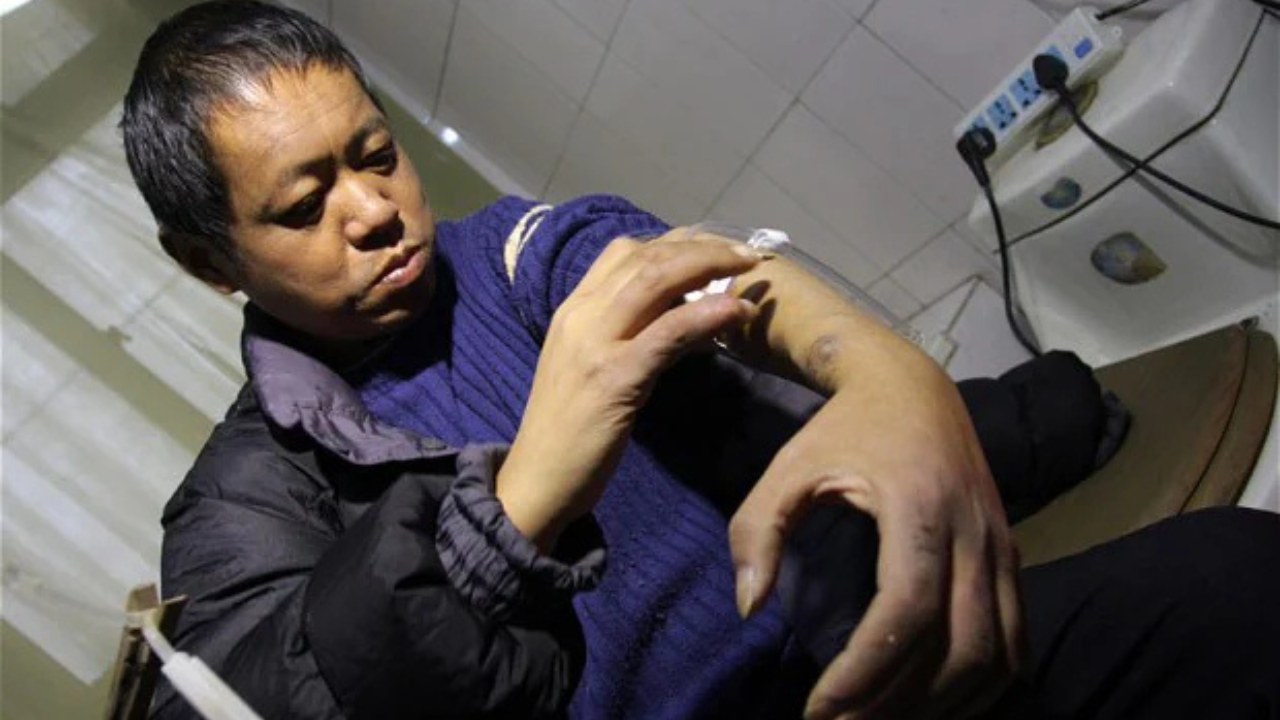
By January 2013, Hu had reportedly been using his homemade system for about 13 years, performing dialysis three times a week. Each treatment reportedly cost around 60 yuan, substantially less than the hospital treatment his family had previously struggled to afford. To reduce expenses further, reports said he reused some dialysis tubing, despite such equipment normally being intended for single use. His makeshift system was not a conventional medical dialysis machine, but an improvised arrangement designed to carry out the basic blood-filtration process. Hu eventually uploaded a video of himself undergoing home dialysis in 2012, partly because he hoped to find better treatment options. His story then became widely reported in Chinese and international media.
His homemade treatment carried serious medical risks
Hu’s system allowed him to continue dialysis, but it was not considered a safe alternative to professionally supervised treatment. He reportedly suffered a potentially dangerous incident when the concentration of his dialysis solution was incorrect, causing pain around the injection site and a change in the colour of his blood. He stopped the treatment and corrected the problem. Nephrologist Sun Wei warned that Hu’s method could easily cause infections and other complications and said it should not be copied. Hu also reportedly refused requests from other kidney patients who wanted to learn how to build similar machines because he did not want them to face the same dangers. Contemporary reports said two people who attempted similar homemade systems had died, although those circumstances were reported by Hu and were not independently established in the available accounts.
His story exposed the desperate cost of long-term dialysis
Hu’s experience was ultimately about more than an unusual homemade machine. It showed the lengths to which a patient could go when a life-sustaining treatment became financially inaccessible. His family had spent years selling possessions and borrowing money before Hu began developing his own system. By late 2012, however, he had reportedly been included in China’s rural cooperative medical insurance and medical assistance system, which was expected to reduce his treatment costs. His case also highlighted the importance of access to affordable long-term kidney care. While Hu’s ingenuity helped him continue treatment for years, doctors stressed that his homemade approach was dangerous and should not be regarded as a model for patients today.