
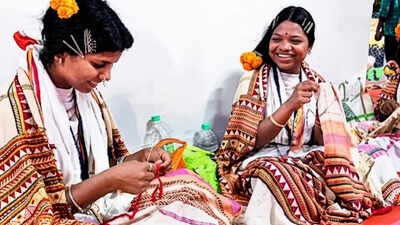
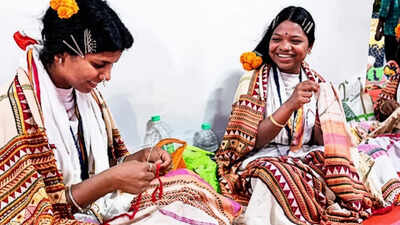
BHUBANESWAR: Kapdaganda, the distinctive shawl of the Dongria Kondhs, has emerged as a celebrated textile heritage rooted in the community’s deep connection with the Niyamgiri hills.But even as demand for the shawl has grown following its Geographical Indication (GI) recognition in 2024, the women who painstakingly create its intricate embroidery are yet to see commensurate economic gains.The Dongria Kondhs, a Particularly Vulnerable Tribal Group (PVTG), live mainly in the Niyamgiri hills of Rayagada and Kalahandi districts.For them, Kapdaganda is much more than a textile.Its motifs embody the community’s relationship with Niyamgiri, nature and its deities, with geometric patterns representing hills, cultivated land and other elements of the Dongria worldview.Its coarse, off-white cotton base is handwoven, while Dongria women create the intricate embroidery using red, green and yellow threads.The painstaking work involves careful thread counting to produce symmetrical motifs. The commonly used shawls measure about 2 to 2.5 metres in length and 1 to 1.5 metres in width.“What makes Kapdaganda particularly unique is that it brings together two distinct craft traditions – handloom and handicraft – in a single textile. The coarse, off-white cotton fabric constitutes the handloom component, while the intricate embroidery represents the handicraft component. The GI protection that it received applies to the embroidery,” Guha Poonam Tapas Kumar, commissioner-cum-secretary of the handlooms, textiles & handicrafts department, said.“The GI protection became necessary after traditional embroidery designs began to be copied by designers and sold at premium prices at outlets such as Delhi Haat, while the women who had preserved the craft were not benefiting proportionately from its commercialisation,” Kumar said, adding, “The recognition was intended to protect the community’s traditional knowledge and ensure that Dongria women benefit from its growing market.”However, the benefits have remained limited on the ground, said Dinja Jakesika, former sarpanch of Kurli panchayat and herself a Kapdaganda embroiderer.“A lot has changed in terms of demand and recognition of the shawl since the GI tag. Once largely confined to the Niyamgiri region, it has gained wider recognition, with demand extending beyond Odisha and India. But the market is still unorganised and the benefits from retail sales do not trickle down to the Dongria women,” she said.Despite the growing demand and GI recognition, Rayagada does not have a single dedicated outlet selling Kapdaganda, Jakesika said.The craft, she added, is yet to emerge as a sustainable livelihood for the women who make it.At the same time, the growing popularity of Kapdaganda has brought NGOs and private sellers to Dongria-inhabited villages to conduct embroidery training programmes.According to Jakesika, such groups visit the villages every fortnight or month and train women to reproduce Kapdaganda motifs on garments, bags, notebooks, footwear, handkerchiefs, stoles and, at times, shawls.“They provide the base cloth and threads, along with food and travel expenses for the day-long sessions. At the end of 15 days, we are paid Rs 4,000 to Rs 4,500, which works out to less than Rs 300 a day,” she said.The gap between what artisans earn and the value of Kapdaganda products becomes more evident once they reach the market.“All products carrying Kapdaganda designs sell at a premium. Even for shawls, there is no fixed price. A shawl can cost anywhere between Rs 8,000 and Rs 12,000. When it reaches a designer, the price goes up several times. If the embroidery is of the highest quality, a shawl can sell for anywhere between Rs 30,000 and Rs 50,000 in international markets,” said Surya Padhi, a local activist.But rising demand has also created another concern – the growing difficulty of finding an authentic Kapdaganda.Textile designer and researcher Pankaja Sethi said original Kapdaganda shawls are becoming increasingly difficult to obtain as Dongria women, who are primarily farmers, have limited time to devote to shawl embroidery.“Women are farmers first and embroider in the little time they get. It takes two to three months to create a shawl,” she said.