
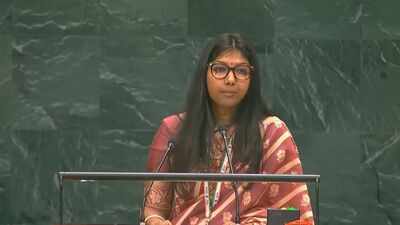
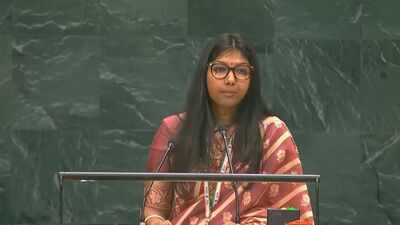
NEW DELHI: India has said the credibility of the United Nations Human Rights Council (UNHRC) depends on “even-handedness”, warning that country-specific mandates pursued without the involvement of the concerned nation deepen divisions rather than improve human rights conditions on the ground.Addressing the United Nations General Assembly’s debate on the Human Rights Council’s report on Friday, First Secretary at India’s Permanent Mission to the UN, Bhavika Mangalanandan, called for dialogue, cooperation and equal treatment of all countries in addressing human rights concerns.She said country-specific mandates pursued without the engagement of the country concerned seldom improve conditions on the ground and instead create divisions within the council.“Credibility of the council rests on even-handedness. Country-specific mandates pursued without the engagement of the country concerned seldom improve the situation on the ground,” she said.Recalling external affairs minister S Jaishankar’s remarks at the high-level segment of the 61st Human Rights Council in February, Mangalanandan said human rights should be advanced through dialogue and genuine partnerships rather than selective approaches.Jaishankar had said that “human rights are best advanced through dialogue, capacity building and genuine partnerships, and not by politicisation, selectivity, or double standards.”Mangalanandan said such an approach was necessary for the council to speak with one voice and address allegations that human rights were being weaponised.She also identified the Universal Periodic Review (UPR), which involves cooperation and engagement with member states while treating all countries equally, as the appropriate platform for assessing human rights records.
India calls for equal emphasis on all human rights
India also stressed that economic, social and cultural rights, along with the right to development, should receive the same attention as civil and political rights.“Economic, social, and cultural rights and the right to development deserve the same attention as civil and political rights,” Mangalanandan said.She noted that poverty, debt and limited access to financing and technology remained major obstacles to the enjoyment of human rights across much of the developing world.“These call for international cooperation and not coercion,” she said.India also flagged terrorism as one of the gravest threats to human rights, particularly the fundamental right to life, and called on the council to maintain sustained attention to the issue.“We would encourage the council to give this threat the sustained attention it warrants on the basis of zero tolerance,” she said.
India raises concerns over funding and duplication of mandates
Mangalanandan said the Human Rights Council should fulfil its mandate within the resources available to it and called for transparent, member-driven rationalisation of its work.She cautioned against budgetary measures disproportionately affecting mandates dealing with development and economic, social and cultural rights.“Rationalisation should remain member-driven and transparent. It should not fall disproportionately on mandates that address development and economic, social, and cultural rights,” she said.
Share your thoughts in the comments
Be respectful · TOI community guidelines
India also called for adequate and predictable funding for the UN’s human rights pillar through the regular budget, arguing that its priorities should not be determined by earmarked voluntary contributions.Mangalanandan further flagged duplication between resolutions and initiatives taken up by the Human Rights Council and the UN General Assembly.“We should consider mechanisms that avoid resolutions and initiatives on the same topic and of similar nature, both in the Council and (General) Assembly.“We see an increasing tendency for the Council to dictate reporting to the Third Committee, including reporting by Special Rapporteurs, which further undermines the need for a specialised Council,” she said.The Third Committee of the UN General Assembly deals with social, humanitarian and cultural issues.India returned to the Human Rights Council in 2026 for its seventh term, covering the 2026-28 period.