
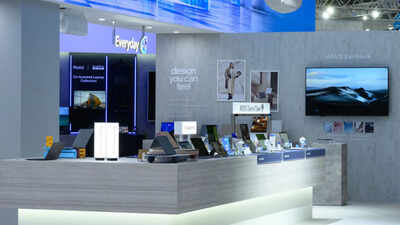
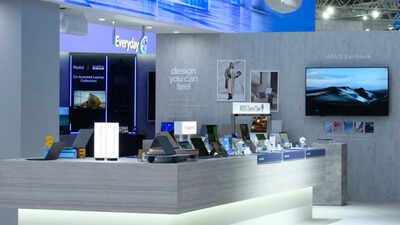
Two years into the AI PC, the category is louder than it is settled. Every OEM is shipping NPUs. Every keynote is an AI keynote. TOPS counts have moved from headline feature to spec-sheet boilerplate. Buyers are being asked to pay a premium for capabilities most of them have not yet found a reason to use.Inside that noise, individual OEMs are arriving at their own answers about what AI on a personal computer is actually for. At Computex 2026, Asus arrived with a fairly distinctive one.The company branded its entire lineup Ubiquitous AI. AI runs through every product line and every category on the show floor—from the entry-level Vivobook all the way up to the ProArt creator laptops on Nvidia’s new RTX Spark platform. Tying it all together was a new agent called Zenni Claw.But on the sidelines of the show, TimesofIndia.com sat down with Sascha Krohn, Director of Technical Marketing at Asus, and the framing he offered in person was more careful than the booth might suggest. Krohn, who has been Asus’s public voice on technical strategy across several Computex cycles, thinks AI belongs in every product the company ships. He also thinks the customer should be the one deciding what to do with it. Both halves of that, he said in different forms through the conversation, are deliberate.
Everything gets AI. Whether people use it is thier call
“We are all in on AI, and that’s a big story for us,” Krohn explained. “Ubiquitous AI is one of the themes here. We’re bringing AI to everything. No matter if it’s cloud or local AI or edge AI, and now also these hybrid solutions like our Zenni Claw agent. We are all in on AI. For every product line, every product.”A few minutes later, unprompted, he added the other half: “We’re not pushing it onto our customers. We’re enabling it. We’re offering options for them. If they don’t want to use it, that’s entirely up to them.”He kept coming back to that idea through the conversation. The AI is in the device because the platform supports it. Whether the user reaches for it or switches it off is up to them. Same with customisation—what to let it see, how much to let it do. Pressed on whether Asus was simply riding the agent wave that ran through almost every announcement at Computex 2026, he didn’t dodge. “We are all in on AI. But we’re not pushing it onto our customers. We’re enabling it.”The silicon underneath the lineup is what lets that choice actually mean something. The Windows laptop space was an Intel-AMD duopoly for most of the past decade. Qualcomm broke that. Now Nvidia is in too. Four platforms means four sets of capabilities, and four ways for Asus to match the chip to what the buyer is actually doing with the machine instead of picking one default and applying it everywhere.“It’s a really exciting time. There’s more options than ever,” Krohn said. “If you’re an engineer and you work at Asus, why do you go to Asus? You don’t want to do just the boring every year, new platform, easy. You want to do something different and new, and maybe a little bit crazy.”So the Zenbook 14 now ships with both Snapdragon X and Intel Lunar Lake variants. The ProArt P16 and P14 arrive on Nvidia’s new RTX Spark mobile platform. AI capability itself runs the entire pricing ladder—Vivobook at the entry, Vivobook S in the middle, S Flip with OLED and metal a step above, Zenbook at the top. The buyer picks the chip, the form factor, the price point. The AI shows up regardless.What that AI actually looks like is partly Microsoft’s call and partly Asus’s. The Copilot+ floor is the part no Windows OEM can avoid—Microsoft’s features come with the platform—though even Microsoft itself has been quietly walking some of it back over the past year, pulling Copilot integrations out of the apps it had already pushed them into and shelving plans for the system-level additions it had lined up next. Users, it turns out, are not reaching for the AI as often as the marketing once assumed.On top of that floor, Asus adds its own implementations. StoryCube for creators who want their footage organised before they edit. The Zenni Claw agent for buyers who want the device handling the routine work in the background. Different features for different users. Which of them the buyer actually reaches for, on Krohn’s account, is the buyer’s call.
The hardware is what stays
The day before the interview, Asus’s design centre in Taipei had walked us through the new Zenbook line. HW Wei, Associate VP at the ADC, described the design language as a counterweight to the moment the company is selling into.“We always think about the design from nature, inspired from nature,” Wei said. “Why nature? Because it’s really difficult for us, especially today’s AI age. People thinking about, is this real or not? But when a lot of these kinds of compact information come to the human beings, human always seeing it. Which one will be more comfortable to us? So nature will be our answer.”I asked Krohn about it. The hardware reads deliberately physical while the software keeps moving in the opposite direction. How does the company hold both at once?“I would say it’s AI capable,” he replied. “If you use that functionality or not, is entirely up to you. And what you use it for as well. When it’s something physical, it is there. It’s always there. But when it’s software or features, it’s something you can use or you can’t use. You can turn it on or off. You can customise it.”It’s the line that ties the position together. The AI is optional. The device itself is not. Two years of agents and Copilots and NPUs have made one thing clear, which is that the software layer is the part that will keep changing. The hardware is the part the buyer commits to. Asus, judging by where it puts its slow work, has decided which one matters more.Helping the bet hold is Krohn’s read on AI itself, which is fairly old-fashioned. It’s a tool, he kept saying, in different forms. People decide what to do with it. Which is what makes “enabling, not pushing” actually mean something—the AI can be optional because the device doesn’t need it to be the reason anyone bought it, and the buyer doesn’t need to be told what to do with it.