
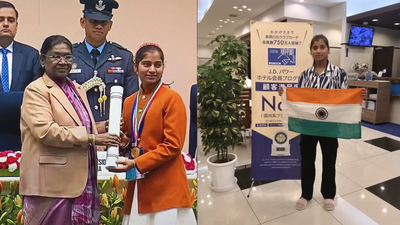
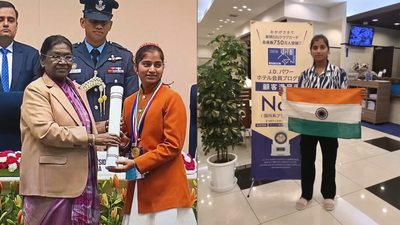
For Pooja Pal, innovation did not begin in a laboratory or with expensive equipment. It began with a problem she could see every day. Growing up in a small village in Uttar Pradesh’s Barabanki district, Pooja noticed children coughing because of the dust released by a nearby wheat-threshing machine. She was only in Class 8 when the thought stayed with her: could something be done to stop that dust?Years later, that question has taken the young innovator far beyond her village. Her low-cost dust-free thresher model has earned national recognition, taken her to Japan, featured in a documentary on Prime Minister Narendra Modi’s life and achievements, and made her a Mission Shakti role model in Uttar Pradesh.
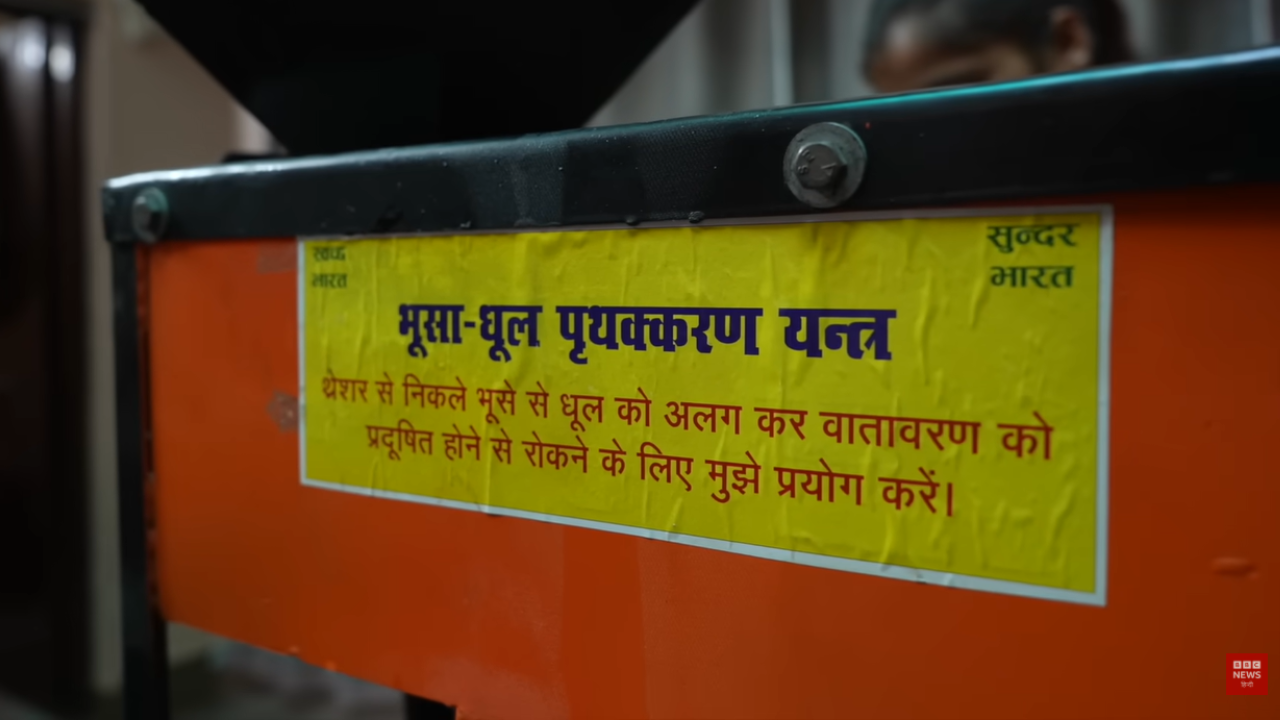
Pooja Pal’s award-winning innovation (Photo courtesy: BBC Hindi)
A question born in a village classroom
Pooja comes from a financially modest family. Her father, Puttilal, works as a daily-wage labourer, while her mother, Sunila Devi, works as a cook at a government school. The family lived in a mud-and-thatch house and, for years, had no electricity.According to The Global Indian, Pooja recalled studying under a kerosene lamp before the family began using a battery-powered bulb. Her parents, however, continued to insist that education was the way forward.“I used to study by a kerosene lamp,” Pooja told The Global Indian. She also recalled her parents telling their children, “We’ll eat less, but you all must study as that will take you ahead.”It was this combination of limited resources and close observation that eventually led to her first major invention. In Class 8, Pooja saw children struggling with the dust produced by a threshing machine near her school. Instead of treating it as an unavoidable part of rural life, she began thinking about how the problem could be solved. That dust just stuck in my mind. It wasn’t right,” she told *The Global Indian*. “I asked myself, can we do something about this?”
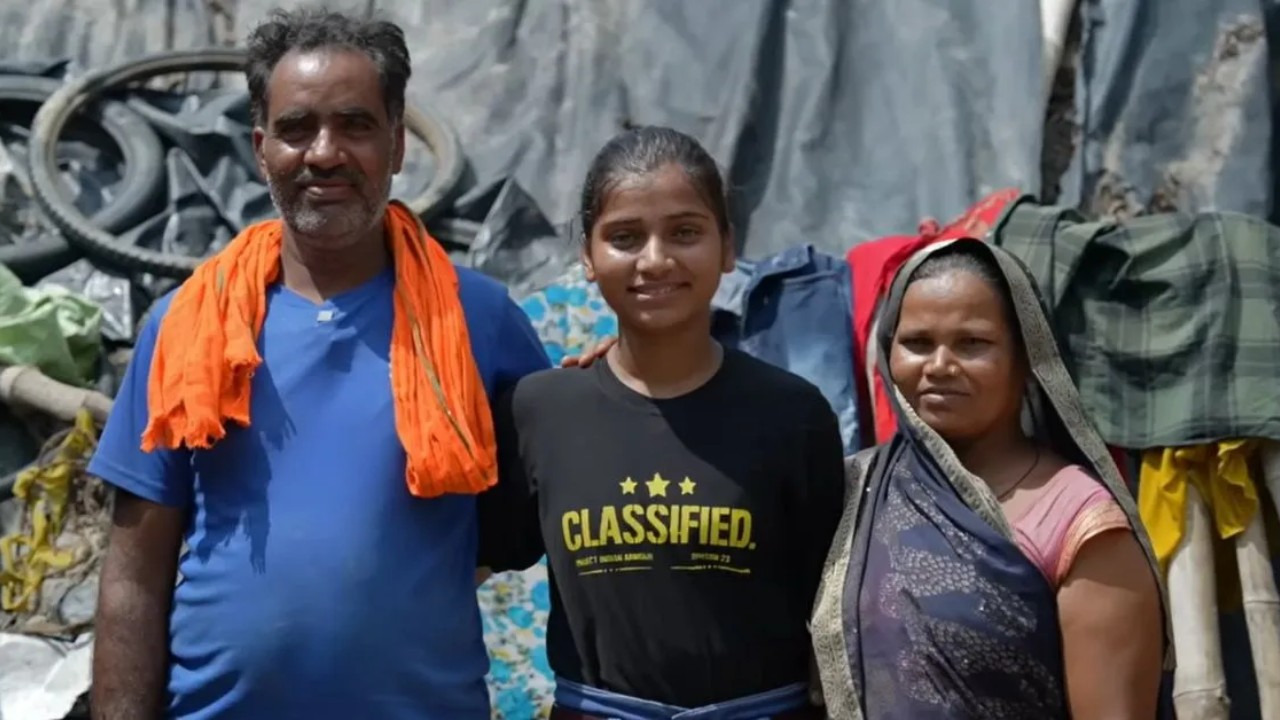
Pooja Pal with her parents; her father earns a living as a daily-wage labourer (Photo: BBC Hindi)
The ₹3,000 idea that travelled far beyond Barabanki
With the help of a welder and under the guidance of her science teacher Rajiv Srivastav, Pooja began experimenting with a model that could reduce the dust released during threshing.The result was a dust-free thresher model. The design was aimed at collecting the flying dust and husk rather than allowing it to spread into the surrounding air. Other reports describe the model as using simple materials such as tin and a fan, with the dust collected separately.The project cost around ₹3,000- a significant amount for her family. Pooja also had to deal with something that young innovators rarely put on their science-project sheets: people telling them their idea would not work. “People in the village mocked me. ‘Why are you doing this? What will you get?’ they said. But I didn’t listen. I went ahead anyway,” she told *The Global Indian*. Her teacher, however, recognised that there was more to the project than a school experiment.
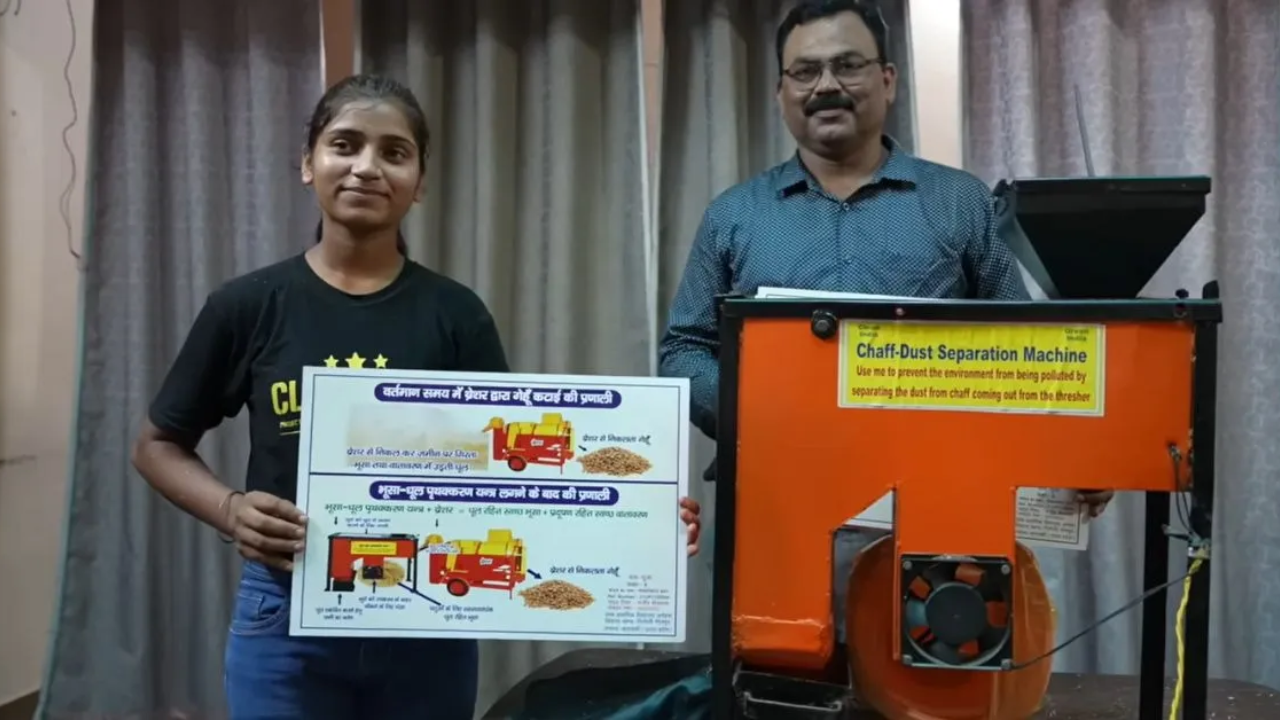
Pooja Pal with her teacher, Rajiv Srivastav, who guided her early experiments (Photo: BBC Hindi)
From school project to national recognition
Pooja’s model was submitted to the INSPIRE-MANAK programme, which encourages school students to develop innovative solutions to everyday problems. Her project progressed from the district and state levels to national recognition. The Global Indian reported that she was among the national winners and the only participant from Uttar Pradesh in the relevant selection. Her model was subsequently showcased at a national science exhibition.
The journey did not stop there.
In June 2025, Pooja travelled to Japan as part of a science exchange programme. According to The Global Indian, she was the only student from Uttar Pradesh among 54 Indian students selected for the Sakura Science High School Programme that year.For a girl who had once felt that even reaching Barabanki was beyond her imagination, Japan was an extraordinary leap. “I never thought I’d even reach Barabanki,” Pooja said in an interview. Her memories of Japan were not only about science. She remembered the small details of the trip, including the umbrellas kept ready for students when it rained. “Everything was so organized, so respectful. It felt special,” she recalled.
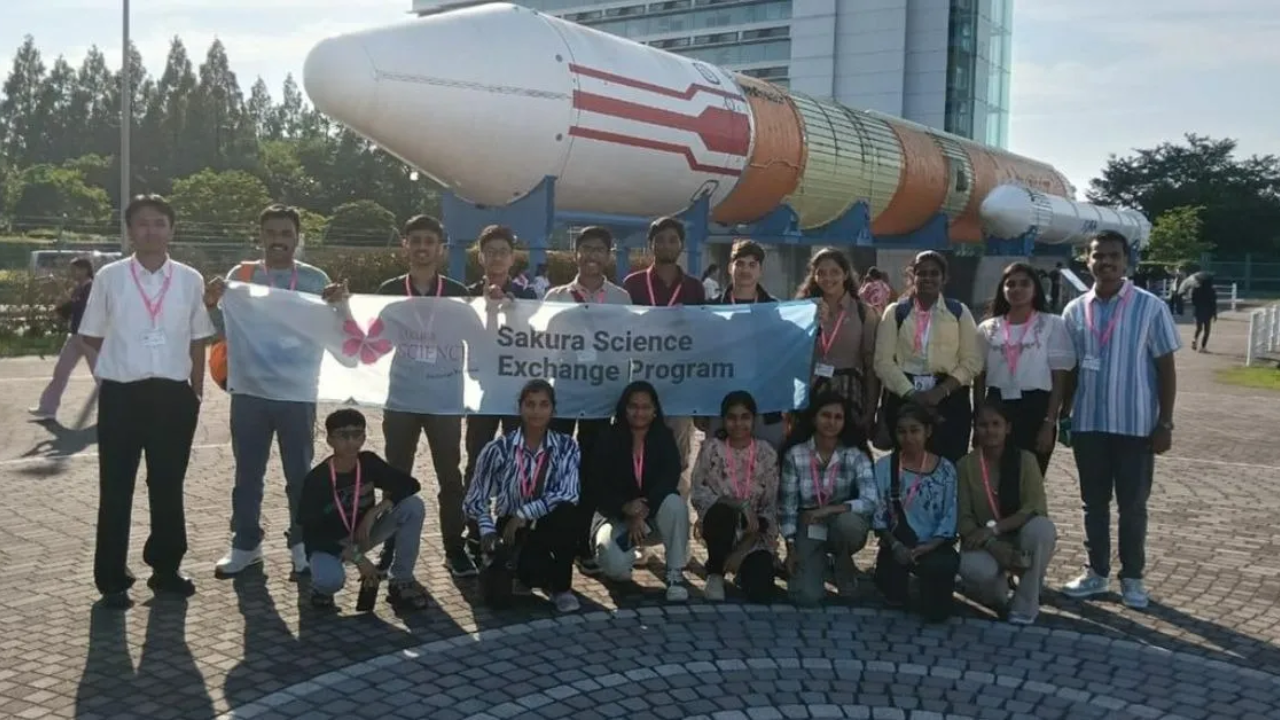
Pooja Pal with other young innovators in Japan (Photo: BBC Hindi)
From Japan to a place in PM Modi’s documentary
Pooja’s story gained another national spotlight in September 2025 when her journey was featured in the documentary Karmayog: Ek Anant Yatra, centred on Prime Minister Narendra Modi. According to reports, her story was presented as an example of the possibilities created by education and the Beti Bachao, Beti Padhao message.Her recognition continued to grow. She was later honoured with the Pradhan Mantri Rashtriya Bal Puraskar for her work in science and innovation, with President Droupadi Murmu presenting the award in December 2025.By September 2025, Pooja had also been recognised as a Mission Shakti role model in Uttar Pradesh- a significant shift for a girl whose own childhood had been shaped by limited access to basic facilities. Her family was also given approval under the state’s housing scheme.
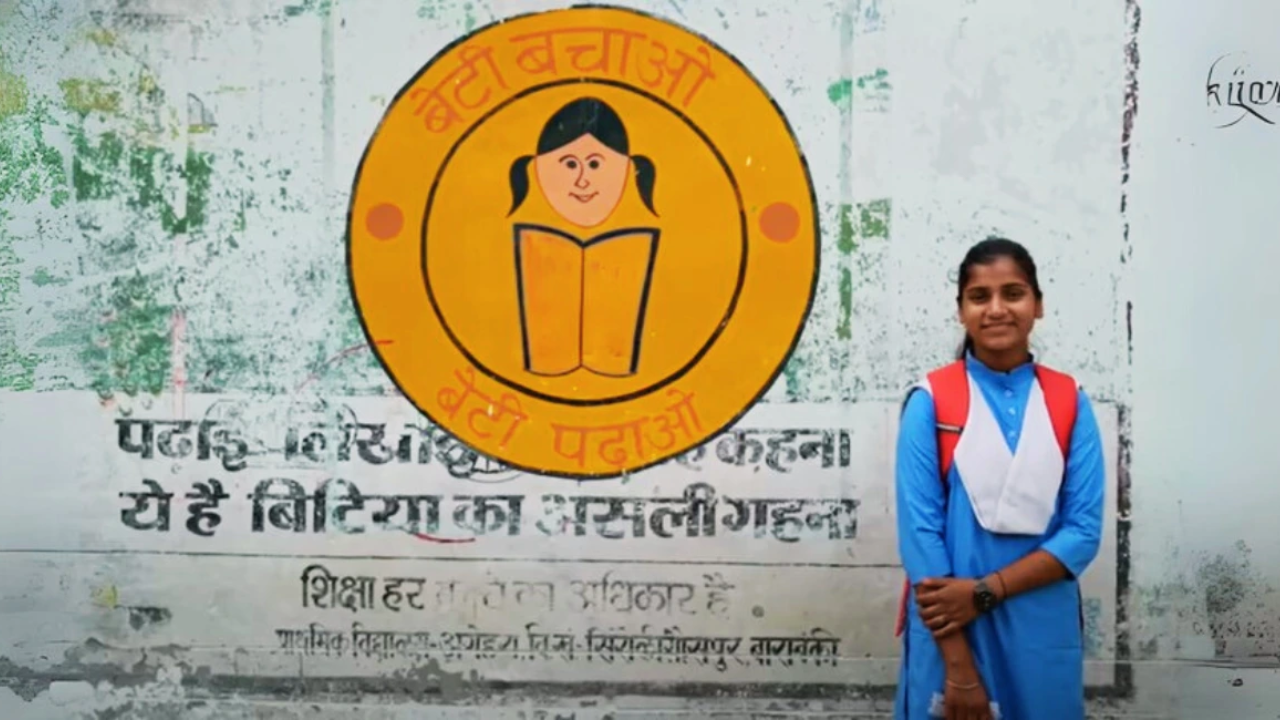
From studying under a kerosene lamp to earning national recognition for innovation (Photo: BBC Hindi)
Her journey is not over
What makes Pooja’s story stand out is that the dust-free thresher was never simply about winning a competition. The idea came from watching people around her and asking whether an everyday problem could be solved differently.And she is still thinking about what comes next. Pooja said that after Class 12, she wanted to start a small business so that she could fund her college education and help her parents financially. “After I pass 12th, I want to start a small business,” she said.Her ambition, however, goes beyond earning a degree or building a career. “I want to become big enough so that the people who once looked down upon us see our true potential,” she said. Pooja Pal’s story is, ultimately, less about how far a village girl travelled and more about what she carried with her. She saw a problem, questioned it, built something with limited resources and refused to stop when others laughed.Sometimes, innovation begins not with sophisticated technology, but with a child looking at something everyone else has learnt to ignore- and simply asking, “Can we do something about this?”