
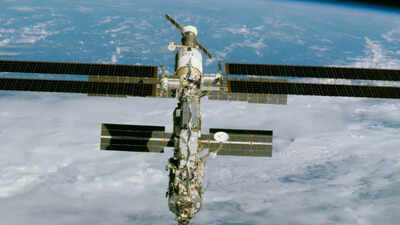
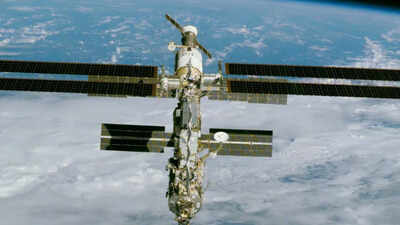
In 1984, Rakesh Sharma flew on a Soyuz and became India’s first man in space. It took 40 years to send a second. On June 25 last year, Shubhanshu Shukla lifted off to the International Space Station (ISS) on the Axiom-4 mission, closing that gap and giving India a fresh milestone.A year on, with India’s Gaganyaan still without a confirmed date for its first crewed launch, the question worth asking is what India does next. The instinct in New Delhi and Bengaluru has been to wait: finish the indigenous launch vehicle, fly it once, fly it safely, and then think beyond it. That instinct is understandable. It’s also increasingly costly.The ISS is approaching retirement, and what it offers, decades of accumulated knowledge in running a station, keeping humans alive in it for months at a stretch, docking, repairing, surviving failure, cannot simply be acquired on demand once the station is gone.

Parallax is the apparent shift of an object when viewed from different positions
India has a narrow, closing window to draw on that knowledge through direct participation in a mature, functioning space station, and right now it is choosing not to. Gaganyaan, whenever it flies, will prove something real: that India can build, integrate and human-rate a complete spacecraft entirely on its own, joining a very short list of nations to do so.That achievement needs no defending. But it’ll prove short-duration capability, a flight measured in days, maybe just hours initially. The Bharatiya Antariksh Station (BAS) that India wants by the early 2030s, and lunar missions envisioned for 2040, need something Gaganyaan’s initial flights cannot give them, operational knowledge built up over months, not days: how a life-support loop behaves as its filters age, what radiation exposure does to a body over ninety days, how a crew recovers from a real systems failure rather than a simulated one.Much of that experience is available today on the world’s only mature, multilateral space station, the ISS, which is in its last leg. This is where India’s existing position is unusually strong, if it chooses to use it. India already has astronaut designates who trained for over a year at Russia’s Gagarin Cosmonaut Training Centre to command-level proficiency on Soyuz systems, fluent in Russian, drilled in procedures most foreign astronauts take years to absorb.They are, in a literal sense, ready now. What’s missing is not capability but a decision to fly them on a long-duration mission, three to four months, as flight engineers aboard a Soyuz to the ISS, rather than letting that training depreciate while Gaganyaan’s schedule keeps slipping.This isn’t a call to repeat Axiom-4. A short commercial flight to a single module is valuable for visibility and a first taste of microgravity, but it teaches little about keeping a station running for a season.A long-duration Soyuz mission is a different proposition: real exposure to Russian station-keeping practice built up since Salyut and Mir, hands-on manual docking the heavily automated Crew Dragon does not require of its crew, and, critically, an actual spacewalk in a Russian Orlan suit, the kind of EVA experience India does not yet possess. None of this is symbolic. Every hour of it maps onto a specific gap in what India needs to know before it builds its own station.Nor is this a departure from self-reliance, properly understood. India isn’t asking anyone to build its station for it. It is asking to learn, the way every spacefaring nation before it has learned, including the Americans, who flew the Apollo-Soyuz Test Project with their Cold War rivals once it served their programme to do so.Securing a seat now, while completed training makes it cheap and fast, is a strategic investment in expertise India would otherwise have to acquire the hard way, indigenously, at a cost and timeline no serious space programme would choose if a shortcut already existed.The neighbourhood offers a sharp reminder of why timing matters. China is not waiting. Its Tiangong station, barely four years old, is already running back-to-back crew rotations and is preparing to host its first foreign visitor: a Pakistani astronaut, selected and now training in Beijing, expected to fly there on a Shenzhou mission before the end of this year.It will be a short visit, a handful of days, but it will still give Pakistan its first human spaceflight experience, while India waits to fly a second astronaut on its own hardware. Beijing is moving fast and actively building a coalition of partner-nations around its station precisely as the ISS winds down. India need not compete on Beijing’s terms. But it cannot afford to stand still while the only mature, multilateral alternative to Tiangong runs out the clock on its own existence.An Indian-built, Indian-crewed, Indian-controlled spacecraft will be a milestone. But a long-duration ISS mission does not compete with that milestone or dim what it represents. It feeds it.The life-support data, docking experience, engineers who would train alongside Russian counterparts on real station hardware, all of it flows into BAS design and reduces risk in Gaganyaan’s own later flights. Waiting for indigenous capability to mature before learning anything more isn’t patience. It’s a window closing while India watches.The choice, therefore, isn’t between national pride and partnership. It’s between using time that’s left on ISS, or watching it run out.Postscript:There is a tendency to think of a space programme as a sequence of machines: first the rocket, then the spacecraft, then the station. But human spaceflight also runs on experience: procedures refined after real failures, instincts developed in orbit, lessons no simulation can fully reproduce. Perhaps that is the Parallax here. We often see self-reliance and partnership as opposites. In space, learning from someone who has already been where you are going may be one of the quickest ways to get there yourself.