


A flash of pink in the murky waters of the Amazon can seem almost unreal. Among tangled roots, flooded forests and sediment-rich channels lives one of the world’s most distinctive freshwater mammals: the Amazon river dolphin, often known locally as the boto. Unlike the grey dolphins commonly seen in oceans, these animals can range from pale pink to a deep rosy shade, creating a striking contrast against the dark rivers they inhabit.Their unusual colour has fascinated scientists, travellers and Indigenous communities for generations. While folklore has often offered its own explanations, research points to a combination of biology, age, environment and behaviour. The pink appearance is not simply a decorative trait. It is closely linked to the dolphin’s anatomy and the unique conditions of the Amazon basin. The colour develops because blood vessels lie close to the skin’s surface, making the animals appear pinker than most other dolphin species.
The biology behind the Amazon’s pink dolphins
The pink tone of Amazon river dolphins does not come from pigments in the way that flamingos gain their colour from food. Instead, much of the effect comes from a dense network of capillaries located near the surface of the skin.According to conservation reports on the species, these blood vessels can become visible through the dolphin’s skin, producing the characteristic pink appearance that has made the animal famous throughout South America. The effect can vary considerably from one individual to another. Some dolphins appear almost grey with a faint blush, while others develop a vivid pink shade across much of their body.Not every Amazon river dolphin looks the same. Young calves are generally born with darker grey colouring and gradually become lighter as they mature. Adult males often display the strongest pink hues.As per the BBC, Scientists believe part of this difference may be connected to the rough lives of mature males. Encounters with rivals frequently leave scars and abrasions on the skin. As the tissue heals, the altered skin can appear lighter or pinker, adding to the animal’s distinctive look. The result is a population where colour varies widely, creating a spectrum ranging from grey to bright rose.
Sonar system of Amazon river dolphins
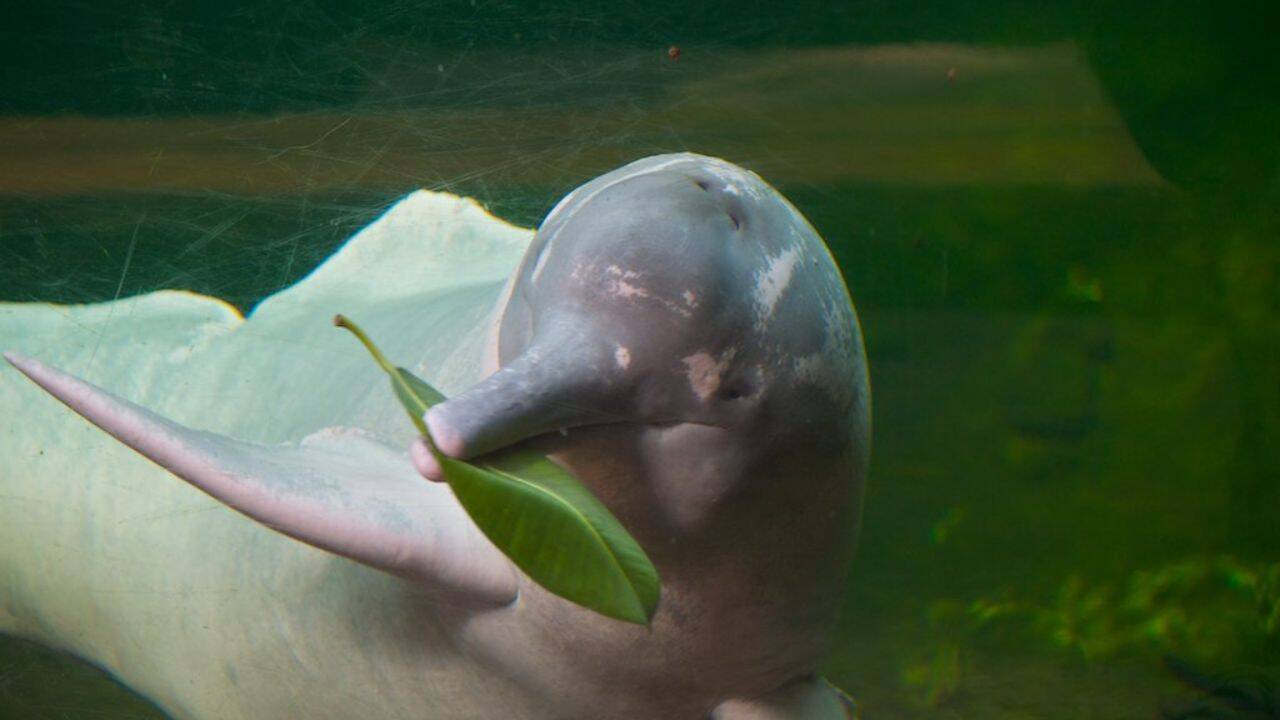
pc: wikipedia
The Amazon’s rivers are very different from the clear coastal waters inhabited by many marine dolphins. Visibility is often extremely limited, especially during seasonal floods when vast areas of forest become submerged.Because sight is less useful in these conditions, Amazon river dolphins rely heavily on echolocation. They produce rapid clicks and interpret the returning echoes to navigate through underwater obstacles and locate prey. According to conservation reports on the species, the large rounded structure on the forehead, known as the melon, helps focus these sound waves and build an acoustic picture of the surrounding environment.Their colour therefore serves little purpose for camouflage. In the dark waters of the Amazon, survival depends far more on hearing than on appearance.
The story behind one of the Amazon’s most iconic animals
The pink dolphin occupies a special place in Amazonian culture. Across the region, stories describe the boto as a mysterious shape-shifter capable of taking human form after sunset. These legends have endured for centuries and continue to be part of local traditions.As per the BBC, at the same time, researchers increasingly view the species as an indicator of river health. Pollution, fishing activity, habitat disruption and extreme droughts can all affect dolphin populations. Monitoring the animals provides clues about wider changes occurring throughout the Amazon’s waterways. Recent conservation work has highlighted how threats facing dolphins often mirror the pressures experienced by the river ecosystem itself.Although scientists understand the basic reason behind the dolphin’s unusual colour, many details remain under investigation. Researchers continue to study why some individuals become much pinker than others and how factors such as blood flow, age and behaviour influence their appearance. What is clear is that the pink colour is not a myth or optical illusion. It is a real biological feature shaped by the dolphin’s unique anatomy.