
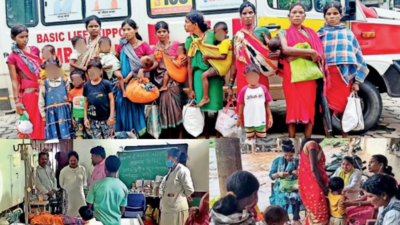
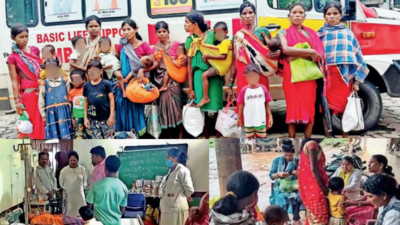
BHOPAL: Nearly a month after the deaths of Baiga children in remote villages of Balaghat first brought the tribal belt into focus, the stream of sick children being admitted into hospitals has still not stopped.Around 30 children are reported to have died in the wider affected area over the past several months, while the latest govt figures show that 486 patients have required hospitalisation after an intensive health survey in just four villages. Forty patients are still undergoing treatment. While an emergency response was put in place, the fact remains that deaths of kids, in large numbers in a short period, occured in a district in MP.For the govt, the latest figures demonstrate that thousands of children and adults are being screened, treated, vaccinated and monitored. For the families in these forested villages, however, the real measure of the response is simpler: whether a sick child can reach treatment before it is too late, whether a malnourished child receives sustained support, and whether the next illness is detected before another family has to mourn. The immediate emergency may be addressed, but the numbers suggest the underlying crisis is far from over.
Systemic woes, access to healthcare under lens
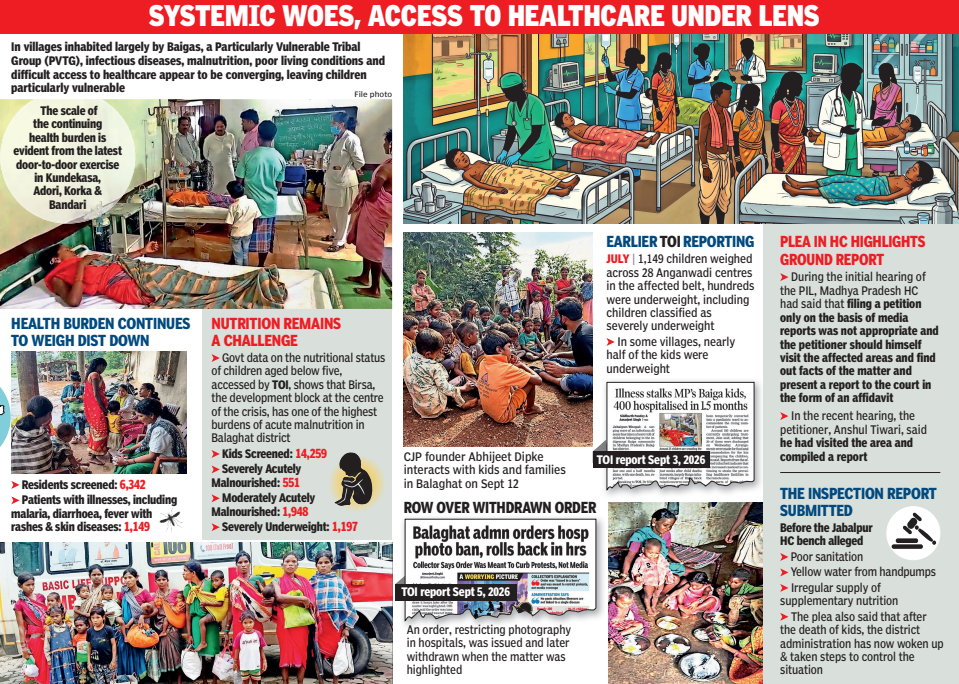
How did it come to be? The numbers point to an issue that goes beyond a cluster of seasonal illnesses. In villages inhabited largely by Baigas, a Particularly Vulnerable Tribal Group (PVTG), infectious diseases, malnutrition, poor living conditions and difficult access to healthcare appear to be converging, leaving children particularly vulnerable. The scale of the continuing health burden is evident from the latest door-to-door exercise in Kundekasa, Adori, Korka and Bandari. Of 6,342 people examined till Sept 10, health teams identified 1,149 patients with illnesses including malaria, diarrhoea, fever with rashes and skin diseases. Of these, 663 were treated at home and 486 were admitted to hospitals. So far, 446 have recovered and been discharged, while 40 remain under treatment.Disturbing Patterns The hospital figures are significant because the crisis had initially been viewed primarily through the deaths. By early Sept, Balaghat district hospital was seeing 20-25 children arriving for treatment every day, forcing the paediatric ward to expand from about 50 beds to 150. Around 400 children had been admitted over a month and a half at that stage. But behind the infections lies another warning sign: nutrition. Govt data on the nutritional status of children aged below five, accessed by TOI, shows that Birsa, the development block at the centre of the crisis, has one of the highest burdens of acute malnutrition in Balaghat district. In Aug, 14,259 children were assessed in Birsa. Of these, 551 were classified as severely acutely malnourished and 1,948 as moderately acutely malnourished. Another 1,197 were recorded as severely underweight. Across Balaghat district, 1,21,892 children were measured. The data recorded 3,741 children with severe acute malnutrition, 15,588 with moderate acute malnutrition and 8,587 as severely underweight. These figures do not establish that malnutrition caused individual deaths, but they underline the vulnerability of children in a region where infectious diseases are also circulating.Protests & Admn Response Large-scale protests and demonstrations have since erupted in the affected parts and the administration’s response came more in the form of clarification at times: On Sept 3, the Balaghat district administration issued an order restricting photography inside hospitals, only to withdraw it hours later after the matter was highlighted. Officials said the order was issued in haste and was not intended to prevent media coverage. “The order was issued in a hurry; it was intended for banning protests as per the norms at places like hospitals; it was not meant for media personnel. But the order issued was not clear, hence it was withdrawn,” district collector Kumar Satyam had said at that time.Older Red Flags The vulnerability among people and kids was visible in the affected villages even before the administration intensified its intervention. Earlier TOI reporting found that of 1,149 children weighed across 28 Anganwadi centres in the affected belt in July, hundreds were underweight, including children classified as severely underweight. In some villages, nearly half of the children assessed were underweight. The administration has since mounted a large-scale response. Twenty survey teams are conducting house-to-house health checks, supported by six PMJANMAN mobile medical units, 18 medical officers and four ambulances. Nearly 21,000 children have been vaccinated through 458 sessions so far. More than 900 children have received Vitamin A, ORS and zinc, while hundreds have been given iron syrup and albendazole. Mosquito-control measures have also been intensified. On Sept 10 alone, insecticide was sprayed in 5,345 houses across 50 villages and indoor and outdoor fogging carried out in 8,610 houses across 44 villages. Yet the continuing admissions raise a larger question: can an emergency response address what may be a deeper structural health problem?A national issue nowThe issue has now moved beyond Balaghat. Leader of Opposition Umang Singhar has sought Prime Minister Narendra Modi’s intervention, citing the deaths and the gaps in healthcare, nutrition, drinking water and basic services. The Congress has also launched protests over the deaths. Then, on Sept 12, Cockroach Janta Party’s founder, Abhijeet Dipke reached Balaghat. “Have reached Balaghat where 30 tribal kids died in the last three months due to the negligence of the administration.” he posted on Instagram. A recent inspection report submitted before the Jabalpur bench of the Madhya Pradesh High Court alleged poor sanitation, yellow water from handpumps and irregular supply of supplementary nutrition. The court, taking note of the report, has sought responses from the state govt. The affected villages remain remote, with access to healthcare historically difficult. Earlier reporting had also highlighted concerns over nutrition supplies, vaccination, mosquito protection, sanitation and access to hospitals but were those past red flags taken into account? Such uncomfortable questions continue to haunt Balaghat and MP.