
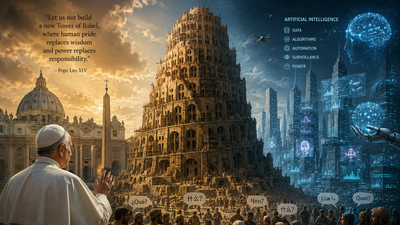
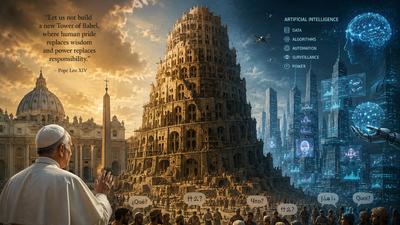
Pope Leo XIV has invoked one of the Bible’s most famous stories, the Tower of Babel, while warning about the rapid rise of artificial intelligence. In recent remarks about AI ethics and global technological power, the pontiff compared the modern AI race to the ancient biblical tale of humanity attempting to build a tower reaching the heavens. The comparison was intended as a warning against unchecked ambition, concentration of power and the pursuit of technological progress without moral responsibility. By referencing Babel, Pope Leo XIV highlighted concerns that artificial intelligence could deepen confusion, inequality and social division if developed without ethical limits and human oversight.
What is the Tower of Babel?
The Tower of Babel is a story from the Book of Genesis in the Bible. According to the narrative, humanity once shared a single language and began building a city and a tower in the land of Shinar, often associated with ancient Mesopotamia. The builders said they wanted to make a name for themselves and construct a tower “with its top in the heavens.”In the story, God confuses the people’s language so they can no longer understand one another, and the construction stops. The people are then scattered across the Earth, and the place is called Babel, which the biblical text associates with the confusion of human language. The story has traditionally been interpreted as a warning about human pride, ambition and the limits of human power.
Why Pope Leo XIV used the Babel comparison
Pope Leo XIV used the Tower of Babel as a symbolic warning about the direction of modern technology, particularly artificial intelligence. His comments focused on the fear that AI could become a tool of excessive control and centralised power if governments and technology companies pursue innovation without ethical safeguards.The Pope suggested that, much like the builders of Babel, modern society risks believing it can overcome all limits through technological advancement alone. He warned that AI systems designed without accountability could weaken truth, increase misinformation and reduce human individuality by treating people as data rather than human beings.The comparison also reflected concerns about global dependence on a small number of powerful AI developers. According to the Pope’s broader message, technology should serve humanity rather than dominate it.Over centuries, the Tower of Babel has become a lasting symbol of failed human ambition, communication breakdown and the dangers of pursuing power without wisdom. Pope Leo XIV’s AI warning shows how the ancient story continues to be used to interpret modern global challenges.