
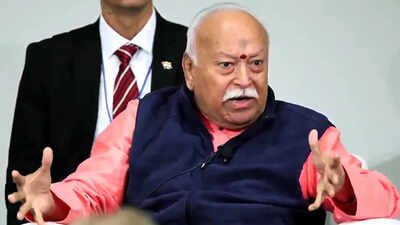
NEW DELHI: Nearly three decades after one of the world’s deadliest aviation disasters, RSS chief Mohan Bhagwat returned to the memory of the Charkhi Dadri mid-air collision in Haryana.He recalled the chaos that followed the crash. He spoke of injured passengers, bodies that had to be recovered and families arriving from far away, searching for their loved ones and trying to identify those they had lost. And he remembered the RSS volunteers who, according to him, reached the site and began helping.They treated the injured. They helped recover the dead. They assisted relatives who arrived later. They also helped arrange funeral rites.Many of the victims were Muslims. But Bhagwat said that was never a consideration for the volunteers who were serving them.Speaking at the “One World One Humanity” event in New York on Saturday, Bhagwat recalled the tragedy as an example of what he described as the RSS’s philosophy of unconditional humanitarian service.“Two planes collided over Haryana, which is part of Bharat, over the place named Dadri. Both were from Arab countries. Most of the passengers were Muslims. After that collision, our Swayamsevaks reached there first, and they served. Served in treating the injured… Recovering their bodies, arranging for the funeral rites when their relatives come, helping them in identifying. We never thought at that time that these were Muslims,” said the RSS Chief.The disaster took place on November 12, 1996. A Saudi Arabian Airlines Boeing 747 and a Kazakhstan Airlines Ilyushin Il-76 collided in the skies over Charkhi Dadri, Haryana.There were no survivors.All 349 people aboard the two aircraft were killed. The crash became the deadliest mid-air collision in aviation history.For Bhagwat, the tragedy was not only about the terrible loss of life. It was also about what happened after the aircraft came down.He recalled a moment when grief and devastation had stripped away every distinction between people. Those at the crash site needed help. Families needed answers. The dead needed dignity.Bhagwat said the volunteers did not ask who the victims were before helping them.He also said the RSS did not publicise such work because it did not expect anything in return.“The prominent working organisation was RSS. We could do this because we are not in politics. And we don’t go on making these things famous because we don’t want anything from this. No return… In Sangha, we only give. We don’t want anything. That is why in publicity matters, we are way behind.”The RSS chief was speaking in New York as he began a three-nation global outreach tour covering the United States, Canada and the United Kingdom. The visit has been organised as part of the organisation’s centenary year celebrations, following invitations from overseas local organisations.Bhagwat also used the occasion to speak about perceptions of the RSS. He said the organisation was often viewed through narratives that, in his view, did not reflect its work on the ground.“There are many perceptions created by wrong narratives. But when you come and see us from inside, all those will be disbelieved in the day.”He then broadened his argument beyond the RSS and its work during disasters. He spoke about the kind of social change he believes is necessary to create greater unity.Bhagwat said political systems alone could not bring about such change. In a democracy, he argued, political leaders ultimately respond to public opinion. The first step, therefore, had to be taken within society itself.“Politics today, especially in a democracy, depends on the public view. If there is public opinion, then no politician will dare to go against it. Therefore, I think after taking a common resolve today, we have to act in these societies, and we have to act first locally.”He argued that social harmony could not be built simply by gaining political power. It had to grow from everyday interactions and acts of service.For Bhagwat, the idea was rooted in what he described as the traditional thought of Bharat, where the unity of humanity is placed above individual interests.“This is the traditional thought of Bharat–unity of humanity. All our leaders, at any point in time, have emphasised that too. After independence, we got the constitution, which emphasises this, but that is not happening. Because these things do not happen through politics. I’m sorry to say, but the fact is, politics has now become a game of self-interest. And where there is me and I, there is no solution. We and ours are the solution. So our experience in Bharat is that we have to start with society.”He called for such efforts to begin locally. Small pockets of people working together, he said, could eventually become larger networks of service and unity.“Whatever we decide to do today, we should start in our own country and create pockets of such selfless service, such an atmosphere of unity, and then this dialogue should continue. Through this dialogue, we should connect them, and then we should grow.”
Share your thoughts in the comments
Be respectful · TOI community guidelines
Nearly 30 years after the Charkhi Dadri crash, the scale of the disaster remains difficult to comprehend. Hundreds of lives were lost in a matter of moments.But Bhagwat chose to remember what happened in the aftermath.Amid the wreckage, he said, volunteers came forward to help people they did not know. They treated the injured. They recovered bodies. They helped families search for answers.And, in his telling of that day, they did so without first asking whether the person in front of them was Hindu or Muslim.That memory formed the emotional centre of Bhagwat’s message in New York: that in moments of profound human suffering, service can begin before identity does.