
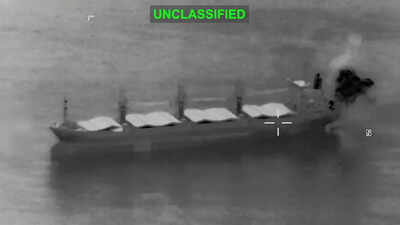
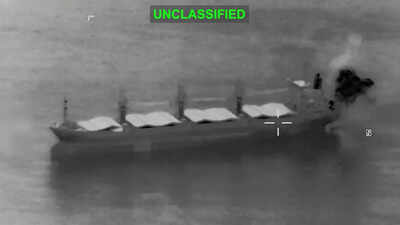
The US Central Command (Centcom) on Saturday released a video showing a commercial vessel being struck in what it described as the Gulf of Oman, after US forces disabled a St Kitts-flagged ship that allegedly ignored repeated warnings and attempted to leave the region after visiting an Iranian port. The disclosure came amid heightened tensions between Washington and Tehran and fresh efforts by mediators to revive negotiations to end the conflict.Centcom said the vessel was disabled after it failed to comply with multiple warnings. The US military has been enforcing a naval blockade on Iranian ports for months, including in waters around the Strait of Hormuz, a key route for global oil shipments.“CENTCOM forces disabled a commercial vessel in the Gulf of Oman, Nov. 7, after the ship’s civilian crew ignored repeated warnings and attempted to violate the naval blockade against Iran multiple times. A U.S. military aircraft fired precision munitions at the stern of St. Kitts-flagged M/V Huda, disabling the ship after CENTCOM forces directed the crew to abandon targeted spaces. The cargo vessel tried to depart regional waters after visiting an Iranian port,” it said.The latest disclosure comes nearly a month after the last confirmed US strike on a cargo vessel in the Gulf of Oman. It also follows at least two reported instances in which Centcom did not publicly acknowledge military strikes in the region. Officials at the command had declined to confirm reports of explosions when questioned about them.Meanwhile, Iranian state media reported explosions on Qeshm Island in the Strait of Hormuz and at the port of Jask on Saturday evening. The cause of the explosions was not immediately clear. The US military did not immediately respond to an Associated Press request for comment.Iran’s military also said late Saturday that two tankers had struck mines in the Strait of Hormuz area and caught fire. It did not identify the vessels’ flags or destinations.
Trump confirms fresh US strikes
The latest maritime incident comes days after US President Donald Trump confirmed that American forces had carried out fresh, limited strikes against Iran.Trump said on Friday that the US military had targeted an Iranian air defence system. Describing the action to reporters as “minor”, he confirmed the strikes. However, Centcom did not comment on the operation, even after Trump’s remarks.For weeks, Trump had said he was considering a fresh wave of strikes against Iran after the US midterm elections on November 3. The possibility of a return to full-scale military operations has raised concerns across the Middle East and beyond. The US had not resumed such operations since the pause in fighting nearly two months ago.
Qatar pushes two-day bridge deal
Even as military tensions persist, diplomatic efforts are continuing to find a way out of the conflict.Two Middle Eastern government officials said on Friday that Iran was reviewing proposals presented by Qatar, the chief mediator, to address differences with Washington over Tehran’s nuclear programme.Regional officials said the proposal envisages a two-day arrangement involving confidence-building measures by both sides. On the first day, the US would lift its naval blockade of Iranian ports and release some of the billions of dollars in Iranian assets frozen under sanctions.In return, Tehran would allow International Atomic Energy Agency (IAEA) inspectors to access nuclear sites bombed by the US and Israel.On the second day, Iran would reopen the Strait of Hormuz under a modified arrangement it has reached with Oman. The proposal has not yet received US approval. The arrangement would remain temporary until a permanent agreement on the waterway is reached with other Gulf countries.Once these measures are implemented, Washington and Tehran would begin broader negotiations on Iran’s stockpile of highly enriched uranium and other aspects of its nuclear programme, the officials said.However, one of the officials said Iran was currently unwilling to negotiate its nuclear activities until Washington agrees to several conditions that Tehran wants included in any ceasefire agreement.These include an end to the US blockade of Iranian ports, the lifting of sanctions, the release of frozen assets, compensation for war damage and an end to hostilities across the region, including Israeli military operations in Lebanon.The officials spoke on condition of anonymity as they were not authorised to comment publicly on the negotiations.
Nuclear programme remains key sticking point
Differences over Iran’s nuclear programme remain the biggest obstacle to a broader agreement. Trump has insisted that the issue must be resolved as part of any deal to end the more than eight-month-old conflict.Iran has consistently maintained that its nuclear programme is intended for peaceful purposes. However, according to the IAEA, Tehran has 440.9 kg of uranium enriched to 60% purity. This is a relatively short technical step away from the 90% enrichment level generally considered weapons-grade. There is no civilian energy application for uranium enriched to such high levels.The conflict began on February 28, when the US and Israel launched strikes against Iran, seeking to destabilise its regime and destroy its ballistic missile and nuclear programmes.In June, Iran agreed to a memorandum of understanding with the US that outlined a path towards a permanent settlement. However, the understanding quickly unravelled as both sides accused each other of violating its terms.