
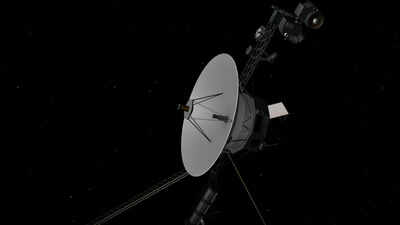
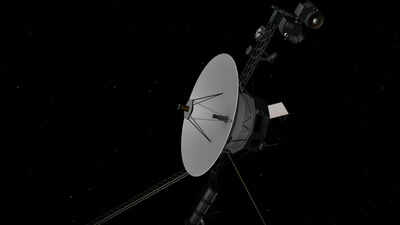
Nasa’s Voyager 1 is believed to have crossed the one-light-day milestone, becoming the first human-made object to reach this distance from Earth. According to advance calculations by Nasa, the spacecraft crossed the mark on Wednesday, at 3.46 pm IST, covering approximately 16 billion miles (26 billion kilometres).This means that now a radio signal travelling at the speed of light will take approximately 24 hours to reach the spacecraft, with another day required for a response to return to Earth.“If you want to say ‘hello’ to Voyager, you send your message and then you go home and you wait two days before you finally get a response,” Voyager project manager Suzanne Dodd said, according to Nasa’s Jet Propulsion Laboratory (JPL).Speaking to Reuters, Dodd described the achievement as an extraordinary feat. “Reaching one light-day is an astounding feat, one that I never expected to see,” she said.Voyager 1, travelling at nearly 61,000 km/h, was launched in 1977 to explore the outer planets of the solar system. It flew past Jupiter and Saturn before crossing the heliopause, the outer boundary of the Sun’s protective bubble of particles and magnetic fields, in 2012 to enter interstellar space. Its twin, Voyager 2, followed in 2018.The spacecraft continues to send scientific measurements of magnetic fields, cosmic rays and plasma waves from interstellar space. Scientists are also studying how the Sun continues to influence its surroundings through solar storms and coronal mass ejections.However, the nearly 50-year-old spacecraft faces declining power supplies. A JPL representative told Reuters that recent power-saving measures could allow both Voyager probes to communicate with Earth for another three to four years. The team hopes to keep their current scientific instruments operational through the mission’s 50th launch anniversary in 2027.