
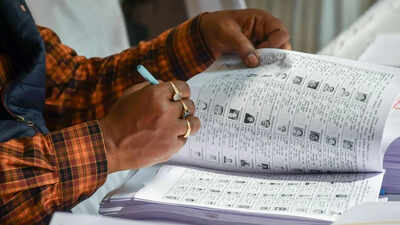
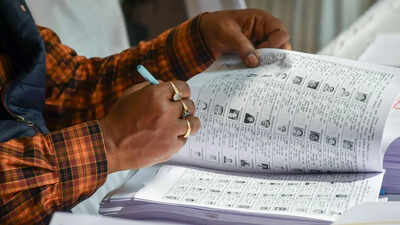
LUCKNOW: Days after 158 unusual entries surfaced in the electoral rolls of Uttar Pradesh Legislative Council’s Graduates’ and Teachers’ constituencies, another similar discrepancy has emerged in Azamgarh, where 13 entries in an assembly constituency’s voter list carried the same Hindi name, Vikas Yadav, despite belonging to different individuals.Taking note of the irregularities, Uttar Pradesh Chief Electoral Officer (CEO) Navdeep Rinwa on Saturday ordered action against nine election personnel, including five booth-level officers (BLOs), a computer assistant and three supervisory officers.The investigation followed allegations raised by the Samajwadi Party during an October 15 press conference that Vikas Yadav’s name appeared 10 times in the electoral roll of assembly constituency 347-Azamgarh.According to the district election officer’s investigation, 13 entries carried the Hindi name Vikas Yadav. Two had already been deleted, while the remaining 11 belonged to different individuals residing in separate villages of Azamgarh. Of these, only one was the genuine Vikas Yadav. Form 8 applications have been obtained to correct the names and other particulars of the remaining 10 voters.Investigators also identified another voter with the same name and father’s name in Gorakhpur’s Chauri Chaura assembly constituency. However, this voter was separate from the 13 Azamgarh entries, and the report did not identify the Gorakhpur entry as fraudulent.Speaking to TOI, Rinwa said the discrepancies involved different individuals, including women, whose photographs, ages, genders and English names were correctly recorded, but whose Hindi names had been changed to Vikas Yadav.“The genuine Vikas Yadav submitted only one application. The remaining entries belonged to different voters. Their English names were correct, but their Hindi names were changed to Vikas Yadav,” he said.Rinwa said five BLOs, a computer assistant, two assistant electoral registration officers and the then electoral registration officer were involved at different stages of verification and approval.“Unlike the Pilibhit case, which involved intentional criminal wrongdoing, we have not established any such intention here. It could be negligence or mischief by an individual. Further investigation is necessary,” Rinwa told TOI.The CEO ordered the immediate removal of the five BLOs and the computer assistant from electoral roll duties and issued notices proposing termination of their services. Notices seeking explanations before proceedings under Section 32 of the Representation of the People Act, 1950, have also been directed.Departmental proceedings have been ordered against the three supervisory officers for negligence and inadequate supervision.The Azamgarh district election officer has been directed to scrutinise electoral rolls across all assembly constituencies and submit a report within a week.The latest discrepancy comes after 158 unusual entries were detected among 14,81,310 voter records prepared for the recent Legislative Council elections.In the Allahabad-Jhansi Graduates’ constituency, one voter, Ravi Sharma, had his father’s name recorded as “Ram Ne Sharma Ko Mara”, while another entry read “Ram Ne Yadav Ko Mara”. Narendra Yadav’s father’s name appeared as “B Com”.Other peculiar entries included Faiz Abbas Ne Kaha, son of Syed Jabbar Hussain, and Irfan Ali Ne Kaha, son of Syed Irfan Ali.The rolls also listed Murkh Kali Devi, whose father’s name was Ramjeet Patel, despite the voter being classified as male. Other entries included Mohammad Pagal Rehan, son of Mohammad Hashim, and Takkar Marna, whose father’s name was also recorded as Takkar Marna.On October 22, Rinwa attributed these discrepancies to software translation errors and human negligence during the first-ever online registration exercise for the Legislative Council constituencies.He explained that the software was supposed to transliterate English names into Hindi but occasionally translated words literally. For instance, incorrectly typing “Ramhit Yadav” as “Ram hit Yadav” could produce “Ram Ne Yadav Ko Mara”.“The software provided an option to manually correct such errors, but these remained wherever officials failed to exercise caution,” Rinwa had said.He described entries such as “B Com” in the father’s name field as human error or negligence.