
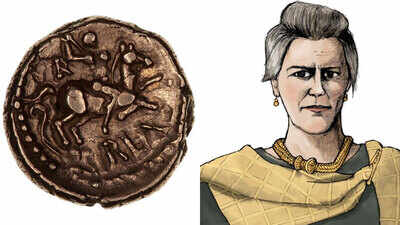
The ruler whose appeal to Rome helped provide the pretext for the invasion of Britain in AD 43 may not have been a king at all. An archaeologist has argued that Verica, the Iron Age leader traditionally identified as a male ruler, could have been a woman who sought the protection of Roman Emperor Claudius after being driven from her territory.The theory has been put forward by Miles Russell, an archaeologist at Bournemouth University, in a feature published in Current Archaeology. His argument draws on the ruler’s name, images on coins issued in Verica’s name and evidence about the status of women in Iron Age Britain. If correct, it would add another female political leader to the history of Roman-era Britain, alongside the better-known rulers Boudica and Cartimandua.
Why does the archaeologist believe Verica was a woman?
One of Russell’s arguments concerns the name itself. The name Verica ends in the letter ‘a’, a feature commonly found in feminine names from Iron Age Britain, including Boudica and Cartimandua. Male names from the period, by contrast, often ended in ‘-us’ or ‘-os’, such as Caratacus and Cunobelinus.There is also a complication in the ancient written record. The Roman historian Cassius Dio, writing in the early third century, referred to a British exile called Berikos who fled to Claudius before the invasion. He recorded that this individual persuaded the emperor to send a military force to Britain.Historians have generally identified Berikos with Verica, whose name appears on coins associated with the Atrebates, a people whose territory included parts of present-day Hampshire and West Sussex. However, Dio does not explicitly establish the person’s gender. Russell suggests that the difference between Berikos and Verica could reflect the difficulties Roman writers and later copyists faced when recording unfamiliar British names.
What do Verica’s coins reveal?
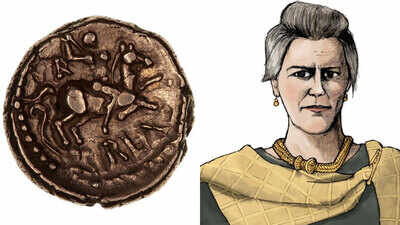
The archaeologist’s second major argument comes from the images on Verica’s coins. Some depict slender, bare-breasted figures riding horses and carrying spears. Russell argues that these figures appear female, unlike the more overtly masculine warrior imagery used on coins issued by other Iron Age British rulers.He also examines the inscription COM F, which has generally been interpreted as Commios filius, meaning ‘son of Commios’. Russell suggests it could instead be read as Commios filia, meaning ‘daughter of Commios’. This would indicate that Verica claimed descent from Commios, a Belgic ruler associated with Julius Caesar.The coins also carry the Latin title rex, meaning king. Russell argues that the use of this title does not necessarily establish that Verica was male, as women could also hold political power and maintain relationships with Roman rulers.
Could a woman have helped bring Rome to Britain?
Verica’s possible role becomes particularly significant when viewed against the political situation before the invasion. According to Russell’s interpretation, the ruler’s territory had contracted, while the neighbouring Catuvellauni expanded into areas associated with the Atrebates.After the death of Cunobelinus around AD 40, his son Caratacus may have taken advantage of the changing political situation to expand his influence. Russell argues that this pressure could have driven Verica to seek protection from Claudius.Cassius Dio’s account places the appeal of the British exile before the Roman invasion in AD 43. Russell suggests that Verica’s request may have given Claudius a political justification for military intervention, while also offering Rome an opportunity to protect its interests in Britain.However, surviving written accounts do not establish whether Verica was reinstated after the conquest or what role the ruler may have played during the invasion itself.
What does the theory mean for Iron Age history?
Russell’s argument also draws on archaeological and genetic research suggesting that women may have held significant social positions in some Iron Age British communities. A study of human remains from Winterborne Kingston in Dorset, for instance, identified patterns of female-line ancestry that researchers interpreted as evidence of a possible matrilocal society, in which men moved to join their wives’ communities.Such findings do not prove that Verica was a woman, but they challenge the assumption that political authority in Iron Age Britain was necessarily male.The case is part of Russell’s wider research and will also be explored in his forthcoming book Caratacus: Great King of Britain, due to be published by Bloomsbury in January.For now, Verica’s gender remains a historical question rather than a settled fact. But Russell’s interpretation raises an important possibility: a ruler whose appeal helped shape one of Britain’s most consequential invasions may have been a queen whose identity was recorded incorrectly by later generations.