
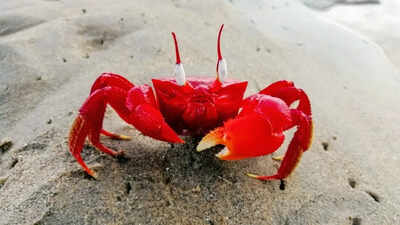
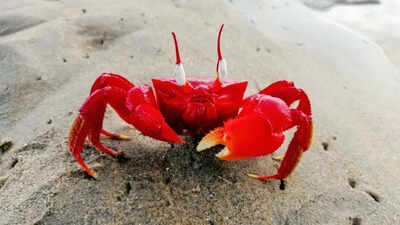
Have you ever found yourself taking a stroll on a not-so-busy beach, watching a bunch of crabs making their way through the crowd of people, and thought: Why do crabs walk sideways instead of heading straight ahead like most animals?Turns out, the answer goes way back — about 200 million years, in fact. That strange sideways scuttle has shaped their history in ways you might never guess.Watch a crab long enough, and you’ll see it: side-stepping along the shore, awkward yet quick. Scientists used to wonder: Did all crabs just “figure out” this move on their own, or did they inherit it?A new study argues it happened just once. One ancient ancestor figured out something special about moving sideways, and every “true crab” since then followed suit. It wasn’t random at all.
All about the study: What did scientists find?
New research published as a Reviewed Preprint in eLife sheds light on the largest dataset yet that deals with the intriguing ways of crabs’ movement.Per the paper, Yuuki Kawabata carried out this research with co-first authors Junya Taniguchi, Tsubasa Inoue, and Kano Kohara from the Kawabata Laboratory, along with additional contributors. According to the editors at eLife, the findings of the study are supported by largely convincing evidence, with broad relevance for scientists studying how animals move.What did the researchers find, exactly?For the study, researchers watched 50 different crab species — one per species — observing how each moved in an arena designed to feel like home. Out of the 50 species studied, 35 primarily moved sideways, while 15 moved forward.The team then cross-referenced those observations with data from an earlier crab phylogeny that mapped the evolutionary relationships of Brachyura using 10 genes from 344 species across most major lineages. As the behavioral data did not always align perfectly with the species in that phylogeny, the researchers then dialled down the evolutionary tree to 44 genera, along with five families and one superfamily. This allowed closely related groups to stand in for species that were not directly included. And the researchers learned: sideways walking evolved one time, right at the base of the group known as Eubrachyura, the “true crabs.”This wasn’t a trait that popped up here and there. It was a breakthrough, and it stuck.Why does it matter?Sideways movement isn’t just “quirky,” it’s useful. Crabs can dart quickly left or right, making their moves hard to predict, and making it easier to dodge predators. That kind of speed and agility is rare in the animal world, but it works for crabs.Kawabata explained, “This single event contrasts starkly with carcinization, which has occurred repeatedly across decapod species,” adding, “This highlights that while body shapes may converge multiple times, behavioral changes such as sideways walking can be rare.”It probably helped them become so successful. “True crabs” now dominate coastlines all over the planet, from beaches and riverbeds to the deep sea and even some forests. They’re among the most adaptable creatures in the marine world. Their close relatives (like lobsters or the group called Anomura) aren’t nearly as common or widespread.The one-time shift to sideways movement was likely a key part of that takeover.As per the senior corresponding author, Yuuki Kawabata, Associate Professor at the Graduate School of Integrated Science and Technology, Nagasaki University, Japan, “Sideways locomotion may have contributed significantly to the ecological success of true crabs.” He said, “There are around 7,904 species of true crabs, far exceeding that of their sister group, Anomura, or their closest relatives, Astacidea; they have colonized diverse habitats around the world, including terrestrial, freshwater and deep-sea environments; and their crab-like body shape has evolved repeatedly over time in a phenomenon known as carcinization.”He also added, “Despite the rich information available on true crabs, data concerning their locomotor behaviors are sparse. Although most true crab species use sideways locomotion, there are some groups that walk forwards, which raises some interesting questions. When did their sideways locomotion originate, how many times over the years did it evolve, and how many times did it revert?”So why don’t more animals walk sideways?Because it’s not always a win. Sideways movement sometimes clashes with activities like digging burrows, feeding, or mating. True crabs managed to make it work, but most other creatures stuck to the more typical head-first crawl.Where did this all start?Scientists estimate this “sideways revolution” started right after the Triassic-Jurassic extinction, when life on Earth was reshuffling. The seas were changing: the breakup of Pangaea opened new coastlines, shallow water habitats expanded, and crabs got new opportunities to diversify. A single clever twist in movement, in the right place at the right time, helped reshape crab history.What does it all mean?For scientists, it’s more proof that a small behavioral shift can transform an entire group. Sometimes, evolution doesn’t need to reinvent the wheel. One lucky change, like the sideways walk, can open up a brand new way of life, and for crabs, it’s helped them thrive for millions of years.So next time you spot a crab scuttling sideways, just remember that quirky little move isn’t just for show — it’s a 200-million-year-old survival strategy, born out of ancient oceans and still working just fine!