
Some quotes seem to wait for their moment.You read them once and move on. Then, years later, the world changes, and the same words start to sound completely different.This proverb feels a bit like that.For decades, most people would probably have read it as a comment on factory machines, industrialisation, or the arrival of computers. Today, many people read it and immediately think about artificial intelligence. Chatbots. Algorithms. Automated systems. Software that can write, draw, analyse data, and complete tasks that once required human effort.That shift makes the proverb feel surprisingly fresh.Not because technology has stopped advancing. Quite the opposite. Technology is advancing so quickly that people have started asking an old question again: what happens when machines become capable of doing work that humans once considered uniquely their own?The proverb offers an answer. Or at least a perspective.
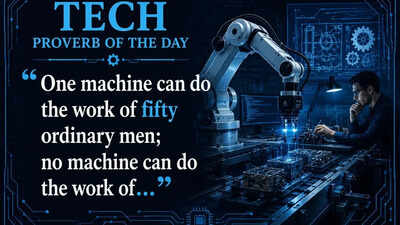
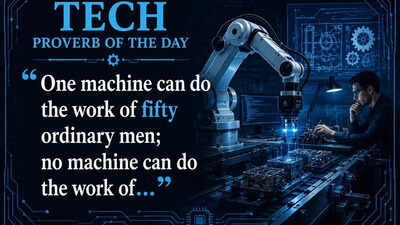
Tech proverb of the day
“One machine can do the work of fifty ordinary men; no machine can do the work of the extraordinary man”
We’ve been worried about machines for a very long time
It’s easy to assume that concerns about technology are new. They aren’t.When factories began introducing machinery on a large scale, many workers feared they would become unnecessary. Similar fears appeared when computers entered offices. Then came the internet. Then automation. Now, artificial intelligence.The pattern is remarkably familiar.A new technology appears. Predictions start flying in every direction. Some people believe it will solve everything. Others become convinced it will destroy everything.Reality usually lands somewhere in the middle.Machines do replace certain tasks. That much is true. They can process information faster than humans. They don’t get tired. They don’t need lunch breaks. They don’t complain about repetitive work.In many situations, they are simply better suited to routine tasks.The first half of the proverb recognises that fact without hesitation.
But people are not assembly lines
The second half is where things get interesting – “No machine can do the work of the extraordinary man.” Notice the wording.It doesn’t say machines cannot do human work. It says they cannot do the work of an extraordinary person.That’s a very different claim.An ordinary task can usually be described step by step. Follow the instructions and you will reach the result. Machines thrive in that environment.Extraordinary people tend to operate differently. They often break instructions. Sometimes they ignore accepted wisdom altogether.And occasionally, they change the direction of entire industries because they refuse to think the way everyone else does.
History tends to remember the outliers
Look back at the people who altered the course of history.Many were not simply hardworking. Plenty of hardworking people never become household names.The individuals who stand out are often the ones who saw possibilities others missed.An inventor obsessed with an idea nobody else believed in. An entrepreneur is pursuing a product that experts consider unrealistic. A scientist was following a theory that seemed ridiculous at the time. A writer producing work that publishers initially rejected. These stories share a common theme. The breakthrough usually looks obvious afterwards.Before it happens, it often looks strange.Machines are excellent at identifying patterns that already exist. Extraordinary people sometimes succeed by questioning those patterns altogether.That’s a different kind of skill.
The strange thing about creativity
People talk about creativity as though it is a neat, organised process.It rarely feels that way.Creative breakthroughs often arrive from unexpected places. A conversation. A mistake. A random observation while walking down the street. An idea that appears unrelated until suddenly it isn’t.Many great discoveries have emerged from accidents, curiosity, or stubborn persistence.There is something wonderfully messy about the process.Technology can assist creativity. It can speed up research. It can generate possibilities. It can remove repetitive work.Yet the spark itself remains difficult to explain.And things that are difficult to explain are often difficult to automate.
The people machines cannot replace
When discussions about artificial intelligence become heated, attention usually focuses on jobs.Which jobs will disappear? Which jobs will survive?Those are important questions. Yet they may not be the most interesting ones. A more interesting question might be: what kinds of people become more valuable as machines become more capable?History suggests the answer is not people who compete directly with technology. It is people who bring something technology lacks.Original thinking. Judgement. Vision. The ability to persuade others. The courage to pursue an idea before evidence guarantees success.These qualities have always been valuable. They may become even more valuable in the years ahead.
An observation hidden inside the proverb
What makes this saying memorable is that it doesn’t attack technology.Some old quotes portray machines as a threat. This one doesn’t. In fact, it openly acknowledges their power.One machine can do the work of fifty ordinary men. That’s not criticism. It’s recognition.The proverb simply argues that productivity is not the same thing as greatness.Speed is not the same thing as imagination. Efficiency is not the same thing as vision. Those distinctions matter. Especially now.
Why the proverb still resonates
Perhaps the reason people continue sharing this proverb is that it contains a reassuring reminder.Technology changes constantly. Tools evolve. Industries transform. Jobs come and go.Yet progress has always depended on individuals willing to think differently.The extraordinary person is rarely the fastest worker in the room. Often, they are the person asking a question nobody else considered asking. That role has survived every technological revolution so far.There is little reason to believe this one will be different.
Final takeaway
“One machine can do the work of fifty ordinary men; no machine can do the work of the extraordinary man” feels particularly relevant in an era dominated by artificial intelligence and automation. The proverb recognises the immense power of technology without surrendering to the idea that human value can be reduced to productivity alone.Machines can accelerate work and transform industries. They can complete tasks at remarkable speed and scale. Yet history suggests that the biggest leaps forward rarely come from efficiency alone. They come from imagination, curiosity, risk-taking, and the willingness to see possibilities where others see limits.Those qualities have always been difficult to measure.They may also be the reason extraordinary people continue to stand apart, no matter how advanced the machines around them become.