
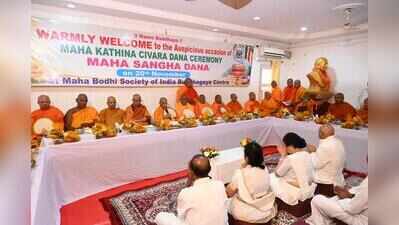
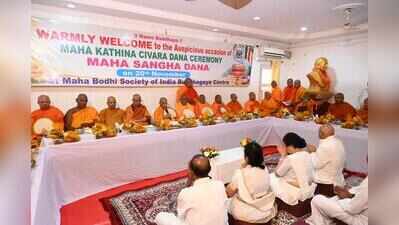
Gaya: More than 1,000 Buddhist monks from Sri Lanka participated in a Kathina puja procession from the Mahabodhi Society of India (MSI) Bodh Gaya centre to the Unesco world heritage site Mahabodhi Mahavihara on Friday morning.Organised by the MSI Bodh Gaya centre, the daylong proceedings began at 6am. At the Mahavihara, devotees offered prayers before the Buddha statue in the sanctum sanctorum, followed by the observance of the Eight Precepts (Atthasila), Buddha puja and a Dhamma sermon on the significance of Kathina puja under the sacred Bodhi tree. The monks later chanted the Mahaparitrana and Paritta suttas.After the rituals, the civara (robe) offered before the statue was brought back to the MSI centre, traditionally dyed and presented to the monks. The ceremony concluded with Sangha dana (meal offering).MSI general secretary P Siwalee Thero said, “It is a tradition to offer a new robe to a selected monk under the ‘Kathina civara dana’. The monk is chosen by the sangha from among those who spend four months indoors during the rainy retreat, or chaturmaas, practising meditation.”Explaining the significance of the chanting, Buddhist scholar Rajiv Kumar said, “A collection of around 30 suttas from the Sutta Pitaka, compiled for the protection of monks and householders, is known as Paritta or Mahaparitrana. According to Buddhist tradition, it is auspicious and helps pacify calamities such as disease and famine. This tradition has been practised in Sri Lanka and Myanmar since ancient times.”Tracing the practice to the Buddha’s time, Kumar added, “The tradition of reciting these verses dates back to the Buddha’s time. It is said that when a famine once struck Vaishali, the Mahaparitrana suttas were recited on the Buddha’s instructions, which was followed by rainfall. Similarly, Mahakassapa was cured of his illness through the recitation of the Bojjhanga Sutta.”