
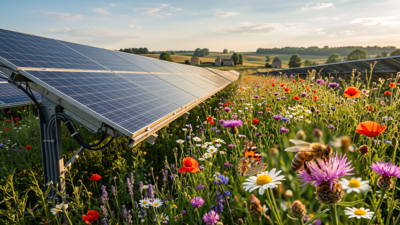
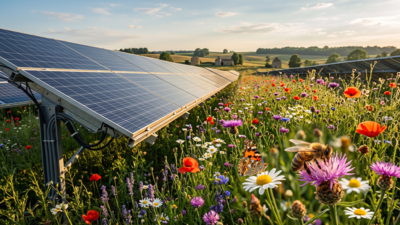
French solar farms are bringing back native wildflowers. The findings also showed that these sites can support bees and butterflies, challenging the notion that solar farms uniformly harm pollinating insects and the plants they depend on. Solar farms produce clean energy, but the panels reshape the surrounding landscape. Those changes can include shifts in temperature, moisture, and vegetation, and research shows solar sites can encourage native plant growth. But the panels can also create shaded areas that affect plant-pollinator interactions.An article in the journal Biological Conservation examined the effects of solar panels on plant-pollinator interactions at 20 solar farms in Southern France. The study found that plants under the panels had 76-86% fewer pollinator visits than plants outside them. But the impact varied across the farm.Researchers found that “inter-row” plants, which grow between rows of solar panels, continued to attract bees, butterflies and other pollinators. Their numbers were lower than in areas outside the solar farms, but the difference was less pronounced than in areas under constant shade.
Shade changes the way plants and insects interact
The researchers found that much of this variation was linked to how much shade the panels cast. Plants in continuous shade attracted fewer visits, but plants in partial shade between rows of panels still attracted pollinators. We found more pollinator activity in the sunnier spots.The researchers suspect the pattern may be partly due to the cooler conditions produced by solar panels. Pollinators tend to avoid cooler and shaded areas, creating what the study calls different “microclimates” around the panels.Shade can also affect the plants themselves. Reduced sunlight can decrease plant diversity and the quantity of pollen and nectar flowers produce. This means that even when pollinators do visit plants growing under panels, these plants may provide fewer resources.The research also examines whether the panels themselves may affect insect movement. The research suggests that solar installations may serve as “a physical barrier” for butterflies that respond strongly to changes in their environment. Changes in soil moisture under the solar panels may also affect plant growth and insect feeding.
Solar farms could still benefit native plants
The findings do not mean solar farms are inherently harmful to pollinators. Instead, they show that conditions within the same solar installation can vary depending on panel placement, vegetation and land management.The researchers also discovered something unexpected about land maintenance. Grazing led to lower pollinator abundance than mowing, the opposite of what the scientists expected.As Europe continues expanding solar power, researchers want future studies to examine pollinator behaviour in greater detail, including differences between individual species. More data could help scientists understand how solar panels alter local microclimates and how those changes affect pollination.The broader question is how solar farms can be designed and managed to become “pollinator-friendly” while avoiding a “net loss of pollinator biodiversity.” The French study suggests that solar installations can alter pollinator activity, but it also shows that their effects are not uniform, leaving room to explore how native vegetation and better land management could make these energy sites more compatible with bees, butterflies and other insects.