
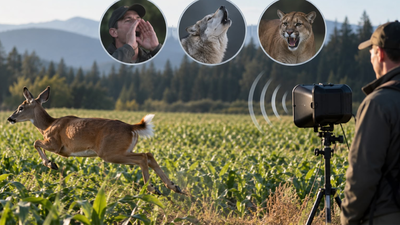
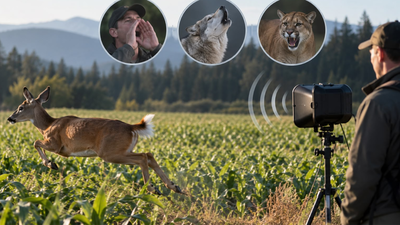
What scares a deer away from a crop field, a wolf howl, a cougar call or the sound of a human shouting? A 2025 study by researchers from the University of Alberta and King’s University found that, among the sounds tested, human shouts produced the strongest flight response in both deer and elk. But the effect did not last: over six weeks, both species became increasingly accustomed to the stationary deterrents. The study, published in Ecology and Evolution, tested audio and flashing-light deterrents on agricultural fields in British Columbia’s Cowichan Valley, where Roosevelt elk and black-tailed deer frequently enter crop fields and can damage crops and fences.
Human shouting worked better than predator calls
Between August 4 and September 17, 2023, researchers placed motion-activated devices on 15 crop fields. When an animal approached, the devices played one of several sounds: people talking, people shouting, wolf and cougar vocalisations, dog barks or local bird calls. Some trials also included flashing LED lights.The researchers analysed 680 usable encounters involving elk and deer. The difference between ordinary human speech and shouting was particularly striking. Deer fled in response to human shouts 64% of the time, compared with 46% when they heard people talking. Natural predator sounds triggered flight in 45% of deer encounters, while the response to dog sounds was lower.Elk were less reactive overall. They fled after human shouts in 36% of encounters, compared with 13% for conversational human speech. Predator sounds, dog barks and bird calls produced flight responses in roughly 16-18% of encounters. The findings suggest that the animals were not simply reacting to the presence of a human voice. The intensity of the voice appeared to matter.
Adding flashing lights made animals more likely to flee
The researchers also tested whether combining sound with another sensory cue could make the deterrent more effective. It did. For elk, the addition of flashing lights roughly doubled the proportion of encounters that ended in flight, from 13% with audio alone to 26% with lights. Overall, the study found that multimodal deterrents increased the odds of fleeing by 4.7 times in elk and 1.8 times in deer. However, the lights did not significantly increase the amount of time the animals remained alert after encountering the deterrent.The researchers suggest that multiple cues may make a perceived threat harder for animals to dismiss, although the study did not establish whether the flashing lights themselves represented a predator or simply intensified the animals’ reaction.
Then the animals started ignoring them
The biggest challenge emerged over time. Both species became less responsive as the six-week experiment progressed. Elk showed the faster decline: their predicted probability of remaining alert fell from 86.4% on the first day to 55% by day 45, a relative decline of about 36%.For deer, predicted alertness fell from 84.8% to 62.9%, a relative decline of about 26%. In other words, the animals appeared to learn that the sounds and lights did not lead to any real danger. This process, known as habituation, is one of the major problems with using artificial deterrents to manage wildlife. A stimulus that initially looks threatening can lose its power when animals repeatedly encounter it without consequences.
Human activity may make habituation faster
The researchers also found that the surrounding landscape mattered, particularly for deer. Deer habituated more quickly at sites with more houses and at locations closer to highways. This suggests that animals already accustomed to regular human activity may be quicker to disregard artificial human-related disturbances.The pattern was less clear for elk. Although the researchers found a possible relationship between habituation and proximity to highways, the strongest statistical model did not establish a clear landscape effect.
Why the findings matter for farmers
Wildlife deterrents are increasingly being explored as a non-lethal way to reduce crop damage and avoid measures such as lethal control or expensive exclusion fencing. The study suggests that sound-based systems can work, particularly when they use salient human vocalisations and are paired with visual signals. But it also shows why simply installing a device and leaving it in the same place may not be enough.The researchers point to varying the types of stimuli and adding real consequences or reinforcement as possible ways to prevent animals from learning that the apparent threat is harmless. The experiment was relatively small, involving 15 sites over 45 days, and the researchers caution that the results cannot establish whether these short-term behavioural changes ultimately reduce crop damage or alter wildlife populations.For farmers, however, the message is clear: a shouting human may scare a deer today, but if the same warning keeps coming from the same box with nothing else happening, the deer may eventually learn not to run.