
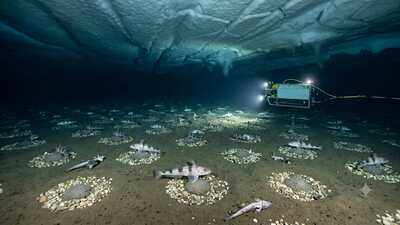
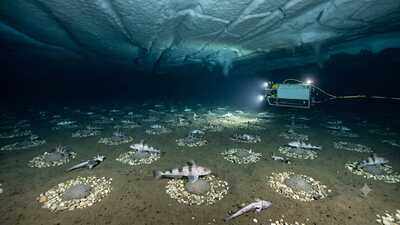
Hidden beneath hundreds of metres of Antarctic ice lies one of the planet’s most extraordinary wildlife spectacles. After drilling through the Filchner Ice Shelf, scientists deployed an autonomous underwater robot into the dark waters below, where it revealed what can only be described as an underwater city, a sprawling breeding colony covering an area roughly the size of Orlando, Florida. Spread across the seafloor were an estimated 60 million nests, each carefully built and guarded by transparent, antifreeze-blooded Antarctic icefish. Yet this remarkable nursery is also the setting for a relentless struggle for survival, as hungry Weddell seals transform the breeding season into a deadly feeding ground. The discovery is reshaping scientists’ understanding of Antarctica’s hidden ecosystems and their importance to the Southern Ocean.
A robot explored beneath Antarctica’s ice shelf and confirmed a hidden underwater metropolis
The vast breeding colony lies beneath the Filchner Ice Shelf in the southern Weddell Sea, one of the most remote and inaccessible marine environments on Earth.The colony was first identified during a 2021 expedition led by Dr Autun Purser of the Alfred Wegener Institute (AWI), Helmholtz Centre for Polar and Marine Research, using the Ocean Floor Observation and Bathymetry System (OFOBS). The team’s findings revealed an astonishing concentration of nests extending across approximately 240 square kilometres, an area comparable to the size of Orlando. The researchers estimated that the site contains around 60 million active nests, making it the largest fish breeding colony ever discovered.More recently, AWI scientists returned with LASSIE (Low-Altitude Survey System for Icefish), an autonomous underwater vehicle specifically designed to monitor the colony beneath the ice shelf. Operating continuously for 48 hours, LASSIE confirmed that both the colony’s size and nesting density have remained remarkably stable since the original discovery, providing researchers with the first long-term baseline for monitoring this unique ecosystem.
Why these transparent icefish build millions of nests beneath the Antarctic ice
The colony belongs to the blackfin icefish (Neopagetopsis ionah), one of Antarctica’s most unusual fish species.Icefish are famous for lacking haemoglobin, the red protein that carries oxygen in the blood of almost every other vertebrate. As a result, their blood appears almost transparent. They also produce specialised antifreeze glycoproteins that prevent ice crystals from forming inside their bodies, allowing them to survive in seawater that remains below the normal freezing point of fresh water.Each nest is a circular depression measuring roughly 75 centimetres in diameter, cleared of fine sediment to expose small stones that help protect the eggs. Researchers found that a typical nest contains around 1,700 eggs, while an adult fish, usually the male, stands guard until they hatch. Across the colony, nests occur at an average density of about 0.26 nests per square metre, creating an immense network of breeding sites stretching as far as the cameras could see. The study was led by Dr Autun Purser and an international team of researchers from the Alfred Wegener Institute, the University of Bremen, the Max Planck Institute for Marine Microbiology, the University of Basel and other institutions.
A slightly warmer pocket of ocean makes this extraordinary nursery possible
Scientists discovered that the breeding colony exists in a remarkably specific part of the seafloor.Measurements showed that modified Warm Deep Water flowing through the Filchner Trough keeps the seabed beneath the colony up to 2°C warmer than surrounding bottom waters. Although still close to freezing, this subtle temperature difference appears sufficient to create ideal breeding conditions for the icefish.The researchers believe this narrow band of relatively warmer water explains why millions of fish concentrate their nests in one location rather than spreading across the Antarctic seafloor. Without these favourable oceanographic conditions, such an enormous breeding aggregation would probably not exist.
Why Weddell seals turn this breeding ground into a seasonal hunting ground
The underwater city does not remain peaceful for long.Using satellite tracking data collected over many years, researchers found that Weddell seals (Leptonychotes weddellii) repeatedly travel to the breeding colony during the nesting season. The dense concentration of adult fish provides an abundant food source, making the area one of the seals’ most important feeding grounds.Scientists also documented numerous fish carcasses scattered throughout the colony, demonstrating that while millions of icefish gather to reproduce, many become prey before the breeding season ends. This intense predation helps transfer enormous amounts of energy through the Antarctic food web, supporting predators while recycling nutrients back into the surrounding ecosystem.Rather than representing ecological failure, the seasonal “massacre” is a natural process that links one of Earth’s largest fish nurseries with the broader Southern Ocean ecosystem.
Why scientists believe the colony deserves stronger protection
The discovery has transformed scientific understanding of Antarctic marine ecosystems.According to Dr Autun Purser and colleagues, the breeding colony represents not only the largest known fish nesting site on Earth but also one of Antarctica’s most significant concentrations of marine biomass. Because millions of breeding fish gather in a single location each year, researchers argue that the area should receive enhanced conservation protection.The findings have already strengthened proposals for expanding Marine Protected Areas (MPAs) in the Weddell Sea. Long-term monitoring with autonomous systems such as LASSIE will also allow scientists to measure how climate change, ocean warming and shifting sea-ice conditions affect one of the planet’s most extraordinary hidden ecosystems.Far beneath Antarctica’s frozen surface, where sunlight never reaches and temperatures remain near freezing, an underwater city continues to thrive, its millions of carefully guarded nests reminding scientists that some of Earth’s greatest natural wonders remain hidden beneath the ice.