
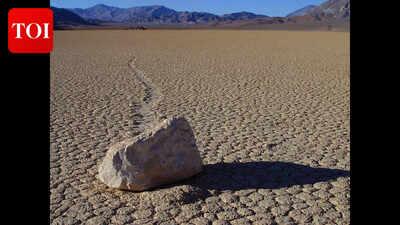
In Death Valley National Park in California, a dry lakebed called Racetrack Playa has long puzzled visitors. For years, this flat area has posed one of nature’s most enduring mysteries. Large boulders, which weigh up to 320 kilograms, have moved across the desert, leaving visible marks in the ground, but no eyewitnesses managed to observe the process for almost a hundred years.The stones’ mysterious movement inspired decades of speculation. Locals once thought magnetic fields were to blame, some suspected pranksters, and others blamed aliens. No matter what the reason behind the phenomenon was, none of the theories adequately explained why those enormous stones moved without any outside force.One hundred years of desert mysteriesThe first recorded mention of the sliding stones and their tracks dates to 1915. Made of dolomite and syenite, the stones slide from the hillsides onto the flat lakebed. Soon after, scientists observed that the stones’ tracks often lined up in parallel patterns. Several stones could slide along parallel lines, making identical turns simultaneously.Early explanations focused on wind. Researchers suggested that rare rains could wet the mud and allow desert winds to move the boulders. However, engineers calculated that winds would need to exceed hurricane force to move the largest 700-pound stones.
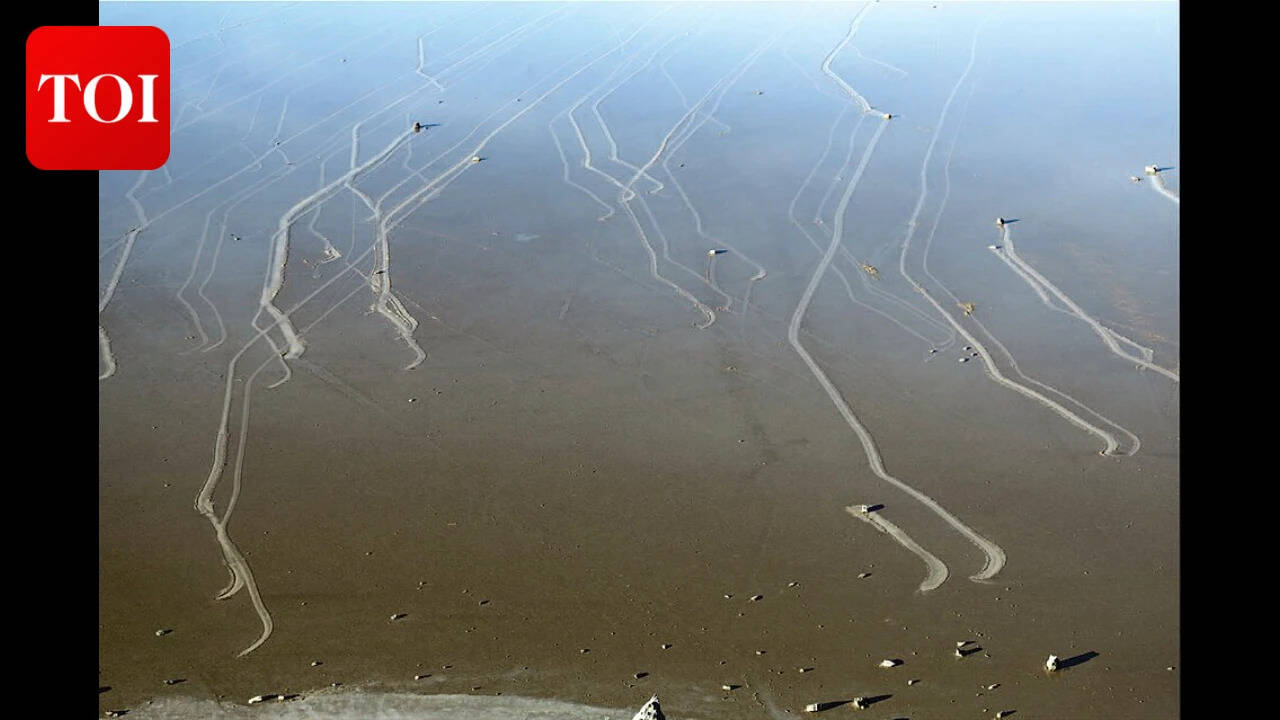
Sailing Stones at Racetrack Playa, Death Valley National Park, California, USA. The image shows the tracks of rocks that were moved by floating ice on a thin water layer. Image Credit: Wikimedia Commons
The kitchen table discoveryThe first breakthrough came from a kitchen-table experiment by Ralph Lorenz, a planetary scientist who became interested in the sailing stones while setting up NASA weather stations in the area, whose harsh conditions make it a useful analogue for Mars.Lorenz froze a small stone inside a bucket of water, creating an ice block with only a small portion of the stone visible. After putting the stone into a tray with sand-filled water and blowing air across it, the stone easily slid and left a clean track in the sand.In that experiment, it became clear that the stones did not need strong winds to move if buoyancy helped lift them. According to a comprehensive article in the Smithsonian Magazine, the stone was likely to be lifted out of the mud by sheets of ice, thus enabling a mild wind to move it along the desert floor.Caught in the actAlthough the theory was convincing, no one had actually observed the rocks moving until 2011, when paleobiologist Richard Norris used an advanced monitoring system. Specifically, he set up a weather station and placed rocks from elsewhere, fitted with GPS sensors that could be triggered by motion.The scientists estimated that they would have to wait at least 10 years before anything happened because the rocks did not move very often. However, in only two years’ time their patience was rewarded. In December 2013, rare winter precipitation left a shallow pool of water on the playa surface.As mentioned in the findings released officially by the National Park Service, the truth of the matter became clear when the team members watched the whole thing happen right before their eyes. During the chilly winter nights, the water in the area froze in extremely thin layers of windowpane ice. As the sun rays started melting the area on mornings, the ice would split into huge pieces of ice. These large chunks of ice moved due to winds blowing with only ten miles per hour and pushed the rocks along the muddy ground with a speed of only several inches per second. Due to being so slow and taking place on such a large scale, it would be easy for an untrained eye not to notice a moving rock even as it passed by them.