
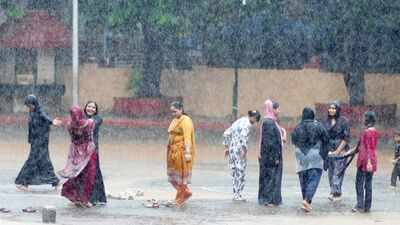
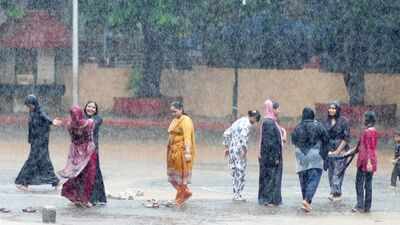
MUMBAI: The ongoing wet spell has pushed rainfall at the IMD’s Santacruz observatory past the 1,000 mm mark within the first seven days of July. Between July 1 and 7, Santacruz recorded 1,017.5 mm of rainfall, already exceeding the 798.3 mm recorded during the entire month of July last year.On Wednesday, the IMD’s Colaba observatory recorded 62.1 mm of rainfall, while Santacruz received 125 mm. The rainfall recorded at Santacruz falls under the very heavy rainfall category (115.6 mm to 204.4 mm), while Colaba recorded rainfall just below the threshold for the heavy rainfall category (64.5 mm to 115.5 mm).Meanwhile, the India Meteorological Department (IMD) upgraded its forecast for Mumbai, Thane and Raigad from a yellow to an orange alert for Wednesday, while Palghar remained under a red alert. On Tuesday, the IMD had forecast that rainfall would ease on Wednesday and had accordingly issued only a yellow alert. However, persistent rain from Tuesday night into Wednesday morning across large parts of the Mumbai Metropolitan Region led the weather bureau to upgrade its warning.Explaining the revised alert, an IMD official said, “Mumbai remained largely dry through the day, but late Tuesday night the radar suddenly picked up intense convective thunderstorm activity over Colaba. Such rapid development is typically triggered by atmospheric instability caused by the interaction of dry air with moisture-laden air masses. While a cloud mass was already present over Palghar and Nashik and we had given heavy rain warning for these areas, the thunderstorm cells developed unexpectedly over Mumbai, resulting in the sudden spell of heavy rainfall.“Meanwhile, fake messages began circulating on social media claiming that an extreme red alert had been issued for Mumbai based on findings from a Japanese satellite about a massive whirlpool developing along the Maharashtra coastline and adjoining interior regions. Weather experts dismissed the claims.“There is no Japanese satellite specifically monitoring Mumbai or Maharashtra. The Japanese Himawari weather satellite can capture cloud cover, but its primary coverage does not extend over Mumbai or Maharashtra. The satellite providing coverage for the region is MOSDAC (Meteorological and Oceanographic Satellite Data Archival Centre) from ISRO, and its latest imagery does not indicate any extreme weather system over the area,” said Akshay Sunil of WeatherEx, Experiqs Pvt. Ltd. He added that rainfall was expected to gradually ease from Thursday morning.Rainfall recorded in Mumbai:Date—-Colaba—–SantacruzJuly 1—-158.2 mm —204.6mmJuly 2—-111.8mm—-101mmJuly 3—90.2mm——109.6mmJuly 4—265.6mm–227.7mmJuly 5—128mm——159.2mmJuly 6—59.2 mm—–90.4mmJuly 7—-62.1mm—-125 mmTotal—-875.1mm——1017.5 mm