


“Did you talk to the doctor?”“Don’t forget your umbrella.”“You see, if I were in your shoes…”Almost every adult has probably heard these kinds of comments from their parents. At times, they may be expressed through text messages, and at other times, they may be offered through unsolicited advice over the telephone. At still other times, these may be expressed through undesired practical assistance.They seem to be unnecessary to the recipient because adulthood is supposed to entail self-sufficiency. Even so, you might wonder why parents keep offering such advice when their children are mature enough to manage on their own.According to psychologists, the explanation has less to do with intrusion and more to do with identity.Helping is simply something that comes naturally for many parentsParenting is unique because it is one role that does not really end at any point in time. People graduate from school. They eventually quit their jobs. They complete projects.Parenting, however, often does not feel as though it has an endpoint.Years of providing, guiding, worrying, planning, and fixing can become such a central part of a parent’s identity that this role does not disappear when a child grows up and moves out.A 2024 report from the Pew Research Center found that parents and their young adult children remain closely connected. Adult children ask for advice from their parents in matters of finances, career decisions, relationships, and even health. This continuous involvement goes on to explain why parents continue to help even without being asked for it.
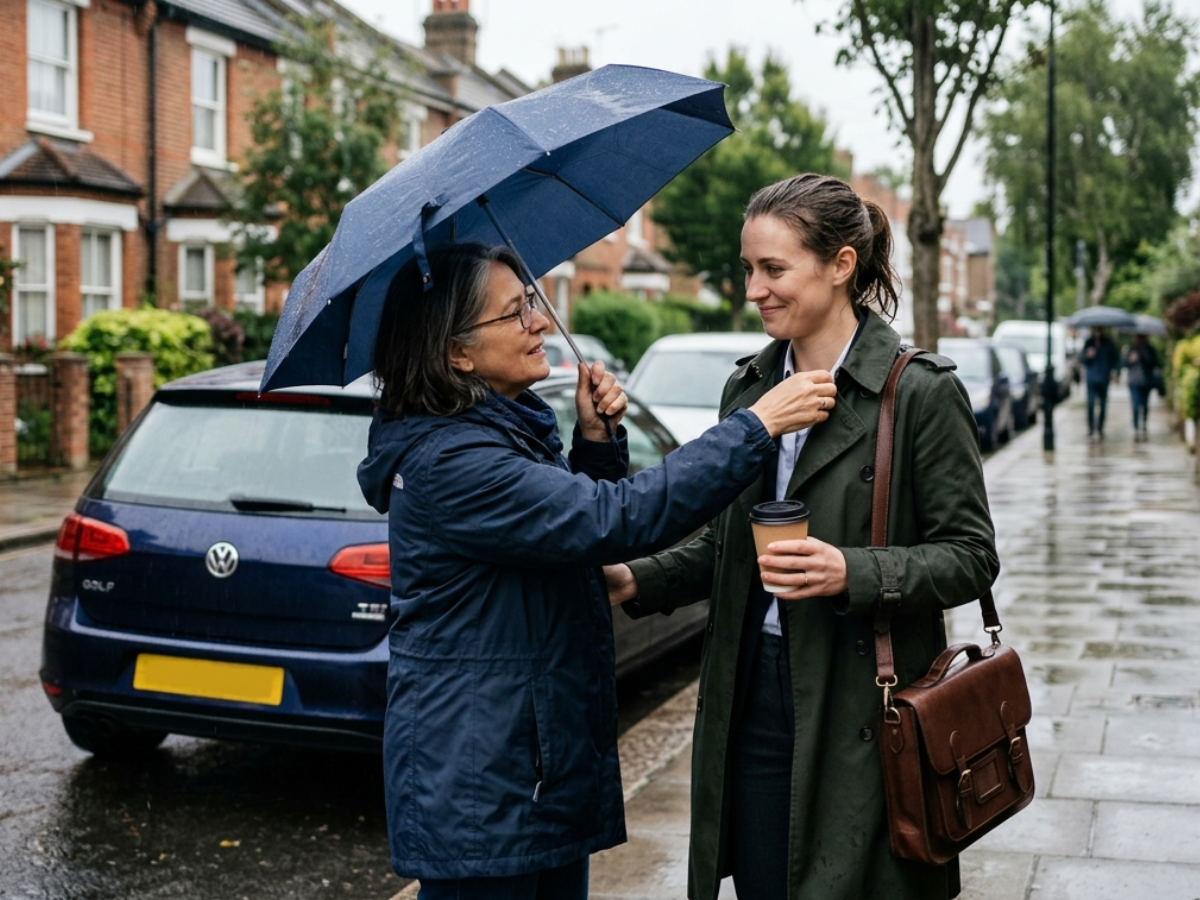
A middle-aged parent is gently offering an umbrella or adjusting their adult child’s collar before they leave for work. Image Credit: Gemini
But the urge to be useful doesn’t just vanish in a secondThe urge to find purpose through taking care of others is something psychologists have been seeing in adults for ages.One influential theory comes from developmental psychologist Erik Erikson, who described this stage as ‘generativity versus stagnation’. In simple terms, it is the need to feel useful. To be valuable because of their experience and hard work.According to Erikson’s theory, supporting adult children may become one such solution to that need. It means being able to give advice, to offer some resources, and to assist in any kind of problem.Adult life has changed, and parents have adapted to that realityThe parent-adult child relationship is not the same as it used to be for previous generations. Adulthood is coming much later for young people today. Buying homes is becoming more and more challenging. Rent is costly. Jobs can be unpredictable and uncertain at times.Consequently, support systems within the family do not end after childhood.According to another Pew Research Center analysis, nearly six in ten parents of adults aged 18 to 34 reported providing financial assistance to their children during the previous year.For many families, helping others is no longer seen as a temporary thing. Instead, it is a part of life.Good intentions: Why they could be causing troubleHowever, knowing why a certain action was undertaken doesn’t necessarily mean that it would be welcomed.While one might see an act as helpful, the other might view it as interfering. A grown-up who tries to take matters into their own hands may find it hard to deal with getting unsolicited advice for every problem. On the other hand, a parent might believe they are being helpful.That’s usually when conflict occurs. The matter is not in the help itself but in the timing of it and in its relevance to the needs of another person.Sometimes it is love in disguiseNot all unsolicited advice is useful; not all parents get the ratio right.However, psychologists believe that most parents who keep offering help are not trying to control their adult children. Rather, their actions are guided by old habits formed over decades of parenting. For years, their job has been to foresee trouble, provide comfort, and offer help whenever needed. Such instincts do not suddenly leave a person just because he or she has become an adult.And the next time you receive an unsolicited piece of advice from your parents via email, perhaps there would be another way to look at the situation.What feels like interference may simply be a parent’s way of holding on to one of the most important roles they have ever had.The other aspect that psychologists emphasise is that this help is usually not one-way. In studies of intergenerational interactions, it has been observed that even when it is the parents who are giving advice and assistance to their children, they, too, receive emotional payoffs in the form of decreased loneliness and greater connectedness. The Pew Research findings also show how adult children provide emotional support and company to their parents, thus creating a subtle reciprocity where “helping” does not become an instrument of control but rather relational maintenance.In addition, findings by the Pew Research Center also highlight the ways in which such support flows both ways through adulthood. Although parents may be the ones who give out tangible forms of assistance, their adult children usually lend a helping hand in terms of providing emotional and social support. Such an interaction is related to lower levels of loneliness felt by parents and a sense of emotional connection with the family members.In the end, this emerging paradigm redefines the very concept of being a family for adulthood. This relationship changes from being an authoritative dependency relationship to a partnership in mutual support. These subtle reminders and constant check-ins are no violation of boundaries but the building blocks of a lifetime of friendship. Through this lens of viewing these acts as merely manifestations of one’s identity, adults gain patience, while parents find meaning, all while sharing a secure, lasting place in a changing world.