
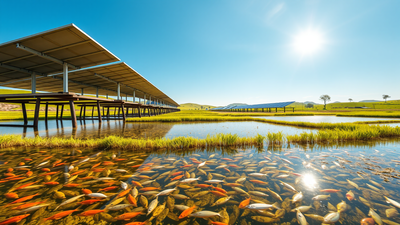
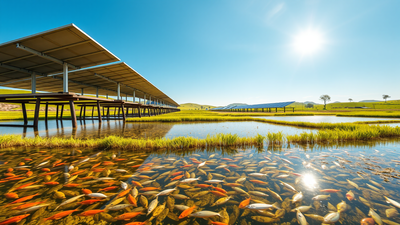
Vietnam’s VinEnergo and Philippine developer SunAsia Energy have agreed to build 422 megawatts peak of solar power spread across three sites in the Philippines, using a design that lifts the panels on steel piles above active fish ponds rather than floating them directly on the water. The approach is intended to let fish farming continue underneath the panels without interruption, addressing a conflict over water use and fishing rights that has slowed similar floating solar projects elsewhere in Southeast Asia. VinEnergo is the energy arm of Vietnam’s Vingroup, and the deal marks the company’s first project in the Philippines.
How solar on stilts differs from floating solar
Conventional floating solar setups typically bolt panels onto plastic pontoons that rest directly on the water’s surface, shading the water beneath and raising concerns about its effect on aquatic life. According to thejoint announcement from VinEnergo and SunAsia Energy, the system used in this project, described as Solar on Stilts, instead drives steel piles into the pond bed and mounts the panels on top, keeping the water column beneath largely open so boats can pass through and fish farming can continue undisturbed. This rigid, pile-supported structure was also chosen with the Philippines location in mind, since the country sits within the typhoon belt, where a fixed structure driven into the seabed can generally withstand rough weather conditions better than a pontoon based system floating on the surface.
Where the three solar plants will be built
The 422 megawatt peak capacity is split across three separate sites. According to solar industry publication PV Tech, the largest plant, at 181 megawatts peak, is planned for Macabebe in Pampanga province north of Manila, while the remaining two plants are located in Negros Occidental in the Visayas region, a 126 megawatt peak site in Sagay and a 115 megawatt peak site in Silay. Together, the three sites will use close to 700,000 solar panels, supported by roughly 62 kilometres of new transmission line built to connect the plants to the grid.
What the companies expect the finished project to deliver
According to the same joint announcement from VinEnergo and SunAsia Energy, the companies expect the completed plants to power around 278,000 households once operational and to cut carbon emissions by more than 460,000 tons annually, a figure the companies compare to the equivalent of planting around 21 million trees. The companies also state that the project is expected to generate more than 1.5 billion dollars in lifetime revenue. The deal was signed on June 26 in Hanoi, with VinEnergo CEO Nguyen Anh Khoa and SunAsia CEO and chairperson Tetchi Capellan signing the agreement, and the plants are targeted to come online in 2027 and 2028.
Why the project was announced during a signing witnessed by officials
The agreement was signed with the Philippines’ Energy Secretary Sharon Garin and Vietnam’s ambassador to Manila, Lai Thai Binh, both present, according to the joint announcement. The signing also took place while the Philippines was hosting the ASEAN Summit, giving the deal a diplomatic dimension alongside its commercial one. Tetchi Capellan described the model as one where food production and clean energy generation can operate together, according to the companies’ own statement, while VinEnergo framed the approach as an extension of its experience in Vietnam protecting local livelihoods while expanding power generation.
Why the Philippines is turning to water for solar capacity
The Philippines is an archipelago of more than 7,000 islands, and much of its available flat land is already used for agriculture, leaving limited space for utility-scale solar development on land alone. This is not SunAsia’s first attempt at combining solar power with existing aquaculture. In 2023, the company and partner BlueLeaf Energy secured rights to develop 1.3 gigawatts of floating solar across Laguna Lake, the country’s largest freshwater lake, in a project covering roughly 1,000 hectares that is rolling out in phases toward 2030. The VinEnergo partnership extends this approach beyond a single large lake and into working fish ponds across two separate provinces.
What still needs to happen before construction begins
As of the signing, construction has not yet started. The agreement marks the beginning of an approximately eighteen-month period covering engineering work, technology selection and contractor arrangements before physical construction is expected to begin, with commissioning targeted for 2027 and 2028. ING advised VinEnergo on the transaction, while SGV and Co. advised SunAsia Energy. Whether the pile-supported design performs as expected at scale across three separate sites, and whether fish farming activity continues smoothly beneath the panels once built, remains to be demonstrated as the project moves from agreement into construction over the coming months.