


The Pradhan Mantri Viksit Bharat Rozgar Yojana (PMVBRY) is a central government scheme designed to encourage formal employment by offering financial incentives to both employers and employees. It provides money to first-time workers entering jobs covered by the Employees’ Provident Fund Organisation (EPFO), while also rewarding companies that expand their workforce and retain new hires.Approved by the Union Cabinet on July 1, 2025, the scheme has a total outlay of Rs 99,446 crore.PMVBRY has two components. Under Part A, eligible first-time employees receive a one-time incentive equivalent to one month’s EPF wage, capped at Rs 15,000.Part B provides incentives to employers who create additional jobs. Eligible employers can receive up to Rs 3,000 per month for each qualifying additional employee. The scheme covers eligible jobs created between August 1, 2025 and July 31, 2027. Manufacturing establishments receive support for four years, compared with two years for employers in other sectors.The government aims to incentivise more than 3.5 crore jobs over two years, including 1.92 crore first-time employees. These are government targets, not independent estimates of jobs expected to be created.The scheme addresses a structural weakness in India’s employment landscape: the limited availability of regular, salaried work.According to the Ministry of Statistics and Programme Implementation’s Periodic Labour Force Survey (PLFS) for 2025, 56.2 per cent of India’s workers are self-employed and another 20.2 per cent are engaged in casual labour. Regular wage or salaried employment accounts for just 23.6 per cent of the workforce.The challenge, therefore, extends beyond reducing unemployment. It is also about expanding access to stable, formal jobs that offer workers social security and a more predictable source of income. PMVBRY is the government’s attempt to encourage that transition.
Where are India’s jobs?
The PLFS Annual Report 2025 estimated that India had 61.6 crore employed people aged 15 and above.
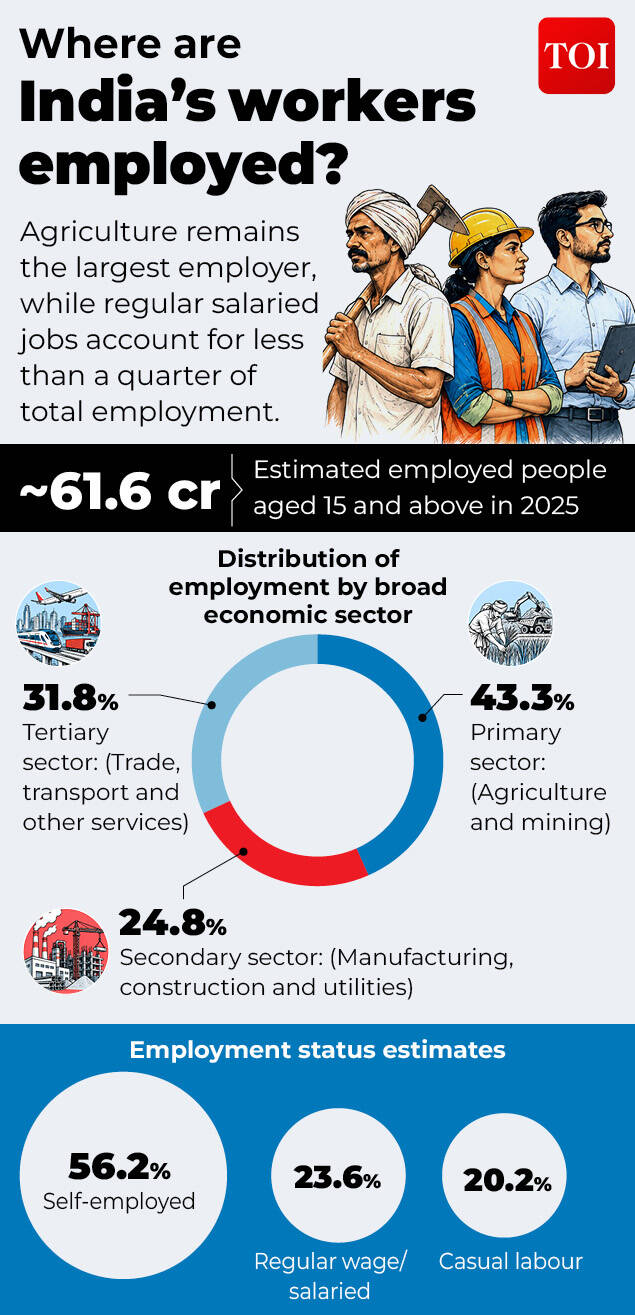
Distribution of India’s workforce
Agriculture remained the largest employer, accounting for 43 per cent of workers. Manufacturing accounted for 12.1 per cent, construction 12 per cent, trade, hotels and restaurants 12.9 per cent, transport, storage and communications 5.8 per cent, and other services 13.1 per cent. Mining and quarrying accounted for 0.3 per cent, while electricity, water and related services made up 0.7 per cent.Grouped broadly, the figures put around 43.3 per cent of workers in the primary sector, including agriculture and mining. Another 24.8 per cent are in the secondary sector, including manufacturing, utilities and construction, and 31.8 per cent in the tertiary sector, including trade, transport and other services. These are employment shares, not shares of GDP or GVA.Employment status adds another dimension. In 2025, 56.2 per cent of workers were self-employed, 23.6 per cent were in regular wage or salaried employment and 20.2 per cent were casual labourers. The unemployment rate for people aged 15 and above was 3.1 per cent under the survey’s usual-status measure, while it was 9.9 per cent among people aged 15 to 29.Year-on-year comparisons need caution. The ministry revised the PLFS sampling design in January 2025 and shifted the annual reference period from July–June to January–December. It advises care when comparing the new series with earlier reports. The reported fall in agriculture’s share from 44.8 per cent in 2024 to 43 per cent in 2025, and the rise in manufacturing from 11.6 per cent to 12.1 per cent, are not conclusive evidence of a structural shift.PMVBRY targets a narrower problem: formal payroll employment recorded through EPFO. It is not an employment guarantee and does not directly address self-employment, casual work or agricultural underemployment.
Why manufacturing is central
PMVBRY covers eligible establishments across sectors but gives manufacturing employers a longer incentive period. Its official guidelines say the scheme is intended to complement the National Manufacturing Mission by promoting new industries and expanding existing ones, particularly in labour-intensive manufacturing.Under the revised national-accounts series with 2022–23 as the base year, manufacturing accounted for 14.7 per cent of GVA in 2022–23 and 2023–24, and 14.8 per cent in provisional estimates for 2025–26, according to the ministry of statistics and programme implementation. The figures are not directly comparable with estimates under the previous base year.The employment picture is distinct. PLFS 2025 put manufacturing’s share of workers at 12.1 per cent. Separately, the Annual Survey of Industries (ASI) results for 2023–24 reported that employment in covered manufacturing establishments rose 5.92 per cent over the previous year, reaching nearly 1.96 crore persons engaged. The ASI covers registered manufacturing establishments within its survey scope, not every manufacturing worker in India.A working paper by Sangeeta Ghosh at the Institute for Studies in Industrial Development, Looking Through Employment Elasticities, found employment elasticities above 0.5 in many of the 55 organised manufacturing industries it studied for the period from the mid-2000s. Employment elasticity measures the relationship between output growth and employment growth. However, the paper also found that more than 40 per cent of new employment generated between 2008 and 2017–18 was contract employment. It focuses on organised manufacturing, so its findings cannot automatically be applied to the whole sector.The four-year incentive window signals the government’s view that manufacturing, particularly labour-intensive segments, can generate sustained employment. The National Manufacturing Mission, announced in the 2025–26 Union Budget, is part of the wider push.
What employers receive, and what startups need to know
Under Part B, employers can receive up to Rs 3,000 a month for each additional employee whose gross wages at joining are up to Rs 1 lakh, subject to the scheme’s conditions. The incentive covers eligible first-time employees and re-joiners. The amount depends on EPF wages:
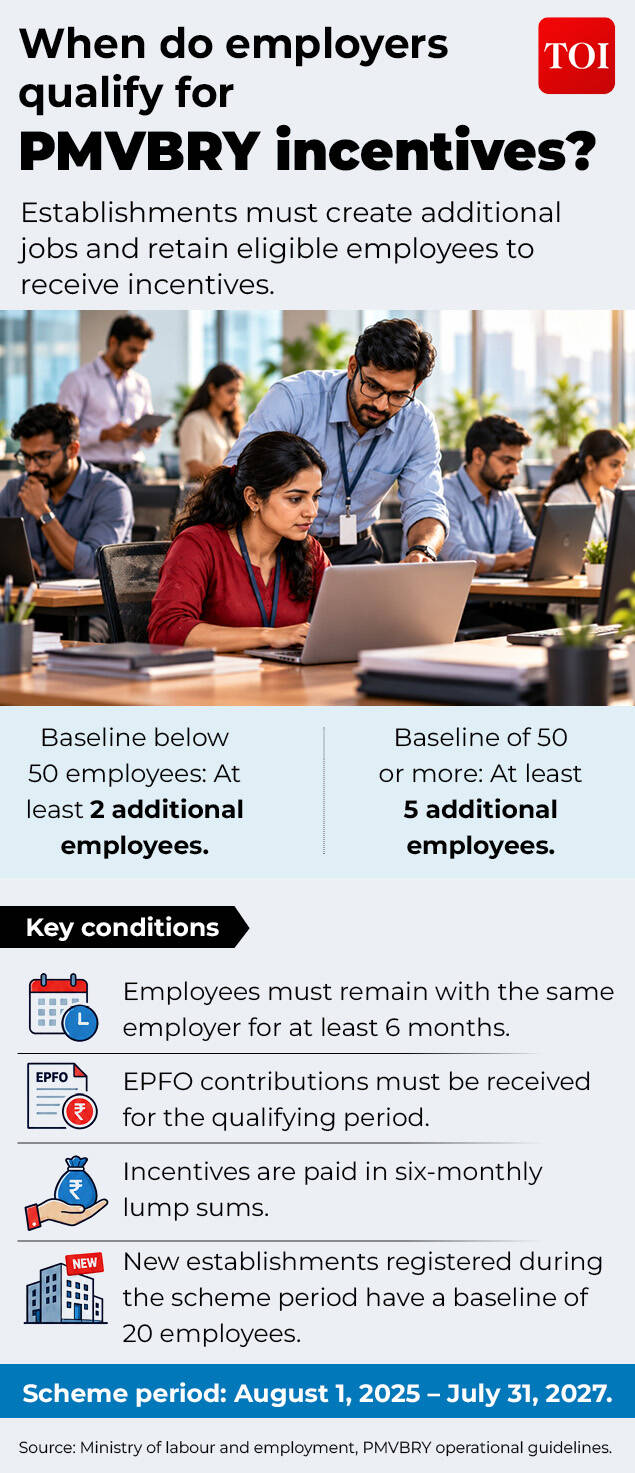
Your eligibility, as an employer, for the scheme.
- For employees earning below Rs 10,000, it is 10 per cent of wages, up to Rs 1,000.
- For those earning more than Rs 10,000 and up to Rs 20,000, it is Rs 2,000.
- For those earning above Rs 20,000, it is Rs 3,000, subject to the gross-wage ceiling.
The incentive is paid in six-monthly lump sums after the relevant six months of employment and electronic challan-cum-return filings. The employee must stay with the same employer for at least six months, with contributions received for that period. Employers must also maintain a minimum net additional-employment threshold. Those with a baseline below 50 employees must add at least two, while those with a baseline of 50 or more must add at least five. Incentives do not accrue for months when the applicable threshold is not met.The baseline is central to eligibility. For existing EPFO-registered employers, it is based on average employment during the relevant period before the scheme. For new establishments registered with EPFO between 1 August 2025 and 31 July 2027, the baseline is fixed at 20 employees. Only qualifying additional jobs above that baseline and beyond the applicable hiring threshold can count towards the incentive.Startups and micro, small and medium enterprises (MSMEs) do not receive a separate incentive rate or automatic exemption from these rules. They can benefit if they are eligible establishments, comply with EPFO filing requirements and create qualifying additional employment. A new establishment with a baseline of 20, for instance, cannot claim the employer incentive merely by hiring a few people while remaining below the baseline and threshold.Consider an eligible employee with EPF wages of Rs 18,000, for whom the monthly incentive would be Rs 2,000. If the employer meets the hiring test and remains eligible for all 24 months, the notional incentive for that employee would be Rs 48,000. For a manufacturing establishment, the incentive can continue for 48 months, making the corresponding maximum Rs 96,000. These are illustrative calculations, not guaranteed payouts.
What first-time employees receive
Part A supports first-time employees earning up to Rs 1 lakh a month with an incentive equivalent to one month’s EPF wage, capped at Rs 15,000. The first instalment, capped at Rs 7,500, is payable after six completed months. The second follows 12 months of service and completion of a financial-literacy programme. A portion of it is placed in a savings instrument or deposit account.
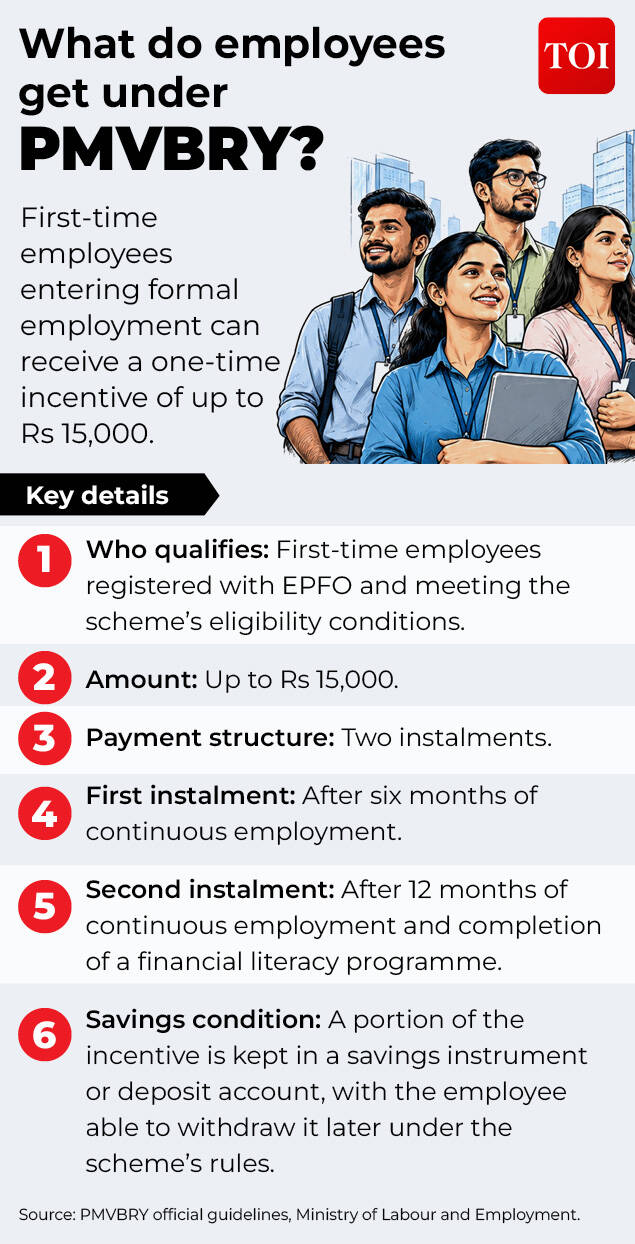
Benefits for first-time employees.
Can the incentives create additional jobs?
The central question surrounding PMVBRY is whether lowering the cost of hiring will persuade companies to create jobs they would not otherwise have offered.Employment subsidies carry an inherent risk: governments may end up paying companies for recruitment that would have happened anyway. There is also the possibility that employers could replace existing workers with eligible employees to qualify for incentives. These are recognised risks in evaluating employment subsidies, not evidence that such practices have occurred under PMVBRY.The government’s initial implementation figures offer an indication of the scheme’s reach. In a backgrounder published on August 1, 2026, the Press Information Bureau said more than 72 lakh first-time employees had joined the formal workforce since August 2025. Nearly 30 per cent of the beneficiaries were women, while more than 15 lakh beneficiaries had received employment-linked incentives.
Share your thoughts in the comments
Be respectful · TOI community guidelines
These are government-reported figures.PMVBRY is an attempt to use public money to make formal hiring more attractive, with manufacturing receiving a longer period of support. But the scale of enrolment and the amount of incentives disbursed will not, by themselves, establish whether the policy has succeeded.The real test will be whether the scheme creates additional jobs, whether those jobs offer stable employment and whether employers retain workers after government support runs out. For India, the challenge is not simply to move more people onto formal payrolls, but to ensure that the jobs they enter are productive, secure and sustainable.