
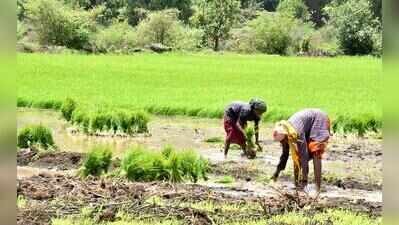
Hyderabad: Delayed monsoon rains have left Telangana’s farm economy waiting, with sowing activity progressing at its slowest pace in years and paddy cultivation emerging as the season’s biggest casualty. Even as farmers in several districts hold back from transplanting their fields, the state’s agricultural landscape is increasingly being shaped by uncertainty over when the rains will arrive.As of July 14, sowing had been completed in 60.22 lakh acres, covering only 45.49% of Telangana’s normal Vanakalam cultivated area of 1.32 crore acres. The figures, compiled under the State Contingency Plan for Vanakalam-2026 prepared by the Telangana govt in association with Professor Jayashankar Telangana Agricultural University (PJTAU) and ICAR-CRIDA, underscore the impact of a delayed and deficient monsoon on farming activity across the state.The greatest concern this season is paddy, Telangana’s principal crop. Against a normal area of 65.95 lakh acres, farmers had taken up cultivation in only 6.38 lakh acres by mid-July — a mere 9.67% of the expected area. While marginally higher than the 5.67 lakh acres recorded during the corresponding period last year, the crop remains far behind its usual schedule.The slow start is particularly significant when viewed against Telangana’s recent agricultural performance. The state recorded total cropped areas of 1.28 crore acres in Vanakalam 2023, 1.29 crore acres in 2024 and 1.38 crore acres in 2025. Paddy acreage had also shown a steady rise, increasing from 65.94 lakh acres in 2023 to 69.89 lakh acres last year.While paddy struggles, cotton has raced ahead to become the dominant crop of the season. Farmers have already sown cotton in 41.52 lakh acres, accounting for 87.57% of its normal coverage of 47.41 lakh acres. Nearly seven out of every 10 acres cultivated so far in Telangana are under cotton. Soybean too has posted robust progress, covering 3.36 lakh acres, or 80.57% of its normal area.Pulses have covered 4.11 lakh acres, representing 63.27% of their normal area, led by red gram cultivation. Maize has reached 3.64 lakh acres, accounting for 58.94% of its normal area, while oilseeds have covered 3.39 lakh acres, or nearly 76% of the normal acreage.Agricultural experts say districts that moved early with cotton, soybean and pulses have fared better, while farmers in paddy-growing regions continue to wait for sustained rainfall before committing to large-scale cultivation, hoping the monsoon will still salvage the kharif season.The monsoon’s uneven spread is reflected sharply in district-wise sowing patterns. Sangareddy leads the state with 81.2% of its normal area already covered, followed by Asifabad (79.8%), Nizamabad (61.5%) and Bhadradri Kothagudem (61.3%).At the other end of the spectrum, Wanaparthy reported sowing in just 7.9% of its normal area. Medak (14.5%), Jagtial (15.6%), Suryapet (15.6%), Medchal Malkajgiri (15.8%) and Bhupalpally (19%) are also among the worst performers.The delayed farm operations mirror the rainfall situation. Telangana had received only 158.4 mm rainfall against a normal 228 mm as of July 14, leaving the state with a rainfall deficit of over 30%. As many as 27 districts were classified as deficit and one as large deficit.