
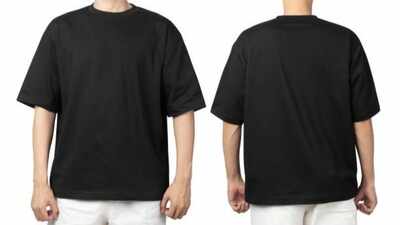
Look around a college campus, an office on casual Friday or a weekend market, and you will spot them: people living in T-shirts that hang well past the hips, sleeves flapping at the elbow. For some it is just style. For others it feels like a soft shield between them and everyone else. Psychologists have long studied what clothes do to the person wearing them, not just to those looking on. While no study says a baggy tee reveals your whole personality, research does offer useful clues about comfort, body image and the space we like to keep around us.
Clothes change how we think and feel
The best-known idea here is “enclothed cognition”, a term coined by psychologists Hajo Adam and Adam Galinsky. In their 2012 research, they proposed that clothes influence the wearer’s psychological processes through two things together: the symbolic meaning of the garment and the physical experience of wearing it. Their experiments used lab coats. Put simply, a garment carries associations, and wearing it nudges the mind towards them. An oversized tee carries associations of relaxation, ease and being off-duty, which may be exactly the mindset some people want to settle into.
The feeling of being “Off display”
Another major framework is objectification theory, proposed by psychologists Barbara Fredrickson and Tomi-Ann Roberts in 1997. It describes how people can learn to view themselves through an observer’s eyes, a habit researchers call self-objectification. A key part of it is body surveillance, which means viewing the body more in terms of how it looks than how it feels. Clothing that demands constant adjusting can keep this monitoring switched on. Loose clothes do the opposite. Nothing needs tugging, tucking or checking, so attention can drift away from the body and back to the day.
What NIH-archived research found
A study archived on the US National Institutes of Health’s PMC database looked at clothing that is painful, distracting or restricting. The researchers found that women and men with higher body surveillance were more likely to report wearing such clothing. The same paper notes that trying on a swimsuit has been shown to raise body shame and state self-objectification in women. The findings do not prove that oversized shirts protect anyone’s mental health, but they show how closely fit, self-monitoring and body shame are tied together.
Fit, coverage and body confidence
Studies on fit show the same pattern. A paper in the journal Body Image, indexed on the NIH’s PubMed database, followed 20 women trying on dresses and concluded that they had a complicated relationship with fit and sizing, and used well-fitting clothes to boost body confidence and cover perceived flaws. Other research reports that lower body image and larger body size are linked with a preference for more coverage. For people who feel self-conscious, then, a roomy tee can be a practical way to feel less exposed.
The sensory side of comfort
Not every choice is emotional. Some of it is simply physical. An NIH-archived paper points out that even in people without pain conditions, friction from clothing and ill-fit can cause discomfort and skin sensitivity. Another experiment on exercising men found that loose clothing allowed free contact between skin, sweat and fabric, while tight clothing limited it. People who are sensitive to seams, tags and tightness may favour loose tees purely because they feel better, with no deeper story behind it.
Personal boundaries and “Distance”
This is where psychology becomes more interpretive. Psychologists often talk about personal space, the invisible bubble people like to keep around themselves, and clothing can work as part of it. A big, relaxed tee can create a sense of buffer, which may appeal to introverts and to people who feel overstimulated in crowded places. It is a reasonable reading, and many therapists describe clothing this way. But the studies above measure comfort, body image and perception. None of them tests whether baggy clothes mean someone wants distance from others.
It is not always about insecurity
It would be wrong to read every oversized tee as a sign of low confidence or withdrawal. Streetwear trends, hot weather, home comfort and plain habit all play a role. Many confident people love the layered, relaxed look. Research on clothing choice also notes that weather, size, fabric and style influence what people choose to wear. The meaning behind a wardrobe differs from person to person, so it is wiser to be curious about your own reasons than to guess at someone else’s.
When it is worth reflecting
If you wear loose clothes mainly because you feel ashamed of your body, it may help to gently ask yourself why. Body image concerns are common and nothing to be embarrassed about. If you simply enjoy the comfort, there is nothing to fix. A healthy wardrobe lets you wear what feels good while leaving room to try something different