
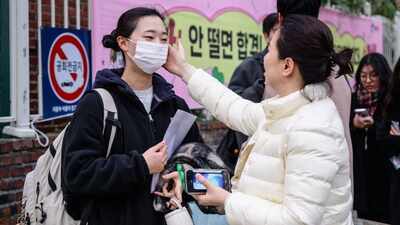
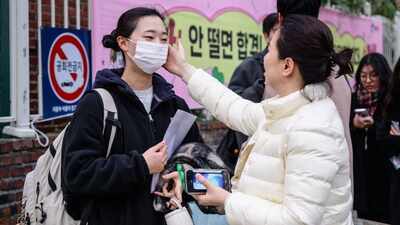
Every year in South Korea, a single day in November transforms the entire country. It’s not a holiday or a national crisis: it’s Suneung day, the day over half a million students face the College Scholastic Ability Test (CSAT), a grueling, all-important exam that takes over nearly every aspect of daily life.Picture this: the morning rush hour stalls, government offices announce a late start, flights are grounded, and the military puts all drills on pause. Buses are told to hush their horns and construction crews down their tools, just for this one day.According to figures released by the Korea Institute for Curriculum and Evaluation, 551,864 candidates have registered for this year’s examination, which will be conducted at 1,312 test centres across 85 examination districts. On November 19, the test is scheduled to begin at 8.40 am and conclude at 5.45 pm for most candidates.
What is Suneung, and why is it such a big deal in South Korea?
In South Korea, Suneung, short for Daehak Suhak Neungnyeok Siheom, isn’t just a college entrance exam. It’s a passage not just for students, but for their families and for the society around them. The results shape which universities students can enter, and those universities, in turn, can determine their entire career trajectory, social network, and even how others see them. Graduating from a top university can open doors to prestigious career paths and build lifelong professional connections. The pressure is, honestly, enormous.Per South China Morning Post, preparation for Suneung starts years before test day. Students pack in long school hours, then head to hagwons (after-school tuition facilities), often staying until late into the night. Some dedicate nearly their whole adolescence to preparing for this single event. For those dissatisfied with their scores, there’s always next year; these repeat takers, known as ‘N students’, make up a steady part of the crowd each November.But Suneung stress doesn’t rest on students’ shoulders alone. Parents pour in support, money, and prayers. On exam morning, parents and younger siblings might hand over sticky rice cakes or sweets (meant to help “stick” the student to their chosen university) and steer clear of “slippery” foods like seaweed soup, out of superstition that knowledge might slip away.
Nearly nine hours at the examination centre: What happens on November 19?
When exam day actually arrives, students face nearly nine straight hours of testing, and that’s just for the standard schedule. It starts at 8:40 a.m. and for most, wraps up at 5:45 p.m., with only short breaks and lunchtime in between. Subjects stretch from Korean, mathematics, and English to Korean history, social sciences, vocational studies, and a chosen foreign language or classical Chinese. It’s a marathon of focus and stamina, and it’s one that tests both knowledge and nerves.
How South Korea prepares
South Korea’s commitment to Suneung is something to behold. The government coordinates with public and private employers to stagger morning working hours, pushing start times to 10 a.m. Subways in Seoul run extra services, more buses ply the roads, and, in case of emergencies, over 600 special vehicles stand ready to whisk students to their centers if they find themselves running late; even police jump in to help. Noise near centers is strictly controlled: no honking, no construction. Even the country’s grand palaces open late, just to keep the city a little quieter.The most unique adjustment? The total grounding of flights during the English listening section. Between 1:05 and 1:40 p.m., nothing takes off nationwide — not commercial airliners, not helicopters, not even drones. About 130 flights get rescheduled. In the skies already, planes must fly above 3,000 meters. Grounded military drills add one more layer to this seamless quiet, all so students can catch every word through their headphones during the most critical 25 minutes of English listening.
A new challenge this year: AI-assisted cheating fears
This year, there’s a new wrinkle: the fear of AI-aided cheating. After a high-profile case where a candidate used smart glasses and a covert camera to beam questions to an AI, then get answers on a concealed phone, exam centers are on high alert. Supervisors now search for hidden devices, scanning for any hint of unfair advantage. The Ministry of Education has tightened security but refused calls to postpone the exam, saying the stakes are too high, and disruption would ripple through society.But Suneung isn’t only about stress and strict silence. Outside the test centers, crowds gather: from parents and siblings to teachers and friends, all cheering the students as they walk in. Some parents wait outside for the entire day, anxiously hoping for good news, while others visit temples and churches, praying quietly through the long hours. Police officers stand by, helping frantic latecomers get to the right classroom. In these little moments, you see a softer side—a nation rallying around its students, everybody playing their small part.
Why Suneung matters
What’s striking about Suneung is the collective spirit it inspires. Even people with no direct ties to a student respect the traffic restrictions, skip noisy work, and keep things low-key. The entire country seems to agree that on this day, everyone’s job is to make sure South Korea’s students get the best shot possible. Nearly every adult in the country once sat for Suneung, remembers the nerves and the hope, and wants to give the next group a fighting chance.For the over half a million students, November 19 is a day they’ve dreamed of, dreaded, and prepared for since they were kids. Their families are right there with them: worrying, praying, and encouraging. And while the stakes are undeniably high, Suneung has become more than a test. It’s a day when South Korea moves as one, just to give its next generation a little extra room to succeed. Even the skies go quiet to help them hear every last question.