
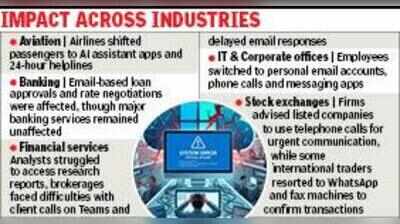
Kolkata: Personal email accounts, telephone calls, helplines and alternative messaging platforms emerged as unlikely saviours for businesses in Kolkata and elsewhere as they struggled to keep operations running because of Microsoft’s global outage. With Outlook inboxes inaccessible and Copilot unavailable, companies fell back on basic communication tools to avoid disruptions to customer services and internal workflows.The impact was particularly visible in aviation, financial services and IT companies, where dependence on Microsoft’s cloud-based services slowed operations. While airlines shifted passengers to helplines and AI-powered assistants, corporate employees resorted to personal email and phone calls. The disruption did not, however, bring all workplace communication to a halt. Some employees said Microsoft Teams continued to function, allowing internal teams to coordinate though communication with clients and people outside their organisations suffered.“Outlook is closed, Copilot is closed, but Teams is running. Important communication isn’t happening because Outlook isn’t there, but there is no problem with work within my own team because that is happening through Teams,” said Kaustav De, a senior AI engineer.“Mail service (Outlook) is completely disrupted. Although Teams is the platform for internal office communications, the impact of the outage is evident with customer communications where Teams is not an option,” said Santanu Chatterjee, a manager at a multinational IT firm.In aviation, airlines adopted different measures to minimise passenger inconvenience. IndiGo warned that its email-based customer support was affected and advised passengers with urgent queries to use its AI-powered virtual assistant, 6E Skai, through its website and mobile app.Akasa Air asked passengers to use its 24-hour Akasa Care Centre and social media channels for immediate assistance. Air India temporarily rerouted customer email traffic to ensure messages continued reaching its support teams. It said flight operations and communication channels remained unaffected. SpiceJet cancelled three flights departing from Delhi, to Pune, Leh and Mumbai, while two others were delayed but aircraft movement was unaffected in Kolkata.Financial services companies also faced difficulties. A senior bank official said: “Email-based approvals, including those for loans and rate negotiations, had been severely affected.”Financial analysts struggled to access daily research reports needed for morning meetings, while brokerage employees faced difficulty conducting calls with institutional and major clients through Teams. IIFL Capital Services alerted clients that responses to emailed queries could be delayed. HDFC Bank, however, reassured customers that its banking services were functioning normally.In corporate offices, employees switched to personal email accounts to ensure important correspondence was not held up. The challenge was particularly acute for companies dealing with overseas clients across different time zones.Kalyan Kar of the Sector V Stakeholders Association said the outage had caused significant operational friction across the IT industry and global enterprises. “Modern organisations rely heavily on cloud infrastructure. The disruption created severe bottlenecks in accessing critical data, authenticating logins and maintaining seamless internal and client-facing communications,” he said, adding that productivity had slowed considerably despite businesses switching to alternative messaging platforms, SMS and phone calls.The outage also provided comic relief, with social media being flooded with memes mocking the technology giant. One suggested that “Microsoft was no longer 365, but 364”; another read: “Dear Microsoft, there’s no rush, take your time, spend time with your family, prioritise your mental health. Happy Friday to all. Sincerely, every corporate employee.”The memes reflected a mix of frustration and relief among employees, some of whom appeared happy about an unexpected pause in routine office work even as businesses scrambled to keep essential services running.