
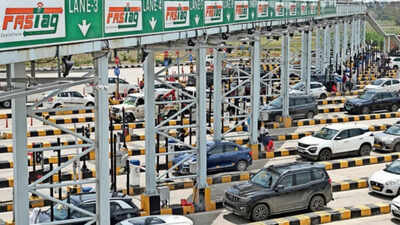
It’s 1.15pm on Wednesday at the Mundka toll plaza in Delhi on the newly opened greenfield Urban Extension Road-II. To the surprise of many drivers, the boom barriers across 16 toll lanes are raised. Vehicles slow down, expecting the barriers to fall for FASTag-based toll deduction. Instead, toll attendants wave them through without stopping. Within minutes, there isn’t a single vehicle waiting at any lane.Most commuters felt they had a free drive across the toll plaza. But they soon got messages —the toll had been deducted from their FASTag wallet.This is because the newly built toll plaza is one of the dozen plazas where Multi-Lane Free Flow (MLFF) — or barrierless tolling — is under testing. The system is scheduled to go live by mid-May, the second such plaza in the country.MLFF is first going live at Choryasi toll plaza on NH-48 between Surat and Bharuch in Gujarat from May 1 (Friday).TOI crossed the Mundka toll plaza on Wednesday, while MLFF testing was on. The taxi crossed the plaza at 60kmph without stopping. An hour later, there was a message of the toll deducted from the FASTag wallet.
“We have been carrying out testing of the system during different periods of the day, including at peak hours, to assess the performance of gadgets and sensors installed at each lane,” said a person involved in the project. “And now, it’s ready to go live this month. People will get the toll deduction message instantly after crossing the plaza.”On The Fast TrackSo far, IHMCL (Indian Highways Management Company Limited) — NHAI’s arm for tolling and highway management — has bid out the contracts for MLFF tolling for 17 toll plazas, including at Gharaunda in Haryana on the Delhi-Amritsar highway, Manoharpura, Shahjahanpur and Daulatpura in Rajasthan on Delhi-Jaipur highway, Nemili in Tamil Nadu, Kesapalli in Andhra Pradesh and Chalakwadi in Maharashtra.To fast-track this rollout, IHMCL has invited bids for 108 toll plazas in bundles under NHAI’s regional offices of Delhi-NCR, Jaipur, Odisha, Gandhinagar and Hyderabad regions.Economic Survey 2025-26 had projected rollout of MLFF tolling across all National Highways that are four-lane or more, and all high-speed corridors, by March 2029. But officials say they are hopeful of achieving the target earlier, considering its benefit for commuters, highway operators and govt, as it eliminates waiting time and congestion at plazas, plugs toll revenue leaks, and makes it unnecessary to build toll booth structures.NHAI chairman Santosh Kumar Yadav said barrierless tolling was now a necessity for the comfort of commuters, “particularly as we build wider highways, economic corridors, and expressways.” “With MLFF tolling, there will be no waiting at toll plazas and no waste of time or fuel. This will help reduce logistics costs,” he added. “In the current tolling system, at least 20 seconds is required for completing the process of vehicle detection, reading the FASTag, completion of transaction and lifting the boom barrier,” said an expert, involved in the MLFF projects. “But, in MLFF, you can cross the tolling point at 80-85kmph. So, we will not need extra lanes to accommodate a large number of vehicles at toll plazas, and there will be no waiting for any vehicle.”Glitches… And SolutionsAt some places, such as in Choryasi and Gharaunda, new overhead gantries have been erected across highways, a little away from existing toll plazas, to install high-powered cameras that can capture registration numbers; advanced radars, scanners and LiDAR (Light Detection and Ranging) systems that can capture details of vehicles; and to complete the process of deducting toll from FASTag wallets automatically. In the case of Mundka, the gantry has been erected above the existing toll lanes, and the gadgets have been installed for seamless tolling.Experts involved in the month-long tests of MLFF at different toll plazas said there have been some instances of cameras not being able to read a car’s number plate — due to defacing, or because the owners had hung ribbons or lemons.“In such cases, the system traces the registration number from the FASTag (if the owner provided it while obtaining the tag). There is no other option to trace the number of such vehicles. But we have rarely seen any truck or heavy commercial vehicle resorting to such practice,” said an expert.As for those who cross plazas without paying — because of a faulty FASTag, having low balance, and for not having a FASTag — the govt has a mechanism in place. In such cases, since the absence of physical barriers makes it difficult to physically catch the vehicles, IHMCL will issue e-notices, with details, to the owners of such vehicles, asking them to clear the due using an online link. If they fail to pay the toll within 72 hours, the pending amount will be doubled, a source said.Failure to pay will result in denial of a no-objection certificate (NOC) at the time of registration renewal, change of ownership, transfer, and while issuing a fitness certificate.Such offenders won’t be able to avail themselves of several other vehicle-related services until they clear all dues.Similarly, for faulty toll deduction, vehicle owners can lodge a complaint on the website within three days, and the deducted amount will be credited to the FASTag wallet after verification of claims.“Since the MLFF system will be rolled out gradually, we expect commuters to be aware that they can’t go scot-free for not paying the user fee. Any subsequent toll plaza on a corridor, even ones that are yet to get an MLFF system, can catch such vehicles,” an official said. WHAT IS MLFF? It’s a barrierless tolling system, where vehicles don’t need to stop or slow down at toll plazas. Toll is automatically collected using FASTag and vehicle number recognition systems. BENEFITS ► No congestion, no waiting► No need to build toll plazas► No revenue leaks, as there is no human interference► Drivers save fuel because there’s no idling