
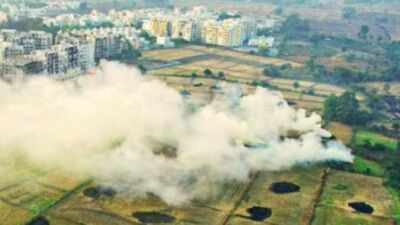
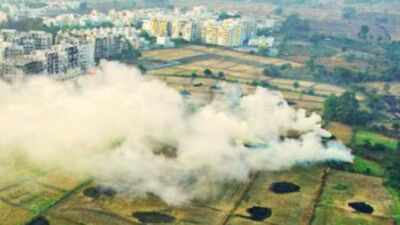
BHOPAL: For years, stubble burning in Punjab and Haryana has been closely linked to the autumn pollution crisis in Delhi-NCR. But as farm fires in the two northern states have fallen sharply, another state is emerging as a significant hotspot — Madhya Pradesh.MP recorded more paddy-residue burning events than Punjab and Haryana in both 2024 and 2025. The state reported 17,067 paddy-residue burning events in 2025, more than three times Punjab’s 5,114.The shift does not necessarily mean that farmers in MP have suddenly begun burning more stubble. Farm-fire numbers in the state have remained relatively steady over the years, but they have become more prominent as the number of fires in Punjab and Haryana has declined.
MP’s wheat-residue fires also rise sharply
Satellite data compiled by the Consortium for Research on Agroecosystem Monitoring and Modeling from Space (CREAMS), part of ICAR-IARI, points to another concern — wheat-residue burning in MP.After declining from 27,759 incidents in 2022 to 13,665 in 2024, wheat-residue fires in the state jumped to 34,429 in 2025 and further to 39,165 in 2026.The 2026 figure accounted for more than half of the 68,259 farm-fire incidents detected across Punjab, Haryana, Uttar Pradesh, Delhi and MP between April 1 and May 31.Vidisha, Siddharthnagar, Hoshangabad, Raisen and Ujjain emerged as some of the hotspots.
Why MP’s farm fires matter
Unlike fires in Punjab and Haryana, which can directly affect Delhi because of wind direction and meteorological conditions, MP’s fires are less likely to contribute significantly to Delhi’s pollution load.The concern, however, is for cities located downwind of the affected areas.With farm fires becoming a larger feature of MP’s agricultural landscape, the question is whether the state could face its own seasonal haze problem — and whether other cities in central, western and eastern India could eventually feel the impact.
More paddy, more residue
MP is a major agricultural state, and its paddy acreage is more than twice that of Punjab. Paddy cultivation has also been expanding, partly because changing weather patterns are making some traditional crops more vulnerable.Erratic rainfall and flooding have affected crops such as urad and soybean in several areas, prompting some farmers to shift towards paddy, which offers higher yields in suitable conditions.But the expansion of paddy also means more crop residue to manage after harvest.
Farmers cite labour, machinery crunch
Farmers say the problem cannot be tackled simply through penalties or awareness campaigns.Labour shortages, rising input costs, unsuitable machinery and the lack of a viable market for crop residue are among the difficulties they face.“In the entire Vidisha district, we mainly cultivate Sharbati variety of wheat. We do not have good irrigation. Only one portion of the district is connected with canal irrigation. Thus, if the residue is not burnt and left in the farm, the soil becomes hard. Labour shortage is also there,” said Vidisha farmer and Kisan Congress district president Vineet Dangi.Farmers also complain that access to subsidised equipment such as harvesters and happy seeders remains limited.“The schemes are there, subsidies for buying required equipment are there, but they are mostly absent on the ground and have not been popularised. If each panchayat is provided with two or three seeder machines that are available for rent, farmers will not go for burning,” Dangi said.
‘Make stubble valuable, farmers won’t burn it’
For farmers, the cost of removing crop residue remains a major deterrent.“Stubble removal increases costs for us. The most practical solution is to create value for the product. If stubble becomes valuable, farmers will do everything possible and will not burn it,” said Vidisha farmer Vishnu Pratap Dangi.This is where the administration is exploring an industrial solution.In Vidisha, authorities have proposed converting crop residue into a resource. Indian Oil Corporation has begun setting up compressed biogas (CBG) plants in the district, with government land being identified for the proposed facilities.The idea is to create a market for crop residue so that farmers have an economic incentive to collect and sell it instead of burning it.
Govt focuses on machinery, harvesters
The agriculture department says improving access to equipment is a key priority this season.MP deputy director for agriculture R K Singh said machinery has been made available to farmers on a large scale.“We have made available equipment to farmers at a large scale. We will also register all big harvester machines coming to the district during the season, and only those having the required equipment to ensure that stubble is not left behind will be allowed to work,” he said.But farmer groups say enforcement alone will not solve the problem.Anil Yadav, state president of the Bharatiya Kisan Union (Tikait), said farmers needed a system that allowed them to dispose of residue directly from their fields.“No farmer wants to create pollution or adversely affect nature. Farmers are the ones who are closest to nature. Govt should make arrangements for procuring stubble from the farm itself,” he said.
One solution may not fit every farm
Farmers also point to differences in soil and local farming conditions as a reason why crop-residue solutions cannot be standardised across the state.In Sheopur, farmer Anil Singh Jaat of Talawada said some subsidised super seeders purchased by farmers were unsuitable for the area’s hard soil.“Technical interventions and solutions should be localised. One solution for everywhere is not possible,” he said.
Can MP avoid Punjab’s stubble problem?
The decline in farm fires in Punjab and Haryana has shown that sustained intervention, access to machinery and economic alternatives can reduce crop-residue burning. But MP faces a different set of agricultural conditions and operates on a much larger geographical scale.With paddy cultivation expanding and wheat-residue fires also rising, the state now faces the challenge of preventing a growing residue problem from turning into a seasonal air-pollution concern.The emerging lesson from Punjab and Haryana is that curbing farm fires requires more than enforcement. For MP, the bigger challenge may be to ensure that farmers have access to affordable machinery, labour and a viable market for the millions of tonnes of crop residue generated every year.