


Winter was once Delhi’s flex. No other Indian metro could quite claim the kind of winter the capital once enjoyed – when the city moved outdoors, cafés spilled into gardens, parks became social spaces and a perfectly ordinary afternoon could turn into a long drive, an impromptu lunch or an evening that nobody was in a hurry to end. Winter was when Delhi was at its most sociable, and perhaps its most romantic.Not anymore though. The city’s most redeeming seasonal quality is increasingly disappearing into a haze of toxic air, with the AQI now determining not just whether people should exercise outdoors or send children to school, but also where they can meet, how long they can stay out and whether an evening together is worth the respiratory risk.Dating and intimacy are being reorganised around indoor spaces. Rakshita Anand, 26, is the family business of garment export. Travelling for work has always been a part of her, and her elder sister’s life, from childhood. Based in Delhi Rakshita’s teenage years were seeing and at times accompanying her elder sister to dates and “arranged matches” to Khan Market or Lodhi Garden. A walk through Dilli Haat was always a good option. Buy an earring, grab some food, chill and talk. But things have changed in her time.“It’s unfair, you know. I am an outdoor person, but my dates are all at cafes and lounges now. As it is a dating prerequisite in our times is to present your best self; at a formal place like a cafe or a lounge, most conversations become very formal. In my sister’s time, a walk down a park or Lodhi Gardens used to loosen people up. There’s something very magical about aimless walking with the sky above. It helps people emotionally open up too. I have seen this many times. But I need at least 3 to 4 dates if not more just to figure out the guy sitting in front of me.”The garden date is giving way to the filtered-air café. The rooftop dinner has shifted to an enclosed restaurant. And the long drive is a thing of the past. An evening spent inside an apartment with an air purifier humming in the background is the new normal.For most couples, the home is the new restaurant, cinema and holiday destination. But staying indoors is not necessarily the same as breathing clean air. Being confined together doesn’t automatically make people more intimate. In a city where even the quality of air inside a restaurant or home can vary dramatically, romance is acquiring an environmental and economic dimension that it never had before.Enter the air purifier. Once an appliance bought largely for health reasons the air purifier has become the new third person in the relationship.
The death of the outdoor date
For a generation that grew up associating Delhi winters with long walks, outdoor brunches, heritage trails, rooftop bars and evenings at India Gate, the change is more than an inconvenience. These were inexpensive ways of spending time together, particularly for younger people who did not necessarily want every date to involve an expensive restaurant or a carefully planned activity.A walk through Lodhi Garden, coffee at an outdoor café, browsing through Khan Market or simply driving around the city offered the possibility of spending time together without having to commit to an elaborate evening. The pleasure was in the spontaneity.But that spontaneity has become increasingly difficult to sustain in our times. An evening out now begins with a check of the AQI, and a sudden deterioration in air quality can mean cancelling plans, changing venues or deciding that staying home is the sensible option.Dating conversations, too, have acquired a new vocabulary – questions about indoor seating, ventilation and whether a restaurant has air purification have become as relevant as its menu, music or ambience.For people using dating apps, the process of meeting someone has changed. Is it better to have first dates around enclosed spaces? Would home dates be better? And does an invitation home carry a different set of expectations when it is no longer simply a matter of convenience but an alternative to going out?An outdoor date used to offer a certain freedom. Two people could walk, talk, explore a neighbourhood and leave when they wanted. But now, the nature of the encounter has changed. The issue is not that indoor dates are inherently less romantic, but that people are losing the freedom to choose the kind of experience they want.
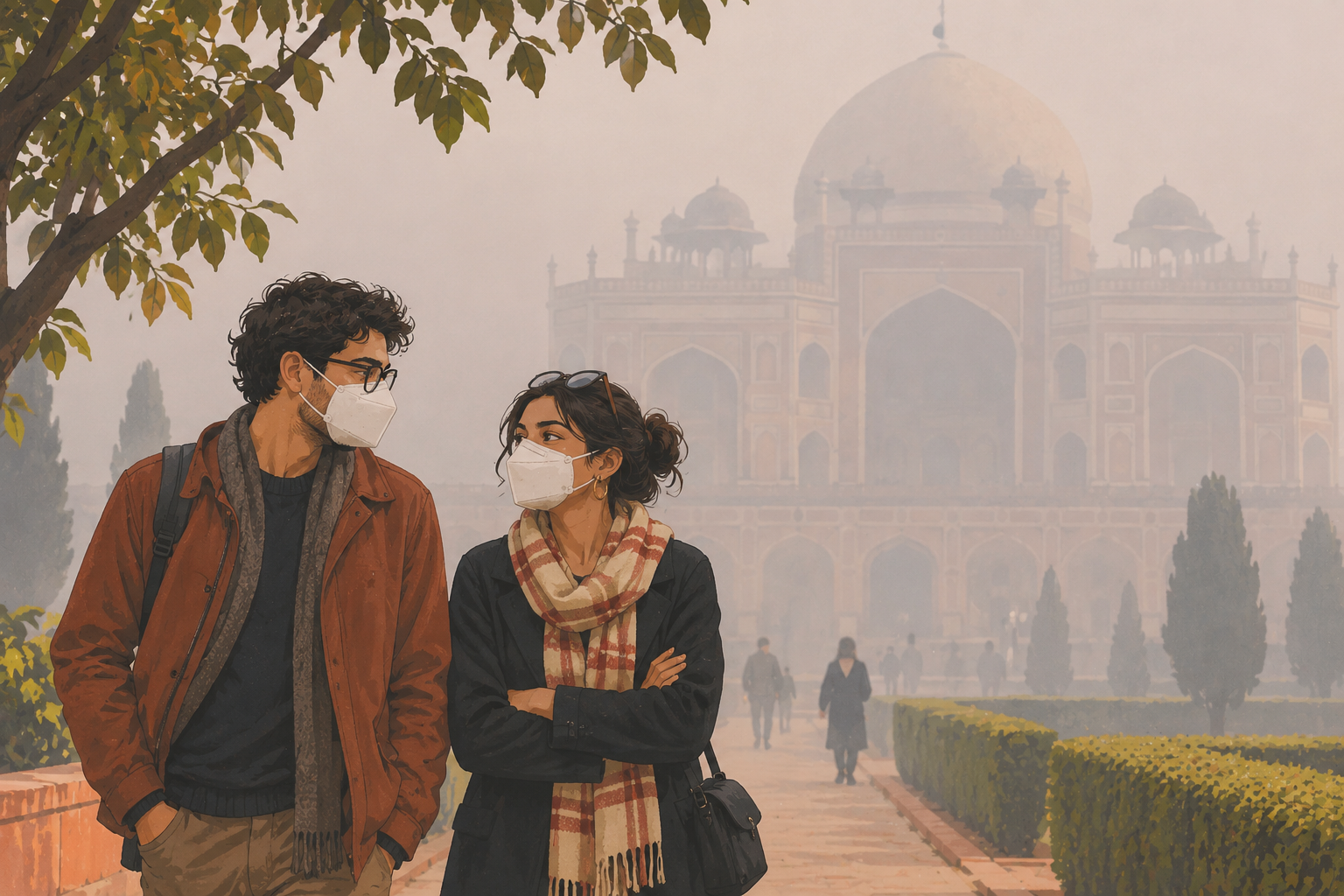
Winter, once Delhi’s flex, is a ‘smog-osphere ‘ for couples
What a meteorological buzzkill!
There is another dimension to this shift: the emotional consequences of spending more time together without necessarily choosing to do so. Couples who once had separate routines, outdoor exercise, social engagements and spontaneous opportunities to meet friends may find themselves spending considerably more time indoors during the worst pollution episodes. While this can create opportunities for companionship, it can also make the home feel smaller and the relationship more demanding.Prolonged indoor confinement is contributing to irritability, boredom and relationship fatigue, particularly among couples who live and work in the same space. There is also the question of whether the loss of shared outdoor experiences affects relationships over time.Novelty and shared discovery are important parts of maintaining romantic connections, and when couples repeatedly fall back on the same indoor routines, the relationship can begin to feel predictable. Being together more often does not necessarily mean connecting better.For people at the beginning of a relationship, the change is more pronounced. Home dates can accelerate familiarity, but they can also blur boundaries and create expectations around physical intimacy before two people have had the opportunity to develop a comfortable rhythm.What happens when the city effectively pushes dating indoors before people are ready to take that step? The simple answer is it compresses the natural stages of getting to know someone. A public place offers a certain neutrality and allows two people to establish comfort, chemistry and trust without expectations. But when the choice is between an expensive indoor venue and someone’s home, the latter can introduce questions of physical intimacy, personal boundaries and safety much earlier than either person may have intended.What should have been a gradual progression towards familiarity begins to feel like a negotiation of intimacy before emotional comfort has had time to develop.
The new geography of privilege
The ability to escape pollution is also becoming a marker of economic privilege. Couples with well-filtered homes, private cars and access to restaurants with good air filtration have more choices than those who depend on public transport, live in cramped homes or cannot afford expensive indoor spaces.A 2021 study by Michael Greenstone, Kenneth Lee and Harshil Sahai, published in the American Economic Association’s Papers & Proceedings, found that winter indoor pollution in Delhi was more than 20 times the WHO-recommended levels across income groups. Even higher-income households had only marginally lower indoor pollution levels, despite greater access to air purifiers.Moving indoors, therefore, does not automatically mean breathing clean air. But it does determine the choices people have. An expensive restaurant may replace a public garden as a preferred date destination, making dating more expensive.A comfortable, well-equipped home offers an alternative that someone living in cramped accommodation may not have. Even travelling to meet someone becomes easier for those with private transport. Clean air is fast becoming a new form of lifestyle privilege, influencing where people meet, socialise and spend time together.
The café is the new garden
Delhi’s café culture has traditionally benefited from winter — with outdoor seating, garden cafés and terraces. But now, customers prefer enclosed seating spaces.For these businesses, indoor air quality is as important as lighting, music and ambience. Restaurants find themselves competing on the quality of the environment they offer.The larger concern, however, is what happens to a city’s social life when its public spaces become difficult to enjoy for several months every year? Parks, gardens, promenades and outdoor cafés allow people to spend time together without having to spend much money. They provide opportunities for friendships, casual encounters, family outings and romantic relationships to develop. With open spaces becoming inaccessible, the city has lost an important part of its social—and emotional—infrastructure.