
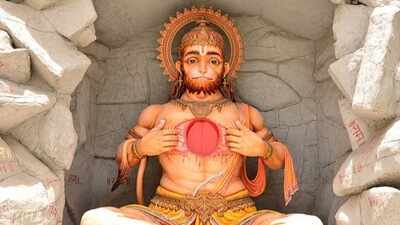
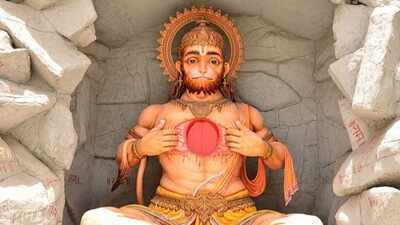
There’s something quietly powerful about the fact that Hanuman, arguably the strongest figure in the Ramayana, someone who could lift entire mountains and leap across an ocean without breaking a sweat, is remembered just as much for his humility as for his power. It would’ve been so easy for someone with that kind of strength to get a little full of himself, to let his abilities do the talking. Instead, across centuries of stories and devotion, Hanuman’s come to represent almost the opposite: this quiet reminder that real strength was never about dominance; it’s about what you choose to do with it. And honestly, that combination, immense power sitting right alongside genuine humility, says a lot about what people have always admired most in him.
He forgot his own power until he actually needed it
Here’s one of the more telling parts of his story: as a child, Hanuman was cursed to forget just how strong and capable he really was, and it wasn’t until Jambavan reminded him, right before that famous leap across the ocean to Lanka, that he remembered who he actually was. What’s interesting isn’t even the strength itself, it’s how he carried himself during all those years of not knowing. No ego, no need to be noticed, just living quietly like anyone else. And even after he found out the truth about his own power, that same grounded, unassuming nature never really went anywhere. Almost like those years of not knowing shaped who he became more than the power itself did.
He served instead of chasing glory
Throughout the Ramayana, Hanuman’s whole thing isn’t conquest, it’s service. He’s not out there fighting for land, recognition, or anything for himself, really. Everything he does, the searching, the fighting, the ocean-crossing, comes purely out of devotion to Rama. And that distinction matters a lot in how he’s remembered, because so many powerful figures in mythology get defined by ambition, while Hanuman gets defined by the exact opposite, this willingness to put everything he has toward someone else’s cause without asking for anything back. That kind of strength, used without any expectation of glory, is probably why his humility never comes across as weakness. It reads more like restraint.
He never took credit, even when he’d clearly earned it
When Hanuman finds Sita in Lanka, delivers Rama’s message, and eventually helps get her rescued, he never once tries to make himself the hero of the story. He keeps redirecting the credit, the devotion, all of it, right back to Rama, treating his own genuinely extraordinary feats like they were simply what devotion asked of him, not something worth celebrating on his own. You see this over and over in his stories, whether it’s carrying an entire mountain to save Lakshmana’s life or single-handedly setting Lanka on fire, his instinct is never to bask in what he just did. It’s always to quietly point back to the one he serves.
His strength only ever showed up when it mattered
Unlike a lot of powerful figures who seem to enjoy showing off what they can do, Hanuman’s strength only really surfaces when it’s genuinely needed, and then it just quietly fades back once the moment’s passed. He’s never flexing to intimidate anyone or prove a point. His power is simply a tool, used for devotion and duty, nothing more. And that framing matters, because it separates strength from ego completely. It suggests real power doesn’t need an audience to mean something. It just needs a reason.
Devotion, not dominance, is really what defines him
At the heart of almost every story about Hanuman is his devotion to Rama, often held up as one of the purest examples of bhakti in Hindu tradition. That kind of devotion naturally produces humility, because genuine devotion means setting your own self-importance aside in favour of something bigger than you. His strength almost becomes secondary to that, more a byproduct of his commitment than the actual defining feature of who he is. Which is probably exactly why devotees, generation after generation, have never related to him as some untouchable, godlike warrior. They relate to him as proof of what real, wholehearted devotion actually looks like in practice.
Why this combination still resonates
Part of why Hanuman remains one of the most widely worshipped figures across India even today comes down to exactly this, the pairing of immense strength with genuine humility. It’s aspirational in a way pure invincibility just isn’t. Most people can’t relate to being unbeatable, but they can relate to the idea of using whatever strength or ability they do have for something bigger than themselves, without needing anyone to notice or clap for it. His story really suggests that humility isn’t the absence of power, it’s what power looks like once it’s guided by devotion instead of ego, and that idea still holds up, well beyond mythology.
Disclaimer:
This article is intended for general informational and cultural purposes only, based on commonly known accounts from the Ramayana and Hindu tradition. Interpretations of scripture and mythology can vary across regions, texts, and belief systems. Readers seeking deeper religious or spiritual guidance are encouraged to consult scholars, priests, or authoritative religious texts.