
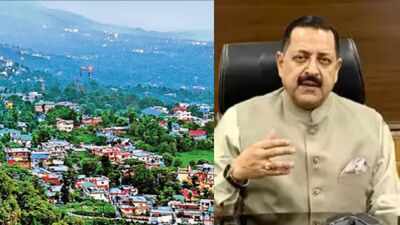
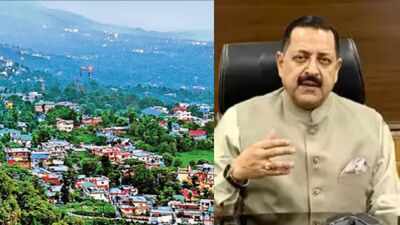
KULLU: The Centre has acknowledged that the Kangra-Chamba-Dharamshala belt in Himachal Pradesh is capable of generating a major earthquake exceeding magnitude 7.0, citing scientific studies by National Geophysical Research Institute and other institutions.Union minister of state (independent charge) for science & technology and earth sciences Jitendra Singh made the statement in the Lok Sabha on Wednesday in response to a query by Hamirpur MP Anurag Thakur. He sought details on recent spurt in seismic activity and govt’s preparedness for a major quake.While Thakur referred to 18 temblors during June, the govt clarified that the National Centre for Seismology (NCS) officially recorded 16 earthquakes in the KangraChamba region that month. Of these, 12 measured between magnitude 2.0 and 2.9, three ranged between 3.0 and 3.9 and one was between 5.0 and 5.9. No quakes in the 4.0–4.9 range were recorded .Pointing out that the region falls under Seismic Zone V, the country’s highest earthquake hazard category, the minister said that active tectonic processes operating beneath the Himalayas give the belt the potential for a massive earthquake.Seven seismic stations in Himachal Pradesh: CentreThe 1905 Kangra earthquake, estimated at magnitude 7.8, claimed nearly 20,000 lives and remains one of the deadliest in India’s history.Addressing monitoring capabilities, the minister said real-time tracking has been strengthened through the National Seismological Network (NSN), which currently operates 172 round-theclock seismic stations nationwide.As many as seven of these are in Himachal Pradesh, located at Shimla, Dharamshala, Tissa, Sundernagar, Kalpa, Bhakra and Pong Dam, feeding real-time data to the NCS 24×7 Earthquake Monitoring Centre.On disaster preparedness, the govt said the National Disaster Management Authority (NDMA) routinely conducts mock drills, trains first responders and enforces disaster management plans alongside state authorities.The Centre added that advisories have been issued to implement seismic design codes under the National Building Code and Model Building Bylaws, though enforcement rests with state govts and urban local bodies.The ministry highlighted its ongoing focus on risk assessment, capacity building, retrofitting vulnerable lifeline buildings and community awareness.However, the reply did not mention any new seismic microzonation studies or plans for a dedicated earthquake early warning system specifically for the Kangra-Chamba-Dharamshala region.