
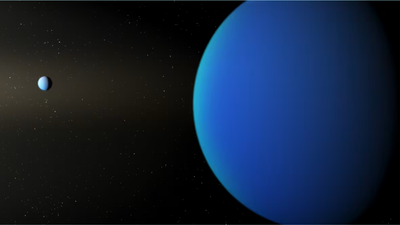
An international team led by the University of Oxford has discovered two of the lowest-density giant planets ever detected, rare ‘super-puff’ worlds with densities lower than candy floss itself. The research, a collaboration between Oxford, the Université Côte d’Azur in France, and the University of Birmingham, was published in Monthly Notices of the Royal Astronomical Society.
What exactly did they find
The two planets, named TOI-791 b and TOI-791 c, orbit an F7-type dwarf star roughly 1,110 light years from Earth, sitting in the southern constellation Volans. Both are roughly the size of Jupiter, but they’re so diffuse that TOI-791 b has a density of just 0.038 grams per cubic centimetre, while TOI-791 c comes in at 0.047 grams per cubic centimetre. For comparison, Jupiter’s average density sits at 1.33 grams per cubic centimetre, somewhere around 28 to 35 times heavier than these two new planets. And candy floss itself typically has a density of about 0.05 grams per cubic centimetre, which means both of these planets are technically lighter than the spun sugar at a carnival stall.
Why scientists are calling this rare
Lead author Dr. George Dransfield, now at the University of Oxford but formerly at Birmingham, said only a handful of these super-puffy planets are known, and finding two of them sharing the same star system is even rarer still. She added that their extremely low densities make them fascinating targets for understanding how planetary systems actually form and evolve over time. And one of her co-authors, Professor Amaury Triaud from the University of Birmingham, who served as the UK Principal Investigator on the project, called the TOI-791 system a unique laboratory for understanding how these strange worlds come to exist in the first place.
How researchers actually pin down a planet’s weight
TOI-791 b and TOI-791 c were first flagged as candidate planets back in 2019 and 2023, spotted by ordinary volunteers taking part in the Planet Hunters TESS citizen-science project, which combs through data from NASA’s Transiting Exoplanet Survey Satellite looking for dips in starlight that hint at a planet passing in front of its star. From there, professional astronomers stepped in to confirm and measure them properly. Part of that work involved using a telescope stationed in Antarctica, which takes advantage of the continent’s long, dark nights to collect data unlike anything available elsewhere on Earth. By combining measurements of each planet’s size with its mass, the team was able to calculate just how spread out, and how astonishingly light, this gas actually is.
How were these planets formed
The study suggests both TOI-791 b and TOI-791 c likely formed from the same disc of gas and dust that surrounded their young star, making them something like siblings born from the same cosmic material. That’s a useful clue for astronomers trying to understand why some giant planets end up dense and compact like Jupiter, while others stay this loosely packed and gassy for billions of years.Dransfield herself described the planets’ densities as comparable to a fresh blob of shaving foam straight out of the can. Whichever comparison sticks, the takeaway is the same: somewhere out in the constellation, there are two enormous planets that weigh next to nothing for their size, and scientists are only just beginning to understand why.