
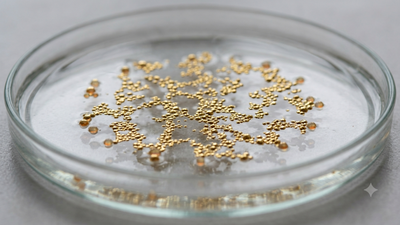
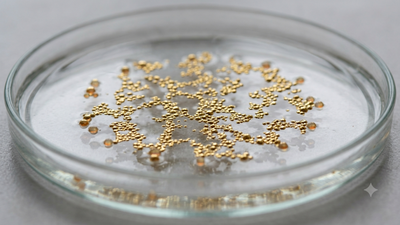
It is reported that scientists at Tohoku University in Japan have found that certain gold nanoparticles can display nearly fluid-like properties that enable them to respond by changing their structures to heat and pressure. The findings may revolutionise the future of biomedical engineering, intelligent surfaces, drug delivery technologies, and microfluidic devices. Reported in the journal Journal of the American Chemical Society, the findings show how small changes in molecular structure can result in big changes in the structure. Gold nanoparticles, intelligent materials, nanotechnology, advanced materials, temperature-sensitive nanoparticles, and self-assembled nanostructures are among the core elements of future materials science.
How Japanese scientists created liquid-like gold nanoparticles
The research group under the supervision of Dr Rina Sato and Professor Kiyoshi Kanie paid attention to gold nanoparticles, which were located at the interface between air and water. The nanoparticles did not remain constant but rather exhibited flexibility, allowing their structure to change when external factors, such as an increase in temperature or mechanical compression, were present.In order to obtain this effect, the researchers used two types of organic molecules for coating of the nanoparticles. It was a thermoresponsive liquid-crystal molecule known as dendron, as well as a linear-chain ligand. As a result of applying these substances, the particles became capable of restructuring.Thus, in a normal situation, the nanoparticles existed in the form of separate “island-like” structures. Nevertheless, when the temperature reached about 40°С, the structures started to connect, forming a network system. Upon pressure, the structures switched from networks to islands, behaving like something living and fluidic.According to Professor Kiyoshi Kanie, “This research highlights how slight changes at the molecular level could result in structural transformations in nanoparticles”.
Why adaptive nanomaterials matter in material science
Materials referred to as adaptive materials are known to react intelligently to their surroundings. Unlike traditional materials, adaptive materials are able to change their physical structure, behaviour, or function based on external conditions like heat, pressure, light, or humidity.This discovery of the gold nanoparticle system is significant due to the changes occurring in physiological temperatures. This makes the discovery very applicable for biomedical purposes, for instance, targeting drug delivery and tumour-responsive treatments. It is expected that future discoveries in this field will see the development of materials that will allow drugs to be released only at particular temperatures within the body.Other fields where the discovery might have an impact include flexible electronics, nanosensors, and microfluidics. Since nanoparticles’ organisation determines the optical, magnetic, and electronic properties, this discovery will provide engineers with yet another tool to develop adaptive devices.These findings also link well with other developments in nanotechnology, where researchers are exploring the possibility of using self-assembling and reconfigurable materials. Previous research on the properties of gold nanoparticles has shown that gold nanoparticles are capable of organising themselves into ordered arrangements and even exhibiting liquid-like behaviour.
The future of smart materials and nanotechnology
Even though this research is still at its initial stage, it is said to be a big step towards the creation of true smart materials. Rather than using static materials that have predetermined properties, scientists suggest that in the future, we will be able to use materials that adapt to their environment all the time.The results obtained by the Japanese scientists point to the possibility that, through nanoscale engineering, we might be able to create self-healing, self-modifying, and shape-changing materials. Such technologies would be crucial for the advancement of various industries, including medicine, robotics, renewable energy, and electronics.What is most interesting about this discovery is the simplicity of the process. Small rearrangements of molecules on a nanoparticle level can transform the whole layer of nanoparticles into something else. Many times, this research reminds us of natural processes because of the complexity generated from microscopic interactions.Further research on responsive nanomaterials might see liquid-like gold nanoparticles as one of the most important discoveries.