


In our twenties, when there is still so much time ahead of us, time that seems ample for a hundred indecisions, for a hundred visions and revisions—we draw a card, and we must decide right then and there whether to keep that card and discard the next, or discard the first card and keep the second. And before we know it, the deck has been played out and the decisions we have just made will shape our lives for decades to come.
Rules of Civility, Amor Towles
Many years ago, I went to my parents expressing my wish to drop a year to prepare for IIT-JEE. It was a particularly stressful time for us financially, and yet, my parents did not think twice before fully supporting me in this risky endeavour. As grateful as I am to my parents, I am probably not unique. As I entered IIT Kharagpur the following year, I met several others who came through very humble backgrounds, students whose parents had pledged their land, or taken an extra job or a loan to provide the best opportunities to their children. For most parents, the choice was self-evident. A good undergraduate degree was a way to move up the social ladder. But lately, people have started questioning the worth of a university education. They contend that the university model is outdated today due to rapid technological advancements. In particular, given that we can now learn everything online using AI, we do not need a university degree. And in any case, the pay gap between those with a degree and those without no longer justifies the ever-rising costs.This view is wrong on three counts. First, it overstates the challenge that awaits us because it ignores the harsh reality of people’s ability to learn on their own. Second, it misses what learning at a university entails. And finally, the pay gap it disputes is still very much there.
On self-learning
First, questions like whether our existing methods of teaching, working, and thinking are suited to the looming changes are hardly new. When computers arrived, apocalyptic prophecies about employment prospects were ubiquitous. Those arguing that the knowledge from a university degree is redundant over a person’s career miss the point that this is how it has always been. A person graduating in 1980 would have barely seen a computer. In 2005, they might not have known how to work without one. A person graduating in 1990 in India would most likely not have known what an email was; in 2020, their entire workflow would have been online. It is tempting to think this time is different. But, as they say, the more things change, the more they stay the same. A good university education teaches us how to learn and not what to learn. Neither AI nor most jobs will teach that. And what is the historical track record of self-learning? Top scholars from the world’s best universities like Stanford and MIT have made knowledge freely available for nearly two decades now. Gilbert Strang, one of the giants of linear algebra (the field that is at the heart of machine learning and AI), has a course on Linear Algebra on YouTube. The first lecture has 4.9 million views. By the last lecture, we have about 200K-250K views. A macroeconomics course drops from 860K to 15K, a deep learning course drops from 518K to 4.7K, you get the drift. In short, the fraction of people who manage to complete a course delivered by some of the best scholars in the world is anywhere from 1 in 20 to 1 in 100. After all, self-discipline and the art of learning have to be acquired. Universities allow the students to learn them the hard way by failing, struggling, and catching up. If being an Eklavya was so easy, Eklavya would not have made it into history in the first place! Recent evidence makes this concrete. David Strömberg and his co-authors tracked some 27,000 Chinese schoolchildren aged 12 to 18, roughly 80% of whom had taken to using models like DeepSeek. Within six months their homework scores had risen by 18%, and the time spent on each assignment had fallen from 64 minutes to 45. So far so good. But at exam time, those same pupils scored 20% below classmates who had never used AI. Most telling of all, the old relationship inverted: homework scores used to predict exam performance, and now the pupils with the best homework are the likeliest to stumble in the exam. A randomised experiment in Turkish classrooms points to the remedy—the damage largely disappears when the AI is set up to give teacher-designed hints rather than answers. In short, the irresistible temptation to fetch an answer immediately—much like scrolling reels to kill time—sounds the death knell of learning. Since much of the payoff in the labour market lies precisely in the harder skills, the relevance of the university is likely to persist.There is another challenge with self-learning. Most academics at good universities have far better information about their students than any online platform and can and do design courses that are better suited to their tastes, abilities, and contexts. For example, at ISB, a course on antitrust policies covers a range of cases from the US and India; a course on Indian National Financial Systems goes deep into the Indian economy through the lens of cutting-edge research in economics. I am yet to come across a place outside the university system where one can learn the foundational principles of these topics without wasting hours on obscure and irrelevant material.
Why do we go to university?
Second, there is a fundamental question: Does one attend a university only to be taught by professors? Here, I cannot do better than ancient Sanskrit wisdom. आचार्यात्पादमादत्ते पादं शिष्यः स्वमेधया। पादं सब्रह्मचारिभ्यः पादं कालक्रमेण च॥You learn a quarter from the teacher, a quarter through your own intellect, a quarter through fellow classmates, and a quarter from the passage of time. The internet at its best replaces only the teacher’s quarter—and even that I doubt; the other three quarters are what the campus is for. If one switches to a self-learning model, would it be so easy to find fellow classmates who are driven by shared interests, passions, and energy to learn? VS Naipaul once wrote, in A Bend in the River, “we make ourselves according to the ideas we have of our possibilities.” A good university reveals to us our possibilities, our challenges and limitations; it exposes us to people better than us and opens our horizons to the opportunities that await us. Skipping university education comes at the cost of denying yourself the opportunity to learn seemingly unrelated and unimportant subjects, the opportunity to engage in intellectually stimulating conversations with your classmates, and above all, the opportunity of discovering yourself. The unstructured time, the enduring friendships and debates, transform us from adolescents to adults, to people. As Oreopoulos and Salvanes show:Schooling not only affects income, but also the degree to which one enjoys work, as well as one’s likelihood of being unemployed. It leads individuals to make better decisions about health, marriage, and parenting. It also improves patience, making individuals more goal-oriented and less likely to engage in risky behavior. Schooling improves trust and social interaction, and may offer substantial consumption value to some students.— Philip Oreopoulos and Kjell G. Salvanes, “Priceless: The Nonpecuniary Benefits of Schooling”Schooling creates adults of the kind we need; the robots who’d maximise productivity can be provided by technology.The obsession with finding the “use case” for every course, every lecture, is rather counterproductive. As Steve Jobs, the patron saint of dropping out, said in his famous Stanford commencement speech:Again, you can’t connect the dots looking forward. You can only connect them looking backwards, so you have to trust that the dots will somehow connect in your future.
The pay gap between having a university degree and not having one
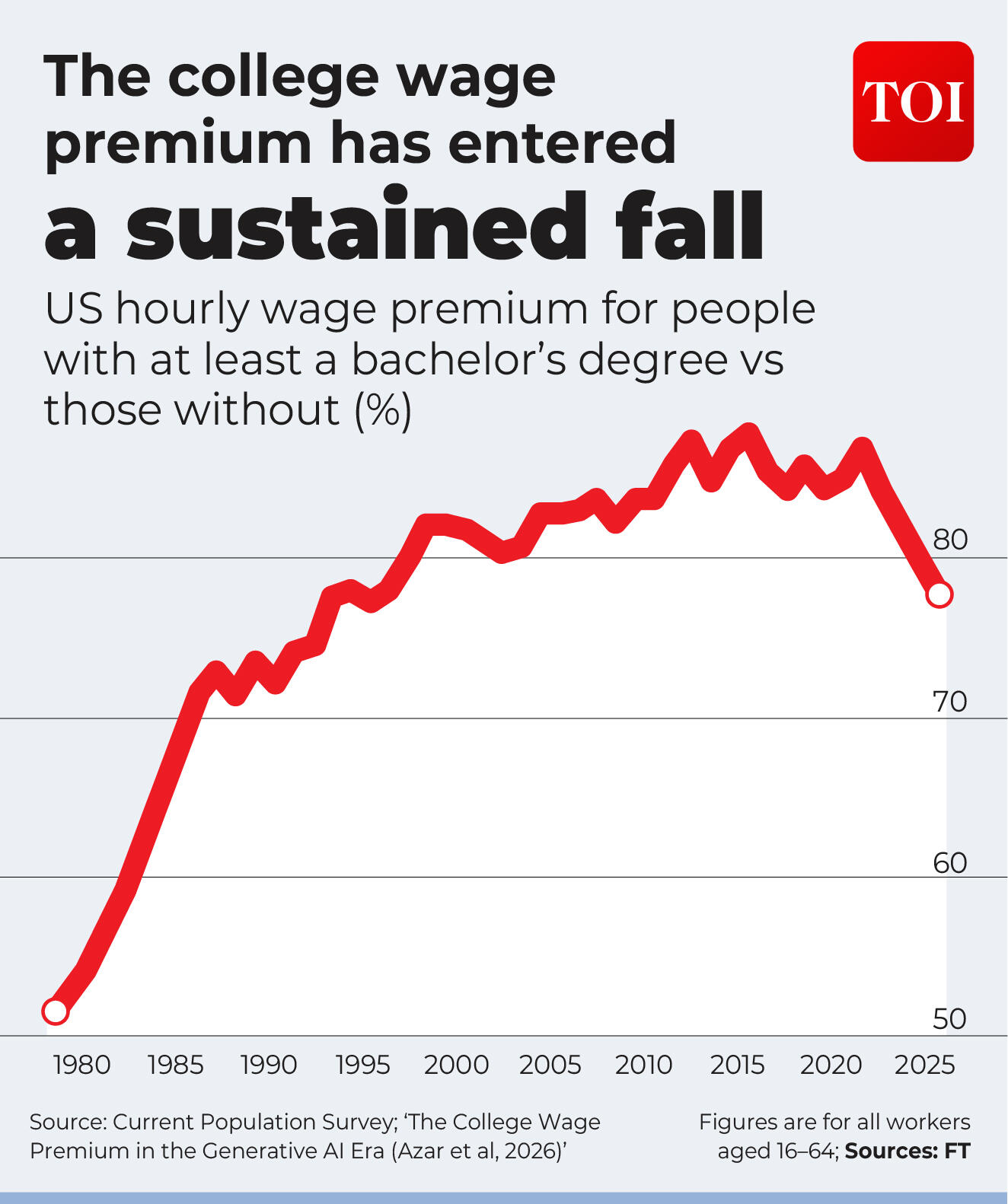
And finally, even if one accepts all these benefits, are the costs—time lost and the tuition paid—worth it? Do graduates get paid significantly more? To slightly paraphrase the apocryphal quote of Mark Twain, the reports of the death of the college premium—the additional salaries that college graduates receive relative to their non-college peers—are greatly exaggerated. For example, in a recent article in the Financial Times, John Burn-Murdoch highlighted how the hourly wage premium for university graduates in the US has begun to slip: from a peak of roughly 85% to below 80% today. Unfortunately, such statistics are not available for India, so we must base the arguments mostly on estimates from the West.
–
Focusing on the decline, though, risks losing the bigger picture: a university education still pays a significant premium, and is likely to keep doing so.Still, I must concede one point. The perception that university education has stopped being useful is shaped by recent studies showing rising graduate unemployment in the US and a collapsing graduate job market in the UK. Over the past few decades, as the belief about the “college-premium” got cemented, universities floated several “soft” undergraduate programmes to earn quick money. It is no surprise that people graduating from such degrees would eventually struggle in the labour market. The median early-career salary (ages 22–27) of computer science graduates in the US is $87,000 (NY Fed data), while it can be as low as $43,000 for some other disciplines. Indeed, the falling average premium may say less about the democratisation of technical knowledge than about the rapid rise of degrees whose worth the labour market is yet to discover. Several empirical studies establish that even taking the costs into account, most undergraduate education in rigorous fields
Share your thoughts in the comments
Be respectful · TOI community guidelines
pays off heavily. The problem is not university education; it is the choice of discipline!Echoing Towles’ protagonist in the opening quote, it may be seductive to embrace a paradigm shift after listening to the confident predictions about the demise of the university model. But it would be rather foolish to play the deck of one’s life, to make choices that will shape your life for decades to come, listening to confident projections about a very uncertain world. It is natural to feel encumbered by the gravity of looming changes in the world that awaits us. We must take comfort in the fact that people have always felt it, in 1960, 1980, 2000, and today. As I was graduating, my PhD advisor David Pearce from New York University gave me a piece of advice that has remained the mantra of my life. One evening in his office, discussing my plans for the years ahead, David said, “Aditya, just take care of the pennies, and the pounds will take care of themselves.” The chances are, if I had not gone to a university, I wouldn’t have learned this, let alone practised it. This was not a part of any curriculum. And that is the beauty of university education: the chance interactions that shape our lives are likely to remain important as long as humans continue to teach humans.