


At a time when layoffs in the IT sector globally grab headlines every few weeks, what’s happening in Indian IT this year? The Indian IT jobs market is going through a shift that is increasingly more structural than cyclical – new jobs are emerging, while some of the old positions and skills are becoming redundant with the advent of artificial intelligence.AI is not just making some jobs obsolete, it is also forcing firms to adapt their business models as the demand for their traditional services faces disruption.In FY27, hiring is expected to remain subdued, while attrition is increasingly being backfilled selectively rather than one-for-one.At the same time, companies are cutting some mid-career and routine roles while continuing to hire specialist freshers and AI-related experts.Employees leaving a company are no longer necessarily being replaced on a one-for-one basis. Companies are allowing some positions to remain vacant, redistributing work, and using internal talent or hiring for a different skill set altogether.Also Read | Trump’s new H-1B visa reality for Indians: Unpredictable costs, tougher odds, greater risks
Layoff trends so far this year
The good news is that the days of large scale layoffs seem to be behind us. The bad news is that targeted exits are continuing, and restructuring is leading to role redundancies across verticals and levels.Neeti Sharma, CEO at TeamLease Digital says, “We are seeing fewer large, headline-grabbing layoffs, but more targeted exits, tighter performance management, thinner middle layers and slower backfilling.”According to her, the top five IT companies reduced their combined headcount by nearly 7,000 in FY26, compared with an addition of around 12,700 in FY25.“At the overall industry level, however, employment still grew by about 1.35 lakh in FY26, only marginally higher than 1.33 lakh in FY25. So I would not call it a return to normal hiring. Revenue is growing, but headcount is growing at a slightly slower pace. The industry is becoming more selective about which skills it hires and which roles it continues to invest in,” she tells TOI.As Anil Ethanur, Co-founder, Xpheno notes: A quick sweep of disclosed layoffs in India and impacted headcounts published shows an easing of layoffs in the tech sector in terms of number of enterprises and volume of headcounts.
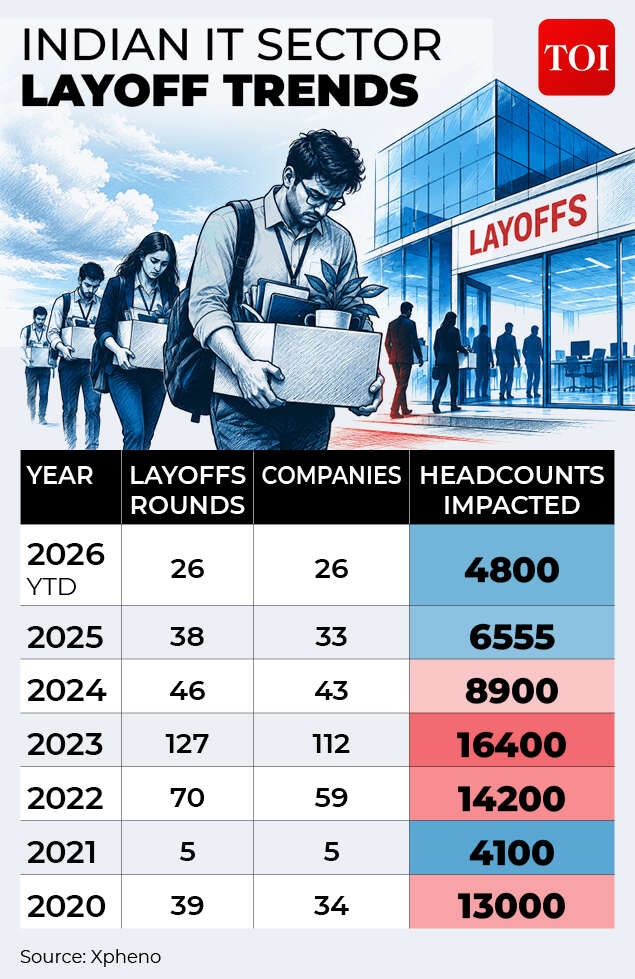
Indian IT Sector Layoff Trends
“Rounds of high-volume blanket layoffs that the tech sector players did, in 2022 and 2023, were necessary to shed excess capacity they’d created during the post-pandemic hiring buoyancy. For most enterprises, layoffs were the quickest fix to shed load and tackle margin pressures in a slow market. Large firms in the tech sector, having already done the necessary downsizing, have also kept headcounts in control with lowered hiring over the last 2-plus years,” Ethanur tells TOI.He also believes that the current context of optimising headcounts is not anymore for just downsizing, but for increasing efficiencies across the enterprise.Performance Improvement Plans (PIPs) with specific triggers, structure interventions and agreed consequences are a better alternative to blanket layoffs, he says.“PIPs are not necessarily an alternative to layoffs, but a tested method to provide a fair chance for employers & employees to jointly work towards improving performance. While the end outcome of a failed PIP could be an exit, it is operationally not a softer substitute to layoffs for sure,” he adds.Experts see the hiring and layoff shift as less of a broad-based contraction and more about aligning workforce capacity with changing client demand, productivity expectations and emerging technology requirements.In fact, Randstad’s Workmonitor study reflects that 95% of employers globally expect their organisations to grow in 2026, even as hiring becomes increasingly focused on specific capabilities.Also Read | The big Indian IT sector shake-up: GCCs are hiring more than traditional tech; who is getting the jobs?
Which jobs are facing the pressure?
The roles facing the greatest pressure are those involving repetitive, rules-based and highly standardised work, particularly where AI can automate or significantly augment existing processes.“This includes some entry-level coding, routine testing, basic application maintenance and repetitive data-processing activities. However, this is not simply a story of technology jobs disappearing; it is a story of the skills required within those jobs changing,” says Milind Shah, Managing Director, Randstad Digital India.Neeti Sharma says that some coordination-heavy middle-management roles are also being redesigned. So it is not just about roles that are diminishing, it is increasingly about the skill content of jobs changing.Traditionally, low complexity roles and engineering output were assigned to entry-level and mid-level talent.In that context, Anil Ethanur says that junior and mid-level engineers are the most exposed and vulnerable to AI’s growing enterprise footprint.“However, it’s not limited to only those layers, as other low complexity engineering functions carried out by the middle and senior level talent pool are also equally exposed,” he says.New generation enterprise AI platforms like Palantir and Anthropic, by design and scope, hold the potential to impact across all 3 – low, mid and high – cognitive layers of an enterprise workforce.“Given the end-to-end multi-function capabilities these platforms offer now, they can impact enterprise roles across functions and levels of expertise. Enterprise grade AI has a potential to impact 40% – 60% of the tech workforce that’s engaged in low & mid cognitive functions. The pace of AI development and maturity in enterprise context can impact and challenge the higher layers of the experienced and specialist pyramids as well in the coming years,” Ethanur adds.
Attrition trends: Where are people going?
What about attrition? Let’s break down the numbers: Voluntary attrition has normalised significantly from the post-pandemic peak, according to TeamLease Digital.At the large IT services companies, current attrition is broadly in the 13–14% range, compared with much higher levels in 2022.“However, there is a big change in where talent is moving. People with AI, cloud, cybersecurity and other specialised skills continue to have mobility, while routine roles and some middle-management layers are facing more restructuring,” says Neeti Sharma.Experts say attrition in technology is increasingly being driven by employee expectations around career growth, flexibility and access to future-relevant skills, alongside organisational restructuring.
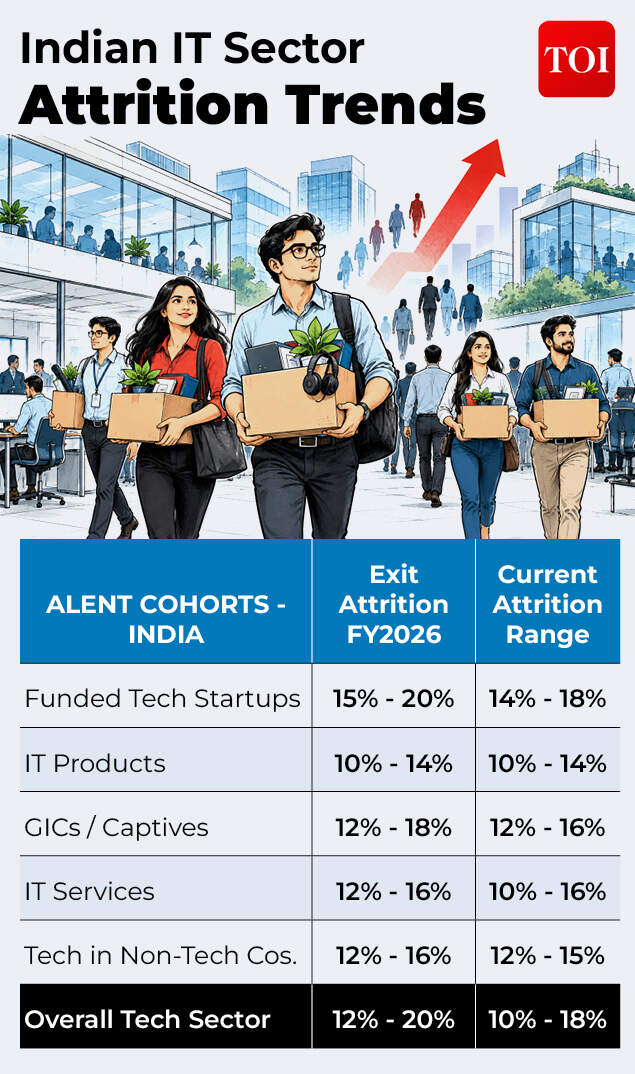
Indian IT Sector Attrition Trends By Cohorts
Randstad’s research highlights the strength of these factors: 40% of IT workers globally say they have left a job because of a lack of flexibility, while 43% have left because of limited career advancement opportunities.“A similar trend is visible in India as well, where employees are increasingly focusing on career advancement opportunities, without which they would consider shifting jobs, even if well-engaged with their current employer,” says Milind Shah.The exit attrition seen in March 2026 has relatively softened in certain cohorts, while remaining high on others.“These variations are largely owing to factors that are highly contextual to the enterprise’s size, client sector & capability mix, financial performance and order book and revenue outlook for the near-future. Macro sector level factors driving attrition has not been a significant trend. The only common factor that’s currently spoken of is AI impact,” Anil Ethanur of Xpheno tells TOI.Not just that, the rapid evolution of technology is making learning and career relevance increasingly important to retention.Randstad Digital’s research found that nearly one in four technology professionals globally have left a job because their employer did not provide adequate upskilling opportunities, while 52% are pursuing training independently.“This suggests that attrition is not simply a function of restructuring or cost optimisation; employees are also actively moving towards organisations that offer stronger career progression, flexibility and opportunities to build future-ready skills,” Milind Shah says.Also Read | Internship the new interview: Companies turning interns into full-time hires; what it means for IT sector jobs
Which skills are in demand?
According to Milind Shah, Managing Director, Randstad Digital India, the current shift is translating into a move from volume-led hiring towards capability-led hiring.“Demand is increasingly concentrated around AI/ML, cloud, data science and analytics, cybersecurity and automation, while organisations are also investing more heavily in reskilling existing employees,” he tells TOI.“Nearly nine in ten Indian employees consider reskilling important, highlighting that the conversation is increasingly shifting from how many people organisations employ to whether their workforce has the skills needed for the next phase of growth,” he adds.Professionals with AI fluency alongside expertise in areas such as cloud, data, cybersecurity, automation and digital engineering will increasingly be in demand.“The ability to combine technical knowledge with problem-solving, domain expertise and client-facing skills will become particularly important. Going forward, continuous learning and reskilling will be central to navigating this transition,” he says.
The bottom line
Fundamentally, the Indian IT sector is moving from headcount-led growth to productivity-led growth.The bottom line is clear: The technology sector is moving towards a more calibrated approach to workforce planning, with organisations becoming more selective about where they add, redeploy and reduce talent.IT services demand is shifting towards people who can work with AI, cloud, cybersecurity, data and digital platforms.“Employees who can combine domain knowledge with AI and digital skills are becoming much more valuable. The bigger risk is not necessarily that a particular role disappears, but that the old version of that job becomes less relevant,” says Neeti Sharma.For IT professionals, the bigger question is increasingly not simply whether jobs are available, but which jobs are being created and which skills employers are willing to pay for.