
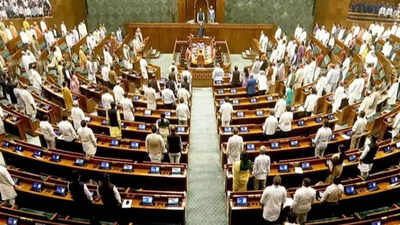
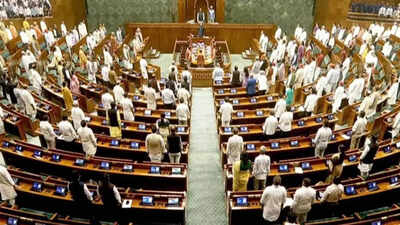
A democracy is a system of government where power belongs to the people. Citizens hold supreme authority. They exercise power either directly or through leaders they choose in fair elections. A democratic country protects human rights, treats people equally, and follows the rule of law. In a direct democracy, people vote on laws and policies themselves through universal referendums that their elected leaders implement. In an indirect democracy like India, people choose elected leaders to make laws and run the government for them. In democratic nations, people enjoy basic rights including freedom of speech, religion, assembly, and a rule of law that applies to every citizen, including those in power. Citizens vote regularly to choose their leaders.The treasury (ruling) benches consist of the political party or coalition that holds the majority in parliament and forms the executive government. They are responsible for formulating policies, introducing legislation, managing finances, executing laws, and maintaining the country’s stability, both internally and externally. They hold the constitutional authority, which in turn gives them the executive power to run the country and make decisions in the interests of the country and its citizens.The opposition consists of the largest party or coalition of parties that are not part of the ruling government. Their main duties include scrutinizing the government’s actions, representing the interests of those who did not vote for the ruling party or coalition, and being ready to take power and run the government if the ruling party fails. Ideally, to effectively deal with the last in the list of duties, the opposition must organise and act like a shadow government. In doing so, they act like a watchdog of the constitution, improve governance through constructive criticism, and prevent the government of the day from becoming authoritarian.Has the Indian opposition fulfilled its traditional duties in the last twelve years? At the cost of ruffling a few feathers, it must be admitted that no informed and committed citizen can answer this in the affirmative. It may be prudent to discuss this in two parts: the period from 2014 to 2024 and the last two years separately.Opposition: 2014 to 2024During this decade, the ruling Bharatiya Janata Party (BJP) won back-to-back strong single-party majorities, something that had not happened in India for 30 years. During this era, the opposition struggled severely to fulfill its traditional duties for various reasons. No single opposition party secured even the minimum 10% of seats required to officially claim the post of the Leader of the Opposition (LOP) in the Lok Sabha. It left the opposition leaderless and structurally diminished in statutory appointments. This resulted in the opposition consigning constructive policy-based criticism to the dustbin. Instead, it frequently resorted to parliamentary walkouts, sloganeering, and disruptions. This allowed, in fact, emboldened the majority government to pass crucial, sweeping legislation with minimal floor debate. The major fallouts of this situation were:
- The opposition had no common ideology or a minimum common programme to offer as an alternative to the government’s goals and objectives. What the ruling party thought and understood in any facet of governance became the order of the day. The only notable exception was the repeal of the Farm Laws in 2021 because of public pressure.
- The opposition was fragmented without a leader of stature who could represent them collectively.
- The national opposition became purely reactive rather than proactive. It focused extensively on anti-government rhetoric rather than presenting a cohesive, forward-looking economic or social alternative to the public.
- A weak opposition in the national parliament resulted in the opposition-ruled states becoming the primary battlegrounds for challenging central authority. This tension severely strained India’s cooperative federalism. Non-BJP states consistently accused the central government of choking their financial resources to undermine them politically, resulting in disputes in GST sharing and borrowing restrictions.
- The role of the Governor—appointed by the Centre—became a massive point of friction. Governments in Tamil Nadu, Kerala, West Bengal, and Telangana accused their respective Governors of acting as “political agents” of the BJP and interfering in state governance.
- Opposition-ruled states actively resisted investigations by central agencies like the Enforcement Directorate (ED) and the Central Bureau of Investigation (CBI), labelling them tools of political vendetta. The credibility of national institutions suffered in this political tug-of-war. Multiple states, including West Bengal, Rajasthan, Punjab, and Chhattisgarh, withdrew their ‘general consent’ to the CBI, making it mandatory for the federal agency to get state permission before investigating cases within their borders
- Political vendetta became the buzzword, particularly when the Chief Ministers of Delhi and Jharkhand were arrested on corruption charges.
- Non-BJP states frequently flat-out refused to implement landmark central policies. States like Kerala and West Bengal openly passed assembly resolutions declaring they would not implement the Citizenship Amendment Act or the National Register of Citizens (NRC).
- Nine non-BJP states fiercely blocked a 2022 central proposal that gave the Union government overriding powers in the central deputation of IAS and IPS officers, arguing it destroyed state administrative autonomy.
- States like Punjab backed massive local farmer agitations, accusing the Centre of bypassing the federal principle by legislating on agriculture—a subject traditionally managed by the states.
Opposition: 2024 to dateThe 2024 General Elections marked a massive shift in Indian parliamentary dynamics. By uniting under the I.N.D.I. alliance, the opposition denied the ruling party a standalone majority. By presenting a united front in elections for many Lok Sabha seats, the opposition succeeded in increasing its numbers. A key development was the appointment of Rahul Gandhi as LOP in June 2024. It restored the opposition’s seat on critical high-level government selection committees (such as the selection of heads of the CBI, Enforcement Directorate, and election bodies).The verdict is still out on whether the opposition is now performing its expected role in a robust democracy. Logically, one will have to assume that the opposition in the parliament is still a work in progress. To some extent, electorally and structurally,they have, in a limited manner, revived the constitutional check on executive power, moving India away from a dominant single-party narrative back to a robust, highly competitive multi-party system. This makes them more effective at representation and government scrutiny. But in the absence of a common ideology and effective leadership, they still rely heavily on parliamentary disruptions to make their points. This not only slows down the country’s legislative productivity but also keeps the dynamic highly adversarial. The recent washout of the August 2026 Monsoon Session led to important bills being pushed through without robust or cooperative debate in the national interest.Most opposition parties see the Congress as a loser and therefore a burden to deal with in their respective states. Allies frequently flag severe coordination and communication gaps under the current Congress leadership structure, giving rise to persistent friction. Formally, Rahul Gandhi holds no executive rank within the coalition. Congress President Mallikarjun Kharge serves as the official national chairperson/convenor of the alliance, leaving Gandhi’s authority over regional chiefs legally and structurally ambiguous. Trust deficits frequently rupture local partnerships. Regional powerhouses, such as the DMK in Tamil Nadu, have openly accused the central Congress leadership of undermining local alliances by allowing elected legislators to defect or form parallel political arrangements without consultation.Unfortunately, even after 2024, the opposition remains far removed from the ‘shadow government’ it is expected to be. The leadership remains weak, as Rahul Gandhi’s limited acceptance is more a matter of convenience than conviction—his status as the natural or undisputed leader of the I.N.D.I. bloc faces persistent resistance within the coalition. The regional and other vested interests of the political parties override their full commitment to the I.N.D.I. alliance. In the end, it is Indian democracy and the nation that pays the price for the lack of a viable and meaningful opposition.(Continued in Part 2: The Treasury Benches- NDA)
Disclaimer: Views expressed above are the author’s own.