
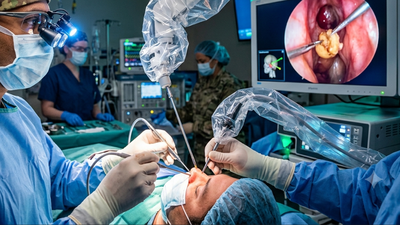
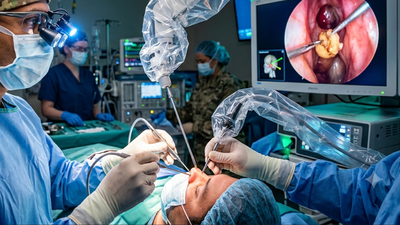
For 15 years, Marine Corps Staff Sergeant Andy Archer lived with pounding headaches that nobody could fully explain. And then his vision started slipping too. That’s when doctors finally found what was causing it all, a tumour roughly the size of a golf ball, sitting right in front of his pituitary gland and pressing straight into his optic nerve.What happened next is the part that’s turning heads. Instead of cracking open his skull, an Indian-American Army surgeon and his colleague pulled the whole thing out through his nose.
The doctor behind the technique
Major Jagatkumar “J.” Patel, an anterior skull base surgeon at Walter Reed National Military Medical Center in Bethesda, teamed up with Army neurosurgeon Lt. Col. Charles Miller to plan out the procedure, according to PTI. The two are both part of the hospital’s specialized skull base team, and once Archer’s MRI came back, they mapped out a minimally invasive route straight through his nasal passage.The scan itself had shown a mass measuring 4.4 centimetres, about the size of a golf ball, parked in a spot that made it a good candidate for this kind of approach. Not every tumour qualifies. Location matters a lot here, and Patel has been clear about that in interviews since.
Why go through the nose at all
It sounds almost too simple to be real, but the logic checks out. Traditional brain tumour removal usually means open surgery, cutting through the skull to reach the site directly. That’s a much bigger ordeal for the patient, longer recovery, more risk, more scarring. Patel explained the shift in thinking to the Pentagon, saying that open surgery just isn’t necessary anymore when a tumour is the right size and in the right location, and going through the nose gives surgeons the best shot at complete removal.The nasal route isn’t exactly easy, though. Archer’s own anatomy added a wrinkle, since he had a severely deviated septum that Patel had to work around, comparing the fix to removing drywall while keeping the support beams intact, per PTI. Patel used an endoscopic camera threaded through the nasal cavity to get a high-definition view of the tumour on a monitor, guiding the extraction without ever opening the skull.
Closing the gap left behind
Once the tumour was out, there was still the matter of sealing things back up. Surgeons reconstructed the skull base using a small graft of tissue taken from Archer’s leg. It’s a detail that sounds minor next to “brain tumour,” but it’s actually a critical step, without a proper seal, there’s a real risk of complications afterward.
How Archer’s doing now
The recovery timeline is what’s really striking people. Just two days after the surgery, Archer was already up and moving, and there were no visible signs he’d gone through major brain surgery at all. His vision, the thing that had tipped doctors off to the tumour in the first place, had already started improving. The only lingering discomfort was the kind of headache and soreness you’d expect, plus some tenderness at the leg site where the graft was taken.Compare that to what a traditional open surgery recovery usually looks like, and it’s not hard to see why this case is getting attention across military medicine circles.