
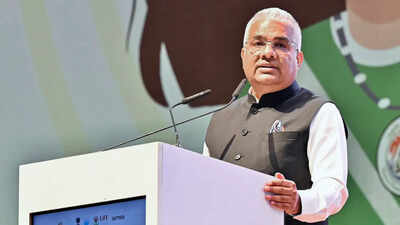
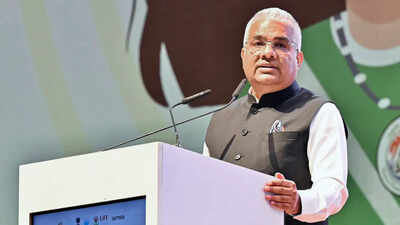
NEW DELHI: India will remain committed to protecting interests of its domestic industry against unilateral trade barriers such as European Union’s carbon border adjustment mechanism (CBAM) and won’t support any move to phase out fossil fuels, keeping in view the country’s energy requirement for its development goals, said Union environment minister Bhupender Yadav on Tuesday. His remarks came as he prepares to lead a team of negotiators to the annual UN climate conference (COP31) in Antalya, Turkiye, next week.Speaking about the country’s overall stand during the climate negotiation, Yadav said India will play a “constructive and bridge-building role”, seeking an outcome that moves from commitments to implementation and support.Turkish presidency of COP31, scheduled from Nov 9 to 20, has invited Prime Minister Narendra Modi for the leaders’ summit of the UN climate conference. It is, however, not yet clear whether Modi will attend the Summit, scheduled for Nov 11-12.On COP31’s proposed “35-by-35” electrification goal that aims to raise electricity’s share of global final energy demand from about 23% today to 35% by 2035, the minister said India will underline that voluntary initiatives under Presidency Action Agenda should remain separate from negotiations and that uniform global targets must respect national circumstances.Though the minister preferred not to comment on the presidency’s global electrification goal, his emphasis on respecting “national circumstances” clearly indicates that India would weigh all options before committing to any such global target which will not be part of the formal negotiation process.As far as CBAM, which entered its operational regime on Jan 1, is concerned, India opposed the proposal from the time it was conceived, arguing that such a unilateral move placed an additional burden on businesses in developing economies due to embedded emissions in their products.CBAM is a tool to put a price, through imposing a border tax, on carbon-intensive goods, like iron and steel, aluminium and cement, that are entering the 27 EU nations.Even all the BRICS nations, including China, Russia, South Africa, Brazil and others, formally opposed it and any other such trade barriers, calling them “unilateral, punitive, discriminatory and protectionist measures”, when they assembled here for the annual summit under India’s chairship in Sept.
Share your thoughts in the comments
Be respectful · TOI community guidelines
Reaffirming that India stands committed to make positive contributions to global efforts to achieve objectives of climate convention and goals of Paris Agreement, Yadav said climate finance will be a key priority, with India seeking a COP31 decision to commence the Climate Finance Work Programme.He also emphasised that finance is an obligation of developed countries under the Paris Agreement and must be “predictable, largely public and concessional”, and should not add to the debt burden.