
Researchers studying a 2,800-year-old princely tomb in southern Siberia have found about 1,000 cannabis seeds alongside preserved human hair containing chemical traces associated with cannabis intoxication. The discovery, reported by Phys.org, ScienceAlert and Discover Magazine, suggests that people buried in the Scythian-era tomb may have used cannabis for its psychoactive effects as part of elaborate funerary rituals involving sacrificed horses and, most likely, human sacrifices.The tomb, known as Tunnug 1, lies in the Republic of Tyva in southern Siberia. An international research team led by archaeologist Gino Caspari of the University of Bern and the Max Planck Institute of Geoanthropology published the findings in the journal Science, describing them as the oldest directly dated archaeological evidence of cannabis being used as an intoxicant. Read more details about this discovery, as per the reports, here:
A royal tomb in the Valley of the Kings
Tunnug 1 is a huge burial mound, or kurgan, measuring roughly 140 metres across. It was built in the early eighth century BCE and is associated with the Arzhan culture at the beginning of the Scythian period, a horse-riding society that spread across the Eurasian steppe.The mound concealed elaborate wooden burial chambers, bronze ornaments, beads, weapons and horse-riding equipment. Its scale and complexity indicate that the people buried there were high-ranking members of Scythian society and that those who built the monument commanded substantial resources.The new research focused on six individuals buried in four wooden structures within the mound. In and around those burials, archaeologists recovered more than 1,000 cannabis seeds, many still intact after nearly three millennia.
Why the seeds mattered
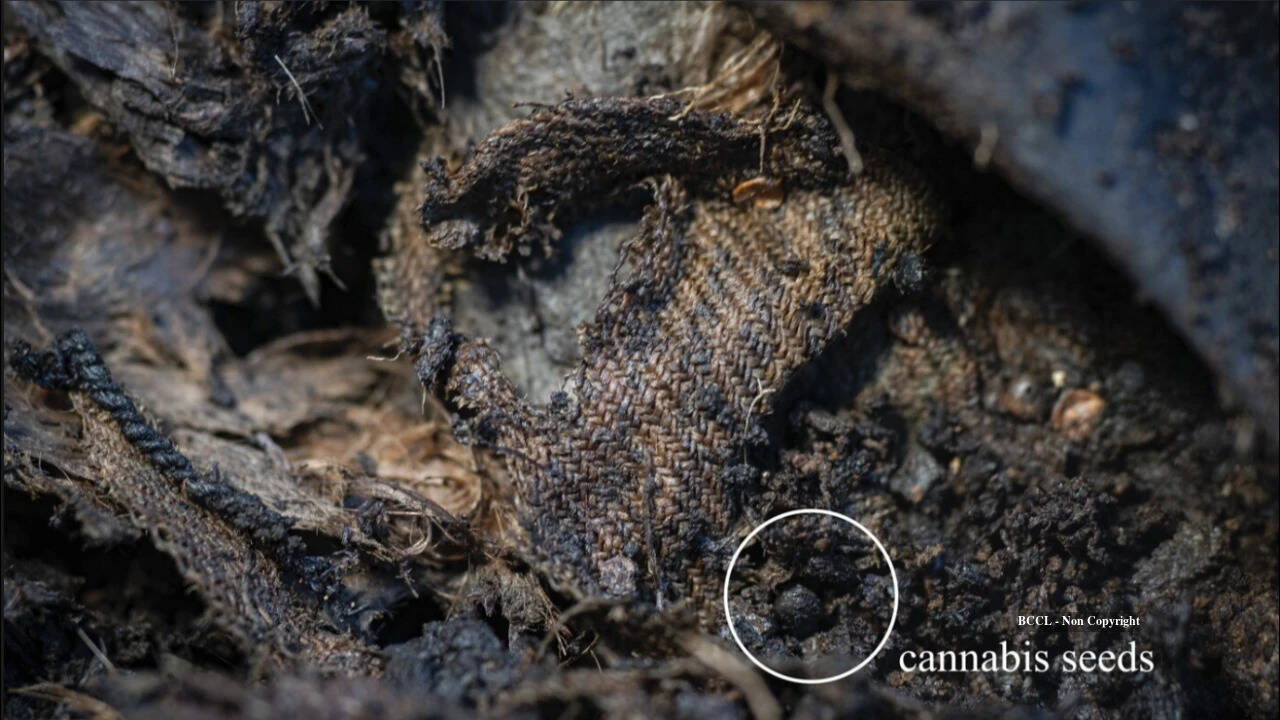
Cannabis seeds found in the excavationPhoto credit: T. Wallace via Phys.org
Cannabis has long been used for many purposes, including producing oil and fibre, as well as for medicine and intoxication. That makes a cache of seeds difficult to interpret on its own, because it does not automatically prove that people used the plant to alter consciousness.To establish the age of the seeds, the researchers radiocarbon-dated six of them. Those results, combined with other dating evidence, indicate that the cannabis was placed in the grave during the early eighth century BCE.The seeds appear to resemble those of wild cannabis rather than modern domesticated varieties. Cannabis grows naturally across temperate Central Asia, so the plants may have been gathered locally rather than cultivated specifically for psychoactive properties.
Chemical evidence in human hair
The decisive evidence came from preserved human hair found in the central burial chamber. Hair can retain molecular traces of substances that circulated through the body while a person was alive, because those compounds become trapped in the keratin structure as hair grows.Using methods including high-resolution mass spectrometry, the researchers analysed several hair samples. They found clear signals consistent with cannabinol, or CBN, a compound that forms when tetrahydrocannabinol, or THC, oxidises over time. They also detected weaker signals whose molecular mass was consistent with THC itself.According to Caspari, the combination of cannabis seeds and molecular traces in hair from the same grave suggests that cannabis was used for its intoxicating properties. The study therefore links the plant remains directly to evidence of consumption, rather than relying on seeds alone.
What researchers still cannot prove
The findings are significant, but they leave important questions unanswered. The researchers cannot reliably determine how much cannabis was consumed, how potent the ancient plants were, or whether the active compounds entered the body through inhalation or ingestion.It is also not possible to say from the evidence whether the cannabis was deliberately cultivated for higher THC content. The seeds likely came from wild plants, and the study does not establish a specific method of consumption.Later archaeological sites in Central Asia have produced cannabinoid residues in vessels and on heated stones, which more clearly point to inhalation. At Tunnug 1, however, the evidence shows exposure to psychoactive cannabis, not the exact way it was used.
Cannabis within a sacrificial ritual
The burial context gives the discovery a striking dimension. The researchers say the tomb contained extensive horse sacrifices, and they believe human sacrifices were likely as well. Earlier work at the site identified the remains of 18 horses arranged on the burial mound, and further excavation has revealed dozens more horse sacrifices along with scattered human bones.Many of the horses were placed with human bones in arrangements that evoke ancient accounts of spectral riders guarding Scythian rulers. The researchers suggest that cannabis may have played a role in calming individuals who were to be included in these rituals, although that interpretation remains a possibility rather than a proven conclusion.The presence of seeds in an elaborate burial also suggests that cannabis held cultural importance. Seeds are not ordinarily included in high-status graves unless they carried symbolic, practical or ritual meaning for the people conducting the ceremony.
What comes next
The team has begun sequencing DNA from the ancient plant remains. Because DNA preservation at the site is excellent, the researchers hope to learn more about whether the cannabis was cultivated and how the plant spread across the ancient world.For now, the study reframes early cannabis use as more than a pharmacological curiosity. The researchers argue that it shows how ancient societies experimented with and ritualised the psychoactive qualities of the botanical world.The discovery at Tunnug 1 does not prove that cannabis was central to every Scythian burial, nor does it reveal the full meaning of the ceremonies held there. But it provides the earliest securely dated direct evidence that people used cannabis for intoxication, and it places that use within one of the most dramatic funerary settings yet studied from the early Scythian world.