
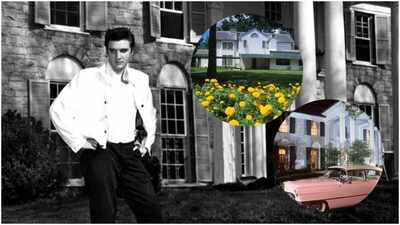
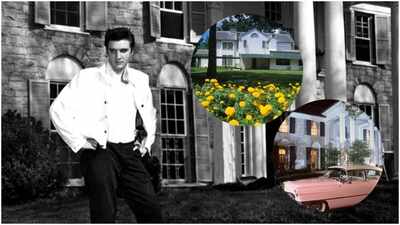
There are celebrity homes, and then there is Graceland. For Elvis Presley, the sprawling Memphis mansion was more than a luxurious house bought at the height of his fame. It became his home base for two decades, a place where he lived with his family, entertained friends and returned between recording sessions, movie projects and tours. Even after his death, the house continued to grow in importance, eventually becoming one of America’s most famous historic homes.
From a 500-acre farm to Elvis Presley’s home
The story of Graceland began long before Elvis arrived. The property was once part of a 500-acre farm owned by the S.C. Toof family and was named after Grace, one of the family members. In 1939, Grace’s niece Ruth Brown Moore and her husband, Dr Thomas Moore, built the mansion.By 1957, however, the property was about to become synonymous with a completely different name.Elvis Presley was only 22 when he purchased Graceland in March 1957 for $102,500, according to Graceland.com. He bought the mansion for himself, his parents and his paternal grandmother. At the time, Elvis was already a huge star. His breakthrough year had brought hit records, television appearances and his first major Hollywood films.The family moved into Graceland in May, although Elvis spent his first night there in June 1957. From then on, the mansion became his constant home base, even as his career took him across the country and around the world.
What was Graceland like when Elvis Presley lived there?
Graceland changed considerably during Elvis’ 20 years in the house. The singer added his own personality to the interiors, creating rooms that today are almost as famous as the mansion itself.One of the best-known spaces is the Jungle Room. Elvis transformed the room with green shag carpeting, carved wooden furniture and a distinctly unusual interior. The room even featured an indoor waterfall, adding to its over-the-top character.Another memorable feature was Elvis’ television room. Inspired by President Lyndon B. Johnson’s habit of watching all three major network news channels, Elvis had multiple televisions installed in the room so he could watch them simultaneously.The mansion also includes the living room, music room, dining room, kitchen, pool room and other private spaces. Together, they offer a picture of how Elvis lived away from the stage.
Graceland and Elvis’ family life
Despite its connection with rock and roll fame, Graceland was also a family home.Elvis’ parents lived there, while his grandmother Minnie Mae Presley was also part of the household. His wife, Priscilla Presley, became closely associated with the property after their marriage in 1967, and their daughter, Lisa Marie Presley, was born in 1968.The estate also became a gathering place for Elvis’ friends and members of his entourage. While Elvis had other residences, Graceland remained the place he returned to.
The final chapter of Elvis Persley’s life
On August 16, 1977, Elvis Presley died at Graceland at the age of 42. His death transformed the mansion from the home of a living superstar into one of the most important places connected with his legacy.Elvis was eventually laid to rest at Graceland’s Meditation Garden, alongside members of his family. The garden has since become one of the most emotional parts of the Graceland experience for visitors.Interestingly, the upstairs area of the mansion, including the room where Elvis died, remains closed to public tours. The decision has helped preserve a private part of the house that has otherwise become a major tourist destination.
How did Graceland become a public attraction?
After Elvis’ demise, keeping the property running proved expensive. According to Graceland, the estate faced a cash-flow problem, with maintenance and taxes costing more than half a million dollars a year.Priscilla Presley and the estate’s executors eventually decided that opening Graceland to the public could help preserve the property and Elvis’ legacy.On June 7, 1982, Graceland opened its doors to visitors. Around 3,000 fans were among the first people to tour the home that Elvis had once called his own.The decision changed Graceland forever. What had once been a private celebrity residence became a destination for Elvis fans from around the world.
Why Graceland is a historic property?
Graceland’s importance eventually extended beyond Elvis fandom. On November 7, 1991, the mansion was placed on the National Register of Historic Places. The National Park Service recognised the property because of Elvis Presley’s major contribution to American music and culture.The National Register documentation notes that Elvis lived at Graceland for much of his career and describes the connection between the singer and the property as particularly significant.That recognition is important because Graceland is not preserved simply because it belonged to a famous person. Its historical value is tied to the enormous cultural impact Elvis had on American music.Over the decades, Graceland has expanded beyond the mansion itself. Visitors can explore Elvis’ cars, costumes, awards, memorabilia and aircraft, including his famous Lisa Marie jet. The surrounding complex has turned the property into an extensive celebration of his career.Reportedly, more than 20 million people have visited since it opened in 1982, with hundreds of thousands of visitors continuing to arrive each year.The mansion itself, however, remains the heart of the experience.
The legacy of Elvis Presley’s Graceland
Elvis Presley passed away nearly five decades ago, but Graceland has ensured that his presence remains remarkably tangible. The furniture, rooms, personal belongings and spaces associated with his family life allow visitors to see something that photographs and recordings cannot quite capture — the physical world in which the King of Rock and Roll lived.From a family mansion on a former farm to a home associated with one of the biggest names in music, Graceland has had an extraordinary journey. Today, it stands not simply as Elvis Presley’s house, but as a piece of American music history, a place where celebrity, family, architecture and legacy all meet.