
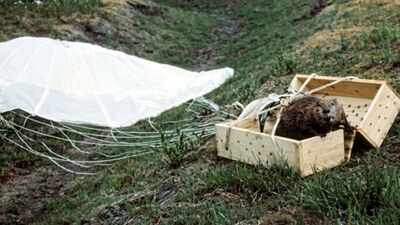
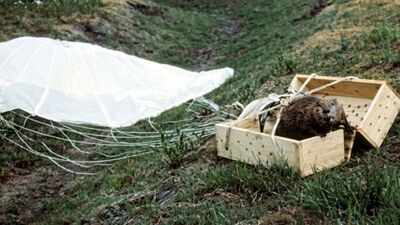
In 1948, Idaho’s Fish and Game Department used an unusual method to move 76 beavers into remote wilderness areas. It dropped them from an aeroplane in boxes suspended beneath parachutes. The operation was intended to solve problems caused by transporting the animals through mountainous, heavily forested country with few roads.Earlier journeys involved trips on horses, mules and trucks, exposing beavers to heat, rough handling and delays. According to Elmo W. Heter’s paper, titled ‘Transplanting Beavers by Airplane and Parachute’, published in the Journal of Wildlife Management, the experiment provided a faster, cheaper, and safer transportation method. Observations made in late 1949 found that the relocated animals had built dams, constructed houses, and stored food.
How did Idaho move beavers to remote release sites
Idaho had been moving beavers from places where they were plentiful and could damage irrigation systems, orchards, and other plantings. In the areas where they were released, the animals usually formed colonies, multiplied, and established fur-bearing populations.Heter also noted their contribution to improving habitats for game, fish and waterfowl, as well as watershed conservation. The department selected release sites through its conservation officers, working with the state fur supervisor and local Forest Service officials. The former transport system was difficult in Idaho’s mountains and remote forests. Beavers were first transported for several days on pack horses or mules before being loaded onto trucks. After reaching the nearest road to the selected site, they had to be carried again on pack animals. The long journeys exposed them to heat and rough handling, while they needed constant cooling and water.
What made the beaver transport boxes suitable for parachute drops
Parachutes were tested with dummy weights, and a 24-foot rayon parachute was chosen from surplus wartime stock. The parachute could carry 140 pounds, while a loaded box containing two beavers weighed between 80 and 105 pounds. The box measured 30 inches long, 16 inches wide, and 12 inches deep, and weighed about 20 pounds. It was made from surfaced lumber and had ventilation holes in its walls.Two sections fitted together like a suitcase. Rope lashings held the box shut during loading and flight, while elastic straps acted as spring hinges. When the parachute landed and its lines slackened, the straps pulled the box open, allowing the beavers to leave. The load kept the box securely closed during its descent.
An old beaver helped test the aerial relocation method
Before carrying out the operation, the team completed successful trials with dummy weights. The team then used an old male beaver named ‘Geronimo’ for repeated test drops at the flying field. After each landing, someone collected him as he scrambled from the box. Heter wrote that Geronimo eventually became resigned to the routine and would crawl back into his box when approached.The team later sent him into the hinterland with three young females. He remained in the box for some time after the females began inspecting their new surroundings. Heter reported that the colony was later well established. The aircraft used for the operation in Idaho was a Travelair, carrying the pilot, a conservation officer and eight crates of beavers.
The relocated beavers built dams and stored food within a year
The drops took place in autumn 1948. The team released 76 beavers, with one casualty. On the first drops, a light lashing broke before the parachute lines could hold the box closed. One beaver pushed its head through the opening, climbed onto the box, and fell when it was about 75 feet above the ground.Observations made late in 1949 showed that the transplanted beavers had built dams, constructed houses, and stored food. Heter estimated that moving four beavers cost about $30, including two boxes, two cargo parachutes and flying time.