
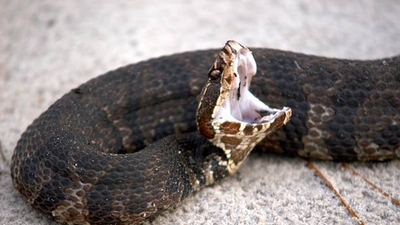
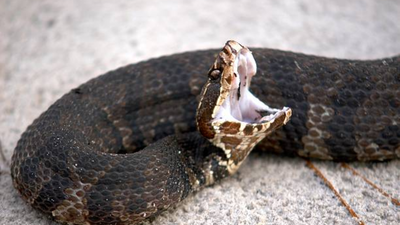
If you live in the southeastern United States, especially near water, there’s a decent chance you’ll eventually spot a cottonmouth, the venomous snake also known as a water moccasin. The thing is, they’re not nearly as aggressive as people think. But you should still know how to recognize one, just in case.The name gives away the biggest identifying feature. The cottonmouth gets its name from the inside of its mouth, which is white or pale colored. When threatened, the snake will gape its mouth wide open to show that stark white interior. From a distance, what stands out is the snake’s overall shape and color.
- Cottonmouths are heavy-bodied snakes, which is one of the key ways to tell them apart from the skinnier nonvenomous water snakes that share the same habitats.
- Adults typically range from 2 to 4 feet long, though some can reach up to 6 feet.
- The body is thick and muscular, with a distinctly short, blunt tail.
- Their color varies depending on age.
- Younger cottonmouths are light brown or tan with darker reddish-brown crossbands and here’s a cool detail: a bright yellow tail tip that they actually use to lure prey.
- As they age, they get progressively darker, eventually looking almost completely black or solid brown by adulthood.
Look at the head and you’ll notice some pretty distinctive features.
- Cottonmouths have a triangular, blocky head that’s noticeably wider than their neck. They’ve also got a dark stripe or “mask” that runs through each eye, kind of like a Zorro mask.
- Some people call it a dark band spanning from the eye to the angle of the jaw.
- Their pupils are vertical and elliptical, not round like the harmless water snakes.
- And here’s something important: they have dark bands behind their eyes with plain upper lips.
One of the most telling features is the facial pit. There’s a deep, sensory pit located between the eye and the nostril on each side of the head. These pits detect infrared radiation—basically, they help the snake sense heat from warm-blooded prey. Harmless water snakes don’t have these pits. Also, if you look at a cottonmouth from directly above, you won’t see its eyes because of an overhanging brow ridge. Water snakes have visible eyes when viewed from above.The bottom line: if you’re near water in the Southeast and you spot a heavy-bodied, dark snake with a distinct head, vertical pupils, and dark bands, keep your distance. Cottonmouths aren’t aggressive and they’re not chasing anyone, despite the myths. But they will defend themselves if you get too close. So just leave them alone, admire from far away, and you’ll both be fine.