
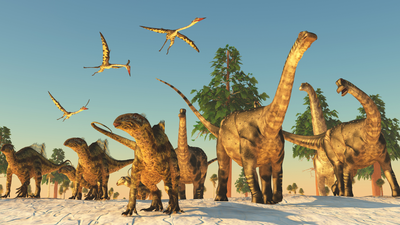
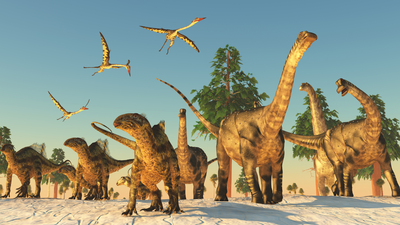
Dinosaurs are often pictured in warm, sun-filled landscapes. But some of them lived and nested much farther toward the poles than scientists once thought.A new study published in Royal Society Open Science has uncovered more than 250 dinosaur eggshell fragments from southern Patagonia, Argentina. The fossils come from the latest Cretaceous Chorrillo Formation, an area that sat at roughly 55-60 degrees south latitude about 69-66 million years ago.The discovery matters because dinosaur eggs are rarely found at such high palaeolatitudes, especially in the Southern Hemisphere.
The eggs belonged probably to giant titanosaurs
Researchers identified the fragments as belonging to Fusioolithus, an egg type probably produced by titanosaurs.Titanosaurs were long-necked, plant-eating sauropods. Some became among the largest land animals known to have existed.The researchers did not find complete eggs or a mother dinosaur sitting beside them. Instead, they studied the eggshell’s microscopic structure. That distinction is important because fossil eggs are often identified through their shell characteristics rather than direct links to a particular dinosaur species.The Patagonia material represents, according to the researchers, the highest palaeolatitude evidence of definitive dinosaur eggshells yet reported from the Southern Hemisphere.
Their eggshells reveal a clever nesting strategy
The biggest clue was hidden in the eggshell itself. The shells were highly porous. Such pores allow gases to move between the developing embryo and its surroundings, but the researchers say the structure also points toward incubation in a humid, buried setting.In other words, these eggs were probably not simply left exposed to sunlight.The evidence instead supports mound-style nests in which eggs were completely covered by nesting material. This would have protected them from the surrounding environment while creating a stable incubation setting.
Rotting vegetation may have become the dinosaurs’ natural incubator
Here is the most fascinating part of the study.If the nests were buried at such a high latitude, sunlight alone may not have provided enough reliable heat. The researchers propose that microorganisms breaking down organic material in the nest generated heat.It is a strategy that has a modern parallel. Some birds called megapodes bury their eggs in mounds of vegetation and rely heavily on heat produced during decomposition.Earlier research on titanosaur nesting has also suggested that these dinosaurs used environmental heat while their eggs were buried.So the dinosaur nest may have worked less like an exposed bird nest and more like a carefully constructed natural incubator.
Why this discovery changes the picture of dinosaur life
The finding does not mean all dinosaurs could live comfortably in polar climates. Nor does it prove that titanosaurs were warm-blooded in the modern sense.What it does show is more specific and more interesting: at least some titanosaurs could reproduce successfully in environments far from the warmer regions usually associated with dinosaur life.The discovery also adds to evidence that titanosaurs were remarkably flexible in their nesting behaviour. Other Patagonian sites have preserved enormous concentrations of titanosaur eggs and suggest repeated use of nesting areas.The new fossils therefore tell a small but powerful story. When sunlight was not dependable, the dinosaurs may have turned soil, vegetation and microbial activity into an underground nursery.Disclaimer: This article summarises findings from a scientific study. The proposed nesting and incubation method is an interpretation based on fossil eggshell structure, palaeolatitude and previous evidence. It does not establish every detail of titanosaur reproduction.