
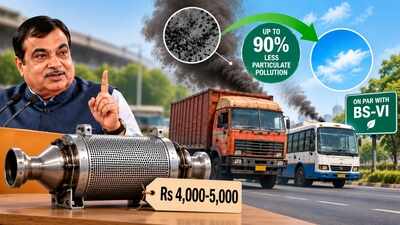
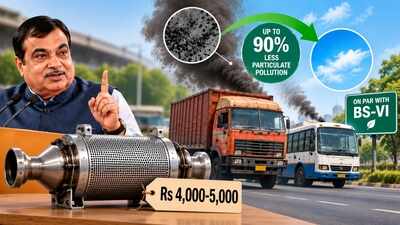
Looking to tackle the growing problem of pollution, the government is now looking to curb vehicular emissions with the help of a new innovation from IIT Delhi.Road Transport Minister Nitin Gadkari on Thursday announced the move, saying it would supplement the government’s existing programme to scrap and replace old heavy vehicles.
Retrofitting old trucks and buses
The government is preparing to allow ageing and heavily polluting trucks and buses to be equipped with retrofit emission-control devices (RECDs), which can cut particulate matter emissions by up to 90% and nitrogen oxide emissions by 60%.Speaking at an event organised by the Society of Indian Automobile Manufacturers (Siam), Gadkari said the technology, developed from an innovation at IIT-Delhi, had successfully completed testing.The devices can be fitted on BS-IV, BS-III and older diesel vehicles, bringing their emissions to levels comparable with BS-VI vehicles.Similar emission-control technology has already been deployed in diesel generator sets to curb pollution. Gadkari said the retrofit device is expected to cost around Rs 4,000-5,000.
Rollout timelines
TOI reported that the road transport ministry is preparing to notify Automotive Industry Standard 228 as part of the rollout. The standard will lay down the technical specifications and performance requirements that the emission-control devices will have to meet.Gadkari also drew attention to India’s shortage of buses. The country has just two buses for every 1,000 people, against a global benchmark of eight. He called for innovative public transport models in Tier-II, Tier-III and smaller cities, pointing out that metro rail systems can involve such high capital costs that they may not be practical for these locations.Speaking about bureaucratic hurdles, Gadkari cited the proposed flash-charging articulated bus system in Nagpur. He said, “IAS officers think they are the only intelligent people in the country. Politicians may know only how to win elections, but they believe only they have knowledge. They keep creating hurdles, but it is my responsibility to resolve them.”Gadkari also repeated his ministry’s plan to introduce a negative points system for traffic offences as a way to deal with repeat violators.He had announced the proposal on Wednesday while launching the ‘Suraksha’ pilot programme, which aims to provide on-the-spot medical diagnosis and counselling to 10 lakh drivers, construction workers and other high-risk workers engaged in highway and mining projects.Under the proposed system, traffic violations would attract penalty points. If a driver accumulates points above a prescribed limit, the driving licence could be suspended or cancelled, Gadkari said.
Focus on road accidents
The government also plans to introduce a new iteration of the Bharat NCAP programme from October 2027, under which the safety of vehicles will be assessed across the entire safety chain, Gadkari said. The initiative is aimed at tackling the country’s serious road accident problem.Introduced in 2023, Bharat NCAP (Bharat New Car Assessment Program) is India’s official independent vehicle safety rating system. Under the programme, passenger cars undergo crash tests and are given a rating between one and five stars based on their performance. The assessment includes the level of protection provided to adult and child occupants in a crash.Gadkari underlined the need for a more comprehensive approach to road safety and said, “We are moving forward with Bharat NCAP 2. This is a very important programme wherein, from October 2027, the entire safety chain will be evaluated. This is very important because road accidents are a big problem… we are number one in the world”.India is currently the world’s third-largest passenger vehicle market, Gadkari said while addressing the gathering. He also pointed out that vehicle testing in India involves considerably less time and cost compared with the global NCAP benchmark of Rs 2.5 crore.Despite various measures being undertaken to improve road safety, accidents and fatalities continue to remain at a high level, Gadkari said. The country records five lakh road accidents every year, resulting in 1.80 lakh deaths.A large proportion of those killed in road accidents fall in the 18-36 age group, he said.Calling the situation a major concern for the country, Gadkari said the number of accidents and deaths must be brought down at any cost. He stressed that examining the entire value chain of a vehicle would be a crucial part of achieving this objective.“We are going to evaluate the entire value chain of the crash, and in that, the new technologies and those developed by Indian startups we will use them,” the minister said.The government is also working on measures to encourage safer driving, including a system under which people who repeatedly violate safety rules could have their driving licences cancelled, while responsible drivers could receive incentives, Gadkari said.He identified driver behaviour as a major challenge and said simply avoiding people who repeatedly commit mistakes would not be an adequate solution. The ministry is therefore working on a graded points mechanism that would be linked to driving licences and vehicle registration certificates.“This is very important and a good scheme. Every offence will cut points on the driving licence, and after a particular limit, the licence will get suspended or even cancelled further. However, people with good points will get incentives from insurance companies and other benefits,” the minister said.Gadkari said those whose irresponsible behaviour contributes to deaths on public roads need to be discouraged.