


Drawing upon almost 3 decades of work in national development, Impact Catalyst Aruna Lohia Goenka developed YASHA, her five-pillar framework for Viksit Bharat 2047. In this edition of the Knowledge Series, Sanjiv Kaura, CEO-CSR, The Times of India, speaks with Aruna Lohia Goenka about Hunar – the power of skills to transform lives.Sanjiv Kaura: Prime Minister Narendra Modi’s 2026 Diwali visit to Bastar in Chhattisgarh must have stirred some memories. Wasn’t that where your journey into skilling began, under rather unusual circumstances?Aruna Lohia Goenka: Indeed, Sanjiv! The Bastar of the 1990s was very different from the Bastar we see today. It was a region deeply affected by Maoist violence, where opportunities for tribal communities were severely limited. We began opening schools and introducing what we then called vocational services – today’s more fashionable term being skilling!And do you know what struck me, Sanjiv? I seem to have inherited a rather unusual family addiction! My father had an addiction to opening schools, sometimes so quietly and anonymously that we discovered some of them only after his passing. My brothers, meanwhile, seem to have developed an addiction to creating employment opportunities wherever they go!The industrial enterprise my father and brothers built now has a presence in some 40 countries, principally in manufacturing and materials. But the family’s interests occasionally take rather unexpected turns – organic farming in Tuscany, cotton cultivation in Uzbekistan! Different geographies, different pursuits, but one common thread: generating employment is in our DNA!And there is another connection I find rather charming. My father and my brother established schools in the jungles of Indonesia back in the 1970s. Decades later, there I was, opening schools and working with tribal communities in Bastar and other parts of India!Closer home, our family also established a women’s college and polytechnic in Kurukshetra, Haryana. And here’s something that gives me particular satisfaction: three of its alumnae have gone on to join the IAS! Imagine that – from a classroom in Kurukshetra to the corridors of national administration!(Laughs) I suppose addictions run in families. Fortunately, ours seem to be socially productive!Perhaps that is the thread connecting it all. Whether it is an industrial enterprise, a farm in Tuscany or a school deep in the forests of Bastar, the setting changes, but the underlying aspiration remains remarkably similar – to create opportunities for people to learn, work and build lives of dignity.And seeing Bastar’s transformation today gives me enormous satisfaction.When you open a school in a place like Bastar, you are not merely opening a school. You are opening a future.Sanjiv Kaura: Bastar was challenging enough. But surely you didn’t stop there?Aruna Lohia Goenka: (Laughs) Apparently, I have a weakness for difficult-to-reach places!From the forests of Bastar, my journey took me to the mountains of Himachal Pradesh, particularly Chamba, historically one of India’s more backward districts and now part of NITI Aayog’s Aspirational Districts Programme. We established 50 skilling centres across Chamba district, bringing opportunities closer to communities that had long been underserved.You see, Sanjiv, talent is remarkably democratic. Opportunity, unfortunately, is not! A child’s postal address should never determine the limits of their future.That is where Hunar becomes such a powerful equaliser.Sanjiv Kaura: From remote villages to the corridors of power! How did you end up training the Delhi Police?Aruna Lohia Goenka: That was an unexpected invitation! Former Delhi Police Commissioner B. K. Gupta asked whether we could help strengthen spoken English and soft skills within the police force. We mobilised resources through Teach India and began training Delhi Police personnel. I remain grateful to Commissioner B. K. Gupta for placing his trust in us. He was so pleased with the initiative that he extended an invitation to work in Tihar Jail, where he had earlier served as its chief before becoming Delhi Police Commissioner. There, we could help inmates, particularly those approaching release, acquire the skills and confidence to prepare for life beyond prison walls.Sanjiv Kaura: And then, somehow, you landed in Tihar Jail! Should I be concerned!?!Aruna Lohia Goenka: (Laughs) You are not the first to ask! There were occasions when friends would call my home and be told, quite casually, “She’s gone to Tihar Jail.” The silence at the other end was sometimes rather long! I suspect a few were already contemplating whether to arrange a lawyer!But jokes apart, Tihar remains one of the most satisfying places in which I have worked. Many inmates approaching release face an enormous challenge. Society may have served them a sentence, but it is often reluctant to offer them a second chance. Through skilling, communication and confidence-building, we prepared them for that second chance. A prison sentence may take away someone’s freedom for a time. It should never take away their hope.And Sanjiv, sometimes the most important skill we can teach someone is the confidence to begin again.Sanjiv Kaura: (Laughs) Fortunately, Tihar wasn’t your only classroom in Delhi! What else were you experimenting with?Aruna Lohia Goenka: Ashok Kumar Nigam, the then Commissioner of the Municipal Corporation of Delhi (MCD), heard about our skilling initiatives and, inspired by the work we were already doing in other parts of Delhi, generously gave us access to, and space within, MCD schools, including those in the Defence Colony area, to introduce vocational skills such as beauty services and stitching. I remember how important it was to give young people skills they could actually use. Acquiring a skill gives a person immense confidence, a sense of self-worth and dignity. In other words, the ability to create one’s own universe!And Sanjiv, never underestimate a skill simply because it does not come with a fancy designation!Sanjiv Kaura: Your views about India’s demographic dividend?Aruna Lohia Goenka: Absolutely, Sanjiv! A demographic dividend is an opportunity, not an entitlement! Millions of young people are an enormous advantage – provided they have the skills, else our demographic dividend risks becoming a demographic bulge. That is why, in employability programmes such as Teach India, with which I am associated, we set a high bar: a minimum of 65% of our learners must secure gainful employment after completing their skilling programme. We measure success by livelihoods, not merely certificates!And remember, a skill should open a door, not become a ceiling.
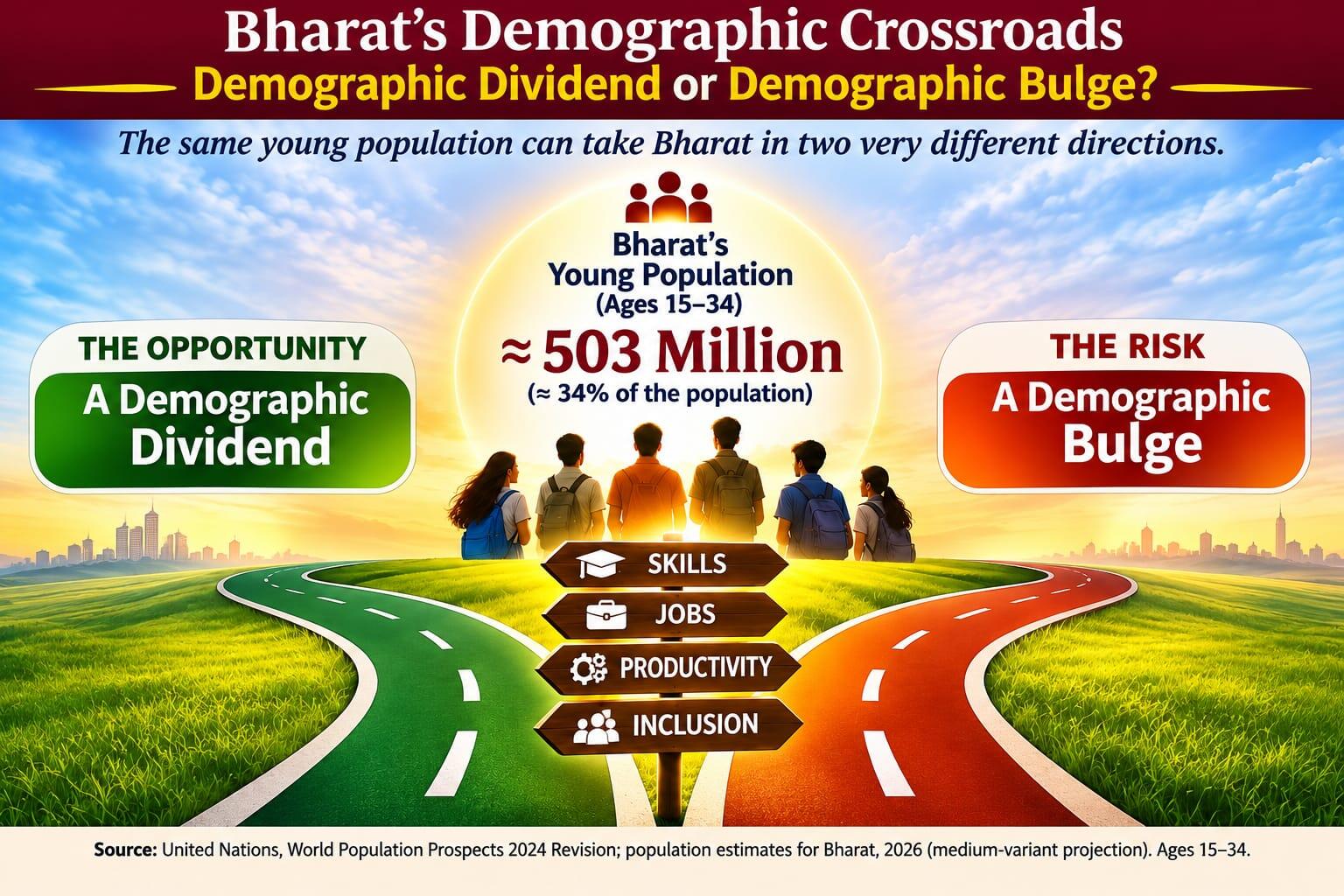
India’s demographic dividend.
Sanjiv Kaura: Finally, how does Hunar fit into your vision of Viksit Bharat 2047?Aruna Lohia Goenka: Sanjiv, for me, Hunar is the bridge between human potential and human dignity. Be it tribal communities in Bastar, or youth in the Chamba hills, or students in government schools or personnel in Delhi police, or inmates in Tihar Jail, I see one common aspiration: People want to learn. They want to earn. They want to contribute. And above all, they want to live with dignity.We often say India has 1.4 billion people. I see 1.4 billion possibilities! Our task is to turn those possibilities into capabilities, those capabilities into livelihoods, and those livelihoods into a more prosperous, inclusive and confident Bharat.That is the Hunar I believe in. And that is the India I dream of!Disclaimer: This article has been produced on behalf of Aruna Goenka for Times Foundation as part of the Knowledge Sharing Series and published by Times Internet’s Spotlight team.