
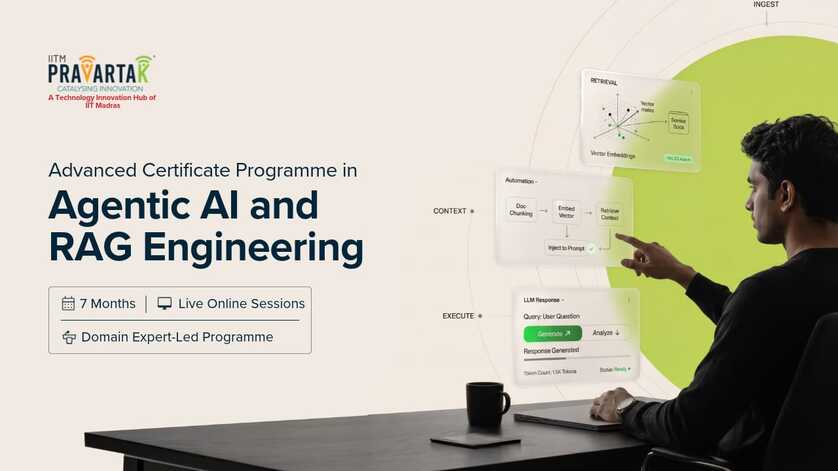
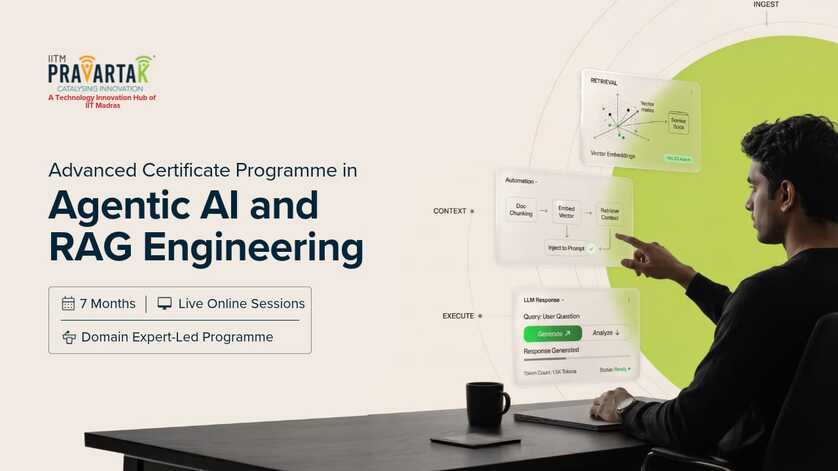
An employee asks an AI assistant to explain a company’s travel policy. The assistant produces an answer, but the policy was updated last week, and the model is still using the old version. Large language models (LLMs) generate responses based on patterns learned during training and the context supplied at inference time. They do not automatically know the latest contents of a company’s database or an internal policy library. Without relevant context, an answer can sound convincing while relying on outdated information.Retrieval-Augmented Generation (RAG) addresses this problem by connecting a language model to an external knowledge source. When an employee asks about an expense policy, for example, a RAG system can retrieve relevant passages from the current policy document and supply them to the model before it generates an answer. Retrieving the right information solves only a part of an enterprise task.An employee seeking reimbursement guidance may also need to check an expense record, identify missing documentation and submit a request for approval. Completing that sequence requires the system to interact with other software and manage several steps. Agentic AI makes this possible through systems that use language models to interpret goals, select tools and coordinate actions. Depending on its design, it can inspect intermediate results and choose a subsequent step.This introduces additional risks. An agent may select the wrong tool, misinterpret a result or repeat an unsuccessful action. RAG and Agentic AI can work together in these workflows. RAG supplies relevant information from enterprise knowledge sources; agentic capabilities coordinate the steps required to use that information.Developing the skills to build these systemsEngineering such applications requires familiarity with retrieval pipelines, agent architectures, tool integration, evaluation and deployment. The IITM Pravartak Advanced Certificate Programme in Agentic AI and RAG Engineering offers a seven-month, applied learning pathway designed to help professionals develop the skills behind such applications.The curriculum covers reasoning workflows, multi-agent orchestration, memory tiers, evaluation frameworks, observability, and scalable deployment stacks. The programme connects technical concepts with implementation decisions. Participants get the opportunity to work with industry-grade frameworks such as Langfuse, LangGraph, Tavily, OpenAI API, vector databases, FastAPI, and Qdrant. Participants apply their learning through an end-to-end production capstone with hands-on assignments covering multi-agent systems, advanced RAG pipelines, and deployment workflows.What participants will learn to buildWith the knowledge gained from this programme, participants will be able to design, deploy intelligent multi-agent systems capable of reasoning, planning and synchronised execution. They will be able to devise advanced RAG pipelines incorporating memory layers, evaluation frameworks and structured output generation. Using production-ready technologies including containerisation and monitoring tools, they will create and deploy AI services. They will also develop governed, and cost effective AI systems that meet real-world performance and scalability requirements.Skills gained from this programme are relevant to software engineers, developers and technical professionals who seek to build a stronger foundation in the new-age AI engineering. Data science, AI, and engineering professionals who want to move beyond model experimentation into designing multi-agent systems, and deployable AI services using Python and modern orchestration frameworks can consider this programme. Mid-career technology professionals who want to upskill into agentic AI engineering and move into high-impact AI system design roles can also look up the prospects of this programme.Programme detailsStart date: 22 December 2026Duration: 7 monthsProgramme fee: ₹1,39,900 (Applicable Taxes will be charged at checkout)Eligibility: Diploma holders (min. 5 years of work exp.) or Minimum graduate | Programming is requiredThe IITM Pravartak Advanced Certificate Programme in Agentic AI and RAG Engineering offers an understanding of RAG engineering, agentic workflows and the systems that connect AI models to enterprise applications. This is a structured opportunity to study the underlying techniques and apply them in practical projects.Disclaimer: This article has been produced on behalf of Emeritus by Times Internet’s Spotlight team.