
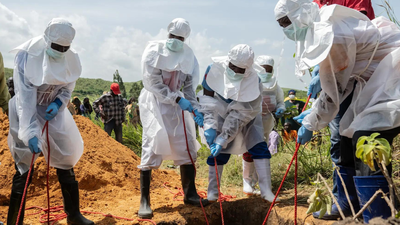
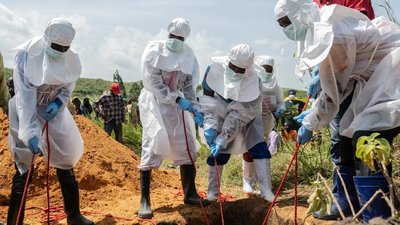
The Democratic Republic of Congo’s latest Ebola outbreak has spread to a fourth province, extending the epidemic across the country’s entire north-eastern region and raising concerns for nearly 15 million people living in the affected area.According to the World Health Organization (WHO), the outbreak has so far resulted in 1,274 confirmed infections and 360 deaths.The DRC declared its 17th Ebola outbreak on May 15. The current epidemic is caused by the Bundibugyo strain of the virus, for which there is currently no approved vaccine or specific treatment.The WHO has issued an international alert over the outbreak, while clinical trials for potential treatments are expected to begin in the coming days.The worst-hit area remains Ituri province, where health authorities have recorded 1,165 cases and 301 deaths. Scientists and humanitarian organisations believe the true number of infections is likely to be significantly higher.Before the latest development, the outbreak had been confined to Ituri, North Kivu and South Kivu. It has now reached Haut-Uele province, which borders both South Sudan and the Central African Republic.According to a source at the National Institute of Biomedical Research, the first confirmed case in Haut-Uele involved a person who travelled from Bunia, the capital of Ituri. A separate health source told AFP that the patient later died.Health officials are now racing to identify people who may have come into contact with the infected individual in an effort to contain further transmission.Authorities say funeral ceremonies have emerged as one of the main drivers of the outbreak because the bodies of Ebola victims remain highly infectious.Aid agencies have faced considerable challenges in organising safe burials, with many communities remaining distrustful of health workers.In the DRC, as in many African countries, funeral ceremonies often last several days and traditionally involve relatives and friends touching the deceased. Health centres have reported several confrontations after grieving families demanded the bodies of loved ones despite the infection risks.The situation has become even more difficult because the affected provinces continue to experience chronic insecurity.Ituri has endured years of violence involving local militias and the Allied Democratic Forces, an armed group linked to the Islamic State. The group has also recently expanded its activities into neighbouring Haut-Uele, complicating efforts to contain the outbreak.Health workers believe the virus may have been circulating for months before it was officially detected, with some suspected infections dating back to January.Although the response has accelerated in recent weeks, healthcare infrastructure in the affected areas remains fragile. Many facilities continue to face shortages of basic protective equipment, disinfectants and other essential medical supplies.Ebola treatment centres established with support from the WHO and humanitarian organisations are already operating well beyond capacity. According to the National Public Health Institute, occupancy has exceeded 138 per cent.The outbreak has also taken a heavy toll on frontline medical staff. So far, 78 healthcare workers have been infected and 18 have died.Experts warn the epidemic has yet to reach its peak despite being more than six weeks old and caution that it could continue for as long as a year.Ebola spreads through direct contact with infected bodily fluids and has claimed more than 15,000 lives across Africa over the past five decades.The Democratic Republic of Congo’s deadliest Ebola outbreak occurred between 2018 and 2020, when nearly 2,300 people died from around 3,500 confirmed infections.